
Forklift Operator Helper Jobs in Canada: When you walk through a bustling distribution center, your eyes are immediately drawn to the roaring forklifts zipping between towering racks. The spotlight is on the operator—the skilled pilot maneuvering tons of metal and product. But watch closely. Behind every efficient forklift operator stands another worker, just as vital, just as busy, but rarely in the spotlight.
Table of Contents
Forklift Operator Helper Jobs in Canada
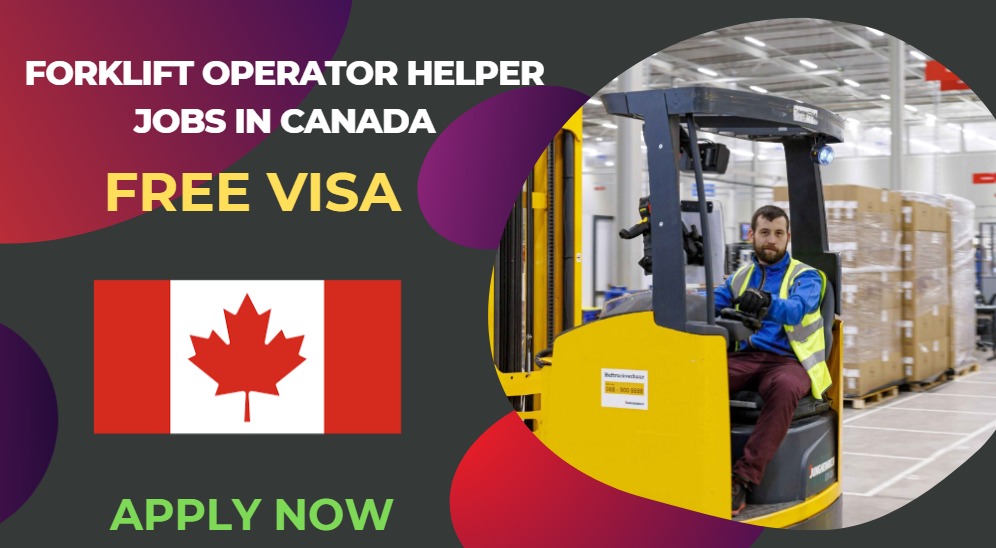
They are the Forklift Operator Helpers, also known as warehouse spotters, lumber pullers, or freight handlers. They are the extra set of eyes, the second pair of hands, and the safety net of the loading dock.
If you are looking for an entry point into the logistics and supply chain industry, this job might be your perfect start.
What Exactly is a Forklift Operator Helper?
In essence, this role is a hybrid position between general labor and logistics support. A forklift operator focuses on driving and lifting; the helper focuses on everything else.
The helper does not typically drive the forklift (though they often get cross-trained). Instead, they work on foot, supporting the operator to ensure that moves are fast, accurate, and—most importantly—safe.
Key Duties and Responsibilities
The daily tasks of a helper are physical, varied, and fast-paced. Typical duties include:
Spotting and Signaling: Acting as the operator’s eyes in blind spots. They guide the forklift into tight spaces, signal when the forks are aligned, and watch for pedestrian traffic.
Loading and Securing Cargo: While the operator lifts the pallet, the helper manually adjusts loads, adds dunnage (packing material), wraps pallets in plastic, and secures straps or chains.
Inventory Management: Scanning barcodes, counting stock, and verifying that the correct product was pulled before it moves to the truck.
Slinging and Rigging (Industrial Settings): In heavy manufacturing or lumber yards, helpers attach slings, hooks, or chains to unbalanced loads so the forklift can lift them safely.
Housekeeping: Keeping aisles clear of debris, broken pallets, and stray shrink wrap to prevent accidents.
Why Companies Are Hiring Helpers
You might wonder: Why doesn’t the operator just do all this themselves?
Productivity. A unionized or high-volume warehouse often operates on “team lift” models. If a $35/hour operator has to stop, unbuckle, climb down, wrap a pallet, and climb back in, the company loses money. By hiring a helper at a lower wage to handle the non-driving tasks, the operator stays in the seat, keeping the machine moving continuously.
The Required Skills (No Degree Needed)
One of the best features of this job is the low barrier to entry. Most employers require:
Physical stamina: You will be walking 8–12 miles per day, bending, lifting up to 50 lbs regularly, and standing on concrete.
Situational awareness: You cannot wear headphones. You must listen for backup alarms and watch for moving machinery.
Basic math and literacy: For counting inventory and reading pick sheets.
Reliability: Warehouses operate on tight schedules. Tardiness creates bottlenecks.
Certifications like OSHA safety cards or CPR are a bonus, but most companies provide on-the-job training.
The Career Ladder: From Helper to Operator
This is where the job shines. Most forklift operator helpers are not meant to stay helpers forever. The role is a paid apprenticeship for the driver’s seat.
After 3–6 months of proving you are safe, reliable, and attentive, most employers will sponsor you for forklift certification. Once certified, you can transition to a full operator role, which typically comes with a $4 to $7 per hour wage increase.
From there, you can climb to reach truck operator, trainer, shift supervisor, or logistics coordinator.
The Pros and Cons
Pros:
No experience required: A high school diploma is usually enough.
Steady hours: Warehouses run 24/7, offering day, night, and weekend shifts.
Union potential: Many large distribution centers (UPS, Amazon, grocery chains) are unionized, offering benefits and job security.
Foot in the door: You learn the language of logistics—SKUs, cycle counts, bills of lading.
Cons:
Physically demanding: Back, knee, and foot fatigue are common.
Weather exposure: If working on a loading dock, you face heat, cold, and rain every time the bay door opens.
Repetitive stress: The same motions—bending, twisting, reaching—thousands of times a week.
Entry-level pay: Starting wages are often near minimum wage, though overtime is usually plentiful.
Safety: The Number One Priority
Forklift accidents are serious. According to OSHA, forklift turnovers and pedestrian strikes cause roughly 100 fatalities and 95,000 injuries annually in the U.S. The helper’s primary function is risk reduction.
A good helper never assumes the operator sees them. They maintain eye contact, use hand signals, and step behind a barrier when the forklift is backing up. Never walk under raised forks—even if the operator says it’s safe.
Is This Job Right for You?
If you hate sitting still, enjoy hands-on work, and want to break into an industry that isn’t going away (e-commerce and logistics are growing every year), then applying for a Forklift Operator Helper position is a smart move.
It is not glamorous. Your hands will get calloused, your boots will get scuffed, and you will go home tired. But you will also go home knowing you kept the supply chain moving. And in a few short months, you could be the one in the driver’s seat.
How to Apply: Search job boards (Indeed, Monster, Craigslist) for titles like “Warehouse Associate,” “Forklift Spotter,” “Lumber Puller,” or “General Laborer – Dock.” Emphasize your reliability, physical fitness, and willingness to learn. Show up to the interview in work boots—they’ll know you’re serious.
The warehouse floor is loud, fast, and demanding. But for those who start at the bottom with a helper’s mindset, the lift to the top is only a certification away.
Disclaimer
This job information is shared for educational and informational purposes only. Any discussion of visa categories is based on general immigration laws and publicly available information.