
Poultry Farm Helper Jobs in the USA with Work Visa: If you are looking for poultry farm helper jobs in the United States with work visa sponsorship, you are targeting a sector with genuine and consistent demand. America’s poultry industry is massive, producing billions of chickens and turkeys annually, and it relies on a steady workforce to maintain operations. For foreign workers, the H-2A visa program provides a legal and structured pathway to temporary employment in agriculture, including poultry production. This guide provides comprehensive, up-to-date information on poultry farm helper opportunities, the H-2A visa process, worker rights, and how to find legitimate positions.
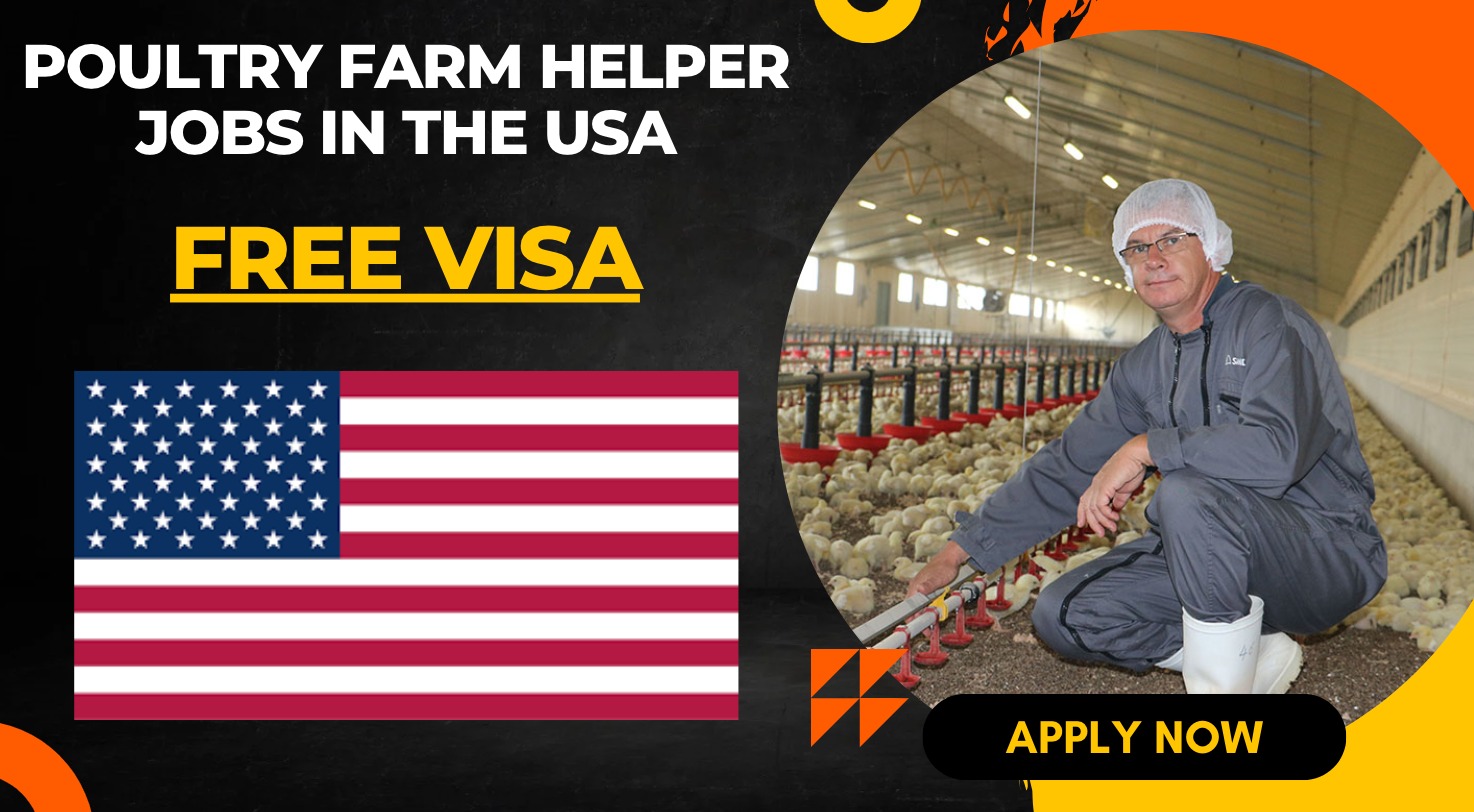
Table of Contents
Understanding Poultry Farm Helper Jobs
Poultry farm helpers perform a wide variety of duties essential to the daily operation of chicken, turkey, and egg production facilities. The work is hands-on and requires physical stamina, attention to detail, and a willingness to work with live animals in various conditions.
Based on actual job listings, common duties include cleaning and sanitizing poultry houses, incubators, hatchers, and equipment, feeding and watering poultry according to schedules, monitoring the health and growth of birds and reporting any signs of illness or injury, collecting, candling, washing, and sorting eggs, operating incubators and hatchers and monitoring the hatching process, assisting chicks in the hatching process and counting them into cages, removing weak, ill, or dead poultry from the flock, selecting, weighing, and crating poultry for shipping, applying medications or vaccines as directed, and maintaining farm infrastructure including fencing, nesting boxes, and ventilation systems.
The work can involve exposure to dust, feathers, and varying temperatures, and requires strict adherence to hygiene and biosecurity protocols.
Poultry operations offer several different roles depending on the farm’s focus. Broiler farm workers raise chickens for meat production. Layer farm workers manage hens for egg production. Hatchery assistants work in the incubation and hatching process. Turkey farm workers care for turkeys. Poultry maintenance workers maintain facilities and equipment.
The H-2A Visa: Your Primary Pathway
The H-2A visa is a temporary, non-immigrant work visa that allows U.S. employers to hire foreign nationals for seasonal or temporary agricultural jobs when qualified American workers are not available. Poultry farm workers are explicitly eligible for H-2A sponsorship as agricultural workers.
Key characteristics of the H-2A visa include being tied to a specific employer and specific job. The duration matches the seasonal need, typically up to 10 months. You must intend to return home after the temporary period, and your employer must prove no U.S. workers are available through a process called Temporary Labor Certification. The visa has no annual cap, unlike the H-2B program.
It is important to understand the difference between the two H-2 visa categories. H-2A visas are specifically for agricultural workers, while H-2B visas are for non-agricultural jobs like construction, landscaping, and hospitality. Poultry farm helpers fall under the H-2A category because they work directly with livestock in an agricultural setting.
A critical protection for H-2A workers is that no job placement fee may be collected at any time from a beneficiary. El Portal Migrante explicitly states that H-2A and H-2B visa holders are entitled to reimbursement for the cost of their trip and their visas. If you are asked to pay for a job offer, it is a scam. Legitimate employers cover petition costs and may reimburse your visa fees after you start work.
Real Job Opportunities with Verified H-2A Sponsorship
Here are actual poultry farm helper positions currently or recently available with H-2A visa sponsorship. These listings are from official government portals and verified sources.
Poultry Farm Worker – Dunlap Hatchery, Caldwell, Idaho
El Portal Migrante, a verified government-affiliated portal that lists H-2A and H-2B positions with legitimate employers, has multiple listings for Poultry Farm Workers at Dunlap Hatchery in Caldwell, Idaho.
The wage ranges from $14.68 to $16.54 per hour. The location is Caldwell, Idaho, and the visa required is H-2A. The duration is seasonal, typically 8 to 9 months.
Job duties include cleaning, maintaining, sanitizing, and disinfecting livestock incubators, hatchers, barns, pens, and equipment, spraying poultry areas with disinfectants and vaccines, operating incubators and hatchers and monitoring the incubation and hatching process, assisting chicks in the hatching process, counting baby chicks into cages and moving them within the barn, removing weak, ill, and dead poultry from the flock, selecting, weighing, and crating poultry, cutting off tips of beaks as a standard poultry management practice, segregating, grading, and sorting chicks, moving poultry and eggs into and out of enclosures, incubators, and hatchers, collecting, candling, washing, and sorting eggs, examining animals to detect illness, injury, or disease, applying or administering medications, vaccines, and insecticides, preparing birds for shipping, driving trucks to haul birds to shipping locations, removing undesirable and excess growth from crops or farm grounds, painting, repairing, and maintaining farm structures, and replacing and repairing fencing. This listing also includes duties related to alfalfa, cattle, and irrigation, demonstrating the variety of tasks on a diversified farm.
Poultry Processing Positions – Foster Farms, Washington State
While not a farm helper position, a poultry processing job listing from Foster Farms in Washington State shows the broader industry opportunities.
The position is EVIS or Pre-Sorter with wages from $19.00 to $21.00 per hour plus shift premiums. The location is Washington State, and benefits include medical, dental, and vision insurance, 401(k) with company match up to 4%, tuition reimbursement, and paid time off.
Job duties include sorting livers and gizzards, trimming carcasses with a knife, packing product into foam trays and plastic bags, placing labels and arranging trays, visually inspecting and grading chicken parts, and rotating through various positions on production lines.
Requirements include the ability to use small hand tools including knives and scissors, repetitive grasping, pushing, and pulling motions, ability to work in cold or hot environments depending on the work area, must pass pre-employment drug screening and background check, and new Poultry Inspection System certification preferred or ability to obtain within 90 days. This position offers comprehensive benefits and demonstrates the range of employment options within the poultry industry, from farm work to processing.
Salary Expectations for Poultry Farm Helper Jobs
Based on verified job listings and industry data, entry-level poultry farm workers earn $14.68 to $16.54 per hour. Poultry processing workers earn $19.00 to $21.00 per hour plus shift premiums. According to industry sources, livestock handlers including poultry workers earn $12 to $20 per hour, with annual salaries ranging from $28,000 to $40,000.
The H-2A visa data for poultry and egg production shows average annual wages for certified positions. Jaindl Farms, LLC offers $33,670 per year for 8 employees. Gregg Dunlap offers $32,748 per year for 7 employees. Phillip J. Burt offers $27,432 per year for 6 employees. Higher Wire Farms LLC offers $31,465 per year for 4 employees. Continental Poultry Sexing Association offers $52,000 per year for 3 employees. These figures demonstrate that wages can vary significantly based on the employer, location, and specific duties involved.
Many poultry farm employers provide valuable benefits beyond base salary including free or subsidized housing common for H-2A positions, health insurance for some positions, 401(k) retirement plans with company matching, overtime pay during peak periods, paid time off and holiday pay, tuition reimbursement for some positions, and transportation assistance.
Eligibility Requirements for Poultry Farm Helper Jobs
Basic qualifications include being at least 18 years old. No formal degree is required, though basic education is preferred. Experience varies by position; the Dunlap Hatchery listing does not specify experience requirements, but many employers prefer previous farm or livestock experience. Basic English communication skills are helpful for understanding instructions and safety protocols. Physical fitness is essential, requiring the ability to perform physically demanding work including standing for long periods, lifting, and repetitive tasks. A clean criminal record is necessary for admissibility under U.S. immigration law.
Poultry farm work is physically demanding and requires the ability to stand and walk for extended periods, lift and carry duties sometimes involving heavy crates or bags, perform repetitive movements including grasping, pushing, and pulling, work in varying temperatures and conditions, tolerate exposure to dust, feathers, and farm environments, and adhere strictly to hygiene and safety standards.
Skills employers look for include reliability and punctuality, attention to detail for monitoring animal health and egg quality, ability to follow instructions and safety procedures, teamwork and collaboration skills, compassion for animal welfare, and mechanical aptitude for operating farm equipment.
Top Regions for Poultry Farm Jobs
Poultry production is concentrated in specific regions of the United States. Southeastern states include Georgia as a leading poultry producer with numerous farms and processing facilities, Alabama as a major broiler production state, Arkansas home to large poultry companies, Mississippi with a significant poultry industry, and North Carolina as a major turkey and chicken producer.
Midwestern states include Iowa as a leading egg production state, Missouri with significant poultry operations, Indiana as a major turkey producer, Minnesota with a large turkey industry, and Ohio as an important poultry state.
Other regions include California with significant poultry production especially in the Central Valley, Pennsylvania as a major poultry state in the Northeast, Texas with a growing poultry industry, and Washington with poultry processing operations.
The H-2A Application Process: Step by Step
Phase 1: Employer Actions
The H-2A process is entirely employer-driven. You cannot apply independently. Your future employer must complete several steps with U.S. government agencies before you can submit your visa application.
First, the employer files a temporary labor certification application with the Department of Labor, proving that there are not enough qualified U.S. workers available and that hiring foreign workers will not negatively affect local wages. The employer must then advertise the position locally and document all U.S. worker applications. After receiving the temporary labor certification, the employer files Form I-129 Petition for a Nonimmigrant Worker with USCIS.
Phase 2: Your Actions
You must be recruited by an employer who has obtained H-2A certification. Many workers are recruited through approved channels or by applying directly to farms with established H-2A programs. After USCIS approval, your employer provides you with the necessary documentation.
You then complete the DS-160 online nonimmigrant visa application form and print the confirmation page. Next, you schedule and attend a visa interview at the U.S. Embassy or Consulate in your home country. Bring your valid passport with at least 6 months validity, DS-160 confirmation page, approved petition details, job offer letter, two passport-size photographs, and visa fee payment receipt.
If approved, you receive your visa and can travel to the U.S. You may work only for the sponsoring employer.
Phase 3: Arrival and Work
Upon arrival in the U.S., you must comply with all visa conditions. H-2A visa holders are entitled to reimbursement for the cost of their trip and their visas.
Worker Rights and Protections Under H-2A
H-2A workers are entitled to extensive wage protections. Employers must pay at least the highest applicable rate among the Adverse Effect Wage Rate, the prevailing wage, or the federal or state minimum wage.
Employers must provide free housing that meets federal and state safety standards and is inspected and approved before occupancy. Many employers provide accommodation on-site or nearby with basic but essential amenities.
Employers must provide or reimburse inbound transportation and subsistence from the place of recruitment to the place of employment once the worker completes 50 percent of the contract period. They must also pay the reasonable costs of return transportation and subsistence upon completion of the contract.
A statutory three-fourths guarantee means employers must offer at least 75 percent of the contract hours even if work is not available due to weather or crop conditions.
Recruitment, application, and placement fees are strictly prohibited. H-2A and H-2B visa holders are entitled to reimbursement for the cost of their trip and their visas. If anyone asks you to pay for a job offer, it is a scam.
Employers must provide workers’ compensation insurance coverage for all job-related injuries. They are also prohibited from retaliating against workers who file complaints, participate in investigations, or engage in other concerted activities for mutual aid or protection related to wages or working conditions.
How to Find Genuine Poultry Farm Helper Jobs with H-2A Sponsorship
Use Official Government Job Portals
El Portal Migrante at elportalmigrante.org is a verified source for H-2A and H-2B positions with legitimate employers. The Dunlap Hatchery listings in Idaho are from this portal.
SeasonalJobs.dol.gov is the U.S. Department of Labor’s official portal for certified H-2A jobs. This government site lists employers that have received temporary labor certification.
State workforce agency websites like the New York State Department of Labor also list H-2A positions.
Target Major Poultry Companies
Focus your search on large poultry producers and egg companies that have established H-2A programs. The H-2A visa data for poultry and egg production lists employers who have successfully hired workers through the program including Jaindl Farms, LLC, Whitestone Farms, LLC, Nelson Poultry Farms, Inc., Lathem Farms, Inc., and Continental Poultry Sexing Association.
Use Search Terms
Try keywords such as poultry farm worker H-2A, livestock handler visa sponsorship, hatchery assistant, poultry production jobs, and farm laborer H-2A.
Apply Early
For seasonal positions, you should be applying several months in advance. The Dunlap Hatchery listing shows contract periods starting in February.
Verify Employers Carefully
Always verify the employer before accepting any offer. Check official company websites, look for reviews from current or former employees, and confirm that the employer has a legitimate physical presence and business history. Never pay money for job offers, and avoid agents who promise guaranteed visas.
Frequently Asked Questions
Are poultry farm helper jobs with visa sponsorship real for 2026?
Yes. Verified listings exist on official government portals like El Portal Migrante, and H-2A visa data confirms multiple employers hiring poultry workers. The Dunlap Hatchery positions in Idaho are legitimate opportunities.
Do I need experience?
It varies by position. The Dunlap Hatchery listing does not specify experience requirements, but many employers prefer previous farm or livestock experience. The livestock handler overview notes that previous experience is helpful but not always mandatory.
What visa is used for poultry farm helpers?
The H-2A visa is used for temporary agricultural workers, including poultry farm helpers. This is different from the H-2B visa, which is for non-agricultural workers.
What salary can I expect?
Based on verified listings and H-2A data, poultry farm helpers earn $14 to $17 per hour on farms, with processing positions paying $19 to $21 per hour. Annual salaries range from $27,000 to $52,000 depending on the employer and position.
Is accommodation provided?
Yes, H-2A employers must provide free housing that meets federal and state safety standards. Many employers provide on-site or nearby accommodation.
Do I need to speak English?
Basic English communication skills are helpful for understanding instructions and safety protocols, but are not always strictly required for field work.
What physical requirements are needed?
You must be able to stand for long periods, lift and carry materials, and perform repetitive tasks. Some positions require working in varying temperatures and conditions.
How long can I work on H-2A?
The H-2A visa is typically valid for the duration of the seasonal work, which can be up to 10 months. After the visa expires, you must return to your home country unless you secure another visa type.
Can I bring my family with me?
Spouses and unmarried children under 21 may accompany H-2A workers on H-4 visas. H-4 dependents may live in the U.S. and attend school but are not authorized to work.
Final Honest Summary
Poultry Farm Helper Jobs in the USA with Work Visa: Poultry farm helper jobs with visa sponsorship are real, with verified listings on official government portals like El Portal Migrante. The Dunlap Hatchery positions in Caldwell, Idaho offer $14.68 to $16.54 per hour with H-2A visa sponsorship. H-2A visa data shows multiple employers successfully hiring poultry workers, with annual wages ranging from $27,432 to $52,000.
The H-2A visa provides important worker protections including free inspected housing, guaranteed wages, transportation reimbursement, the three-fourths guarantee ensuring minimum income, and strict prohibition on recruitment fees.
Poultry production is concentrated in southeastern states like Georgia, Alabama, and Arkansas, as well as midwestern states including Iowa, Missouri, and Indiana. These regions offer the most opportunities for foreign workers seeking employment in the poultry industry.
Your success depends on finding legitimate employers through official portals like El Portal Migrante and SeasonalJobs.dol.gov, meeting physical requirements including standing for long periods and performing repetitive tasks, having relevant experience as previous farm or livestock experience is helpful, never paying for job offers as H-2A visa holders are entitled to reimbursement of their travel and visa costs, understanding that H-2A is temporary with the visa valid for the seasonal contract period, and knowing your rights to free housing, fair wages, safe working conditions, and transportation reimbursement.
Start your search now through official government portals, target states with high poultry production, and follow each job’s specific application instructions carefully. The U.S. poultry industry needs dedicated farm helpers like you.
Disclaimer
This job information is shared for educational and informational purposes only.
Any discussion of visa categories is based on general immigration laws and publicly available information