
Vineyard Pruning Jobs in Italy with Work Permit: When the grape harvest ends and the leaves fall, the vineyard is far from dormant. From November to March, while the vines sleep, a crucial task begins: pruning (potatura). This is the winter work that determines the quality of next year’s grapes. For international workers, vineyard pruning offers a unique opportunity: steady winter employment in Italy’s most beautiful wine regions, work that is skilled (but learnable), and in many cases, free or subsidised accommodation.
Unlike the frantic pace of the harvest (vendemmia), pruning is slower, more methodical, and requires training. But it is also less physically intense than picking (no heavy crates, no racing the clock). And because it happens in winter, pruning jobs can be combined with other agricultural work to create a nearly year-round circuit.
Table of Contents
Vineyard Pruning Jobs in Italy with Work Permit
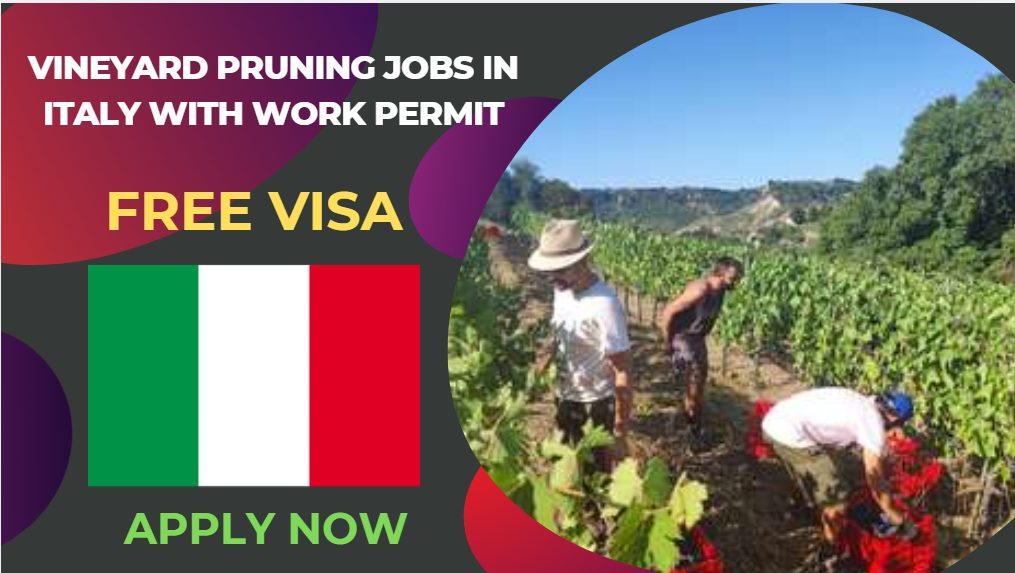
This guide covers everything: what vineyard pruning involves, pay rates (€1,200–€2,000 net/month + often free accommodation), which regions have the most opportunities, visa options for non-EU citizens (including Italy’s decreto flussi programme), working conditions, and exactly how to land a pruning job with a legal work permit.
What Are Vineyard Pruning Jobs in Italy? (Definition & SEO Keywords)
A vineyard pruner (potatore/trice di vite or vignaiolo) is a specialised agricultural worker who cuts back grapevines during their dormant period (winter). Pruning determines the number and placement of buds that will produce next year’s grapes. It is a skilled trade – but many pruners learn on the job.
Other common titles in Italy:
Potatore/trice di Vite (Vine Pruner – most common)
Vignaiolo (Vineyard Worker – broader term)
Lavoratore/trice in Vigneto (Vineyard Worker)
Bracciante Agricolo (Agricultural Labourer – general)
Potatore di Vigneto (Vineyard Pruner)
Operaio/a Agricolo in Potatura (Agricultural Worker – Pruning)
What you are NOT: A grape picker (vendemmiatore – that’s autumn), a tractor driver, a winemaker (enologo), or a vineyard manager.
Critical distinction: Pruning is winter work (typically November to March). Unlike the grape harvest (which is 3-6 weeks of intense, fast-paced work), pruning is slower, steadier, and often done by workers who return to the same vineyards year after year. No experience is required to start – you will be trained on the job.
Core Duties: What Vineyard Pruners Actually Do
Pruning is the most important task in the vineyard. The way a vine is pruned determines how many grapes it will produce and the quality of those grapes.
The Pruning Process – Step by Step:
| Step | Activity | Tools | Details |
|---|---|---|---|
| 1. Select canes | Choose which canes (branches) from last season to keep | Visual inspection, knowledge of the vine’s training system | Different training systems (Guyot, cordon spur, pergola) require different pruning methods |
| 2. Cut away old wood | Remove canes that have already fruited | Secateurs (tronchesi / cesoie) | These canes are now wood and will not fruit again |
| 3. Remove weak canes | Eliminate thin, diseased, or damaged canes | Secateurs | Only strong, healthy canes are kept |
| 4. Cut to desired length | Shorten the selected canes to the correct number of buds | Secateurs | Guyot: 1 cane with 8-12 buds, 1 spur with 2 buds. Spur pruning: 2-3 buds per spur |
| 5. Tie canes (legatura) | Tie selected canes to the trellis wire | Plastic ties, string, or raffia | Prevents wind damage and keeps the vine organised |
| 6. Remove suckers (later) | Remove shoots growing from the trunk (early summer) | Hands or secateurs | This is a summer task, not winter pruning |
Pruning Methods by Training System:
| Training System | Pruning Method | Buds per plant | Regions | Difficulty |
|---|---|---|---|---|
| Guyot (most common) | Cane pruning: 1 cane (8-12 buds) + 1 spur (2 buds) | 10-14 buds | Tuscany, Piedmont, Veneto (Valpolicella), Lombardy | Medium |
| Cordon spur | Spur pruning: short spurs with 2-3 buds every 20-30cm | 8-12 buds per metre | Veneto (Prosecco), Friuli, Emilia-Romagna, Lazio | Medium |
| Pergola (traditional) | Longer canes trained horizontally | Many buds | Alto Adige, Trentino, Veneto (Valpolicella) | Higher (ladder work) |
| Bush vine (alberello) | Low bushes, hand-pruned | Variable | Puglia (Primitivo), Sicily (Etna) | Medium (no trellis) |
The Golden Rule of Pruning: Every cut has a purpose.
Don’t cut randomly. Each cut determines where next year’s grapes will grow. If you cut too many buds, you lose yield. If you cut too few, the vine overproduces and the grapes are low quality. Learn from the vignaiolo (vineyard manager).
When Pruning Happens (Timing by Region):
| Region | Pruning Period | Notes |
|---|---|---|
| Sicily, Puglia, Calabria (South) | November–January | Earliest (warmer climate) |
| Lazio, Campania, Abruzzo, Marche (Central) | December–February | |
| Tuscany, Umbria, Emilia-Romagna | January–March | |
| Piedmont, Veneto, Lombardy, Friuli (North) | February–April (into early spring) | Latest (colder climate) |
Pro tip: Skilled pruners can start in the south in November and move north, pruning for 5-6 months continuously.
Why Vineyard Pruning Jobs Are Available for Foreigners (Market Demand – Deep Search)
Italy’s wine industry is massive, but finding reliable pruning workers is increasingly difficult. Many Italian pruners are retiring, and young people prefer other work.
Hard data (2024–2026):
| Indicator | Statistic | Source |
|---|---|---|
| Italy’s vineyard area | 650,000+ hectares | OIV / ISTAT |
| Vineyards requiring hand pruning | 60%+ (premium regions) | |
| Pruning workers needed annually | 50,000+ | CIA / Coldiretti |
| Foreign workers in vineyard pruning | 30%+ (Romania, Morocco, India, Albania) | Industry estimate |
| Pruning season duration | 4-5 months (November–March) |
The result: Pruning workers are in high demand. Large vineyards and cooperatives often offer free accommodation to attract workers for the winter season.
Who hires pruners with accommodation in Italy:
| Employer Type | International Workers? | English Friendly? | Typical Regions | Free Housing? | Work Permit Possible? |
|---|---|---|---|---|---|
| Large wineries (Antinori, Frescobaldi, Zonin, Cavit) | Yes – through agencies | No – Italian | Tuscany, Veneto, Trentino | Often (free or subsidised) | Yes – through decreto flussi |
| Cooperatives | Yes – high | No – Italian | Nationwide | Sometimes | Yes |
| Vineyard management companies | Yes – high | No – Italian | Tuscany, Piedmont, Veneto | Sometimes | Yes |
| Small family vineyards | Sometimes (word of mouth) | No – Italian | All regions | Rare | No (informal only) |
Italian Wine Regions & Pruning Periods
Tuscany (Toscana) – Chianti, Brunello, Montepulciano
| Detail | Information |
|---|---|
| Key towns | Florence (Firenze), Siena, Montalcino, Montepulciano, Greve in Chianti, Pienza, San Gimignano |
| Pruning method | Guyot, cordon spur |
| Pruning period | January–March |
| Free housing? | Sometimes (larger wineries) |
| Notes | Most famous region – many jobs, but accommodation may be scarce in tourist towns |
Piedmont (Piemonte) – Barolo, Barbaresco
| Detail | Information |
|---|---|
| Key towns | Alba, Asti, Barbaresco, Serralunga d’Alba, Barolo, La Morra, Neive |
| Pruning method | Guyot |
| Pruning period | February–April (latest) |
| Free housing? | Sometimes |
| Notes | Late season, steep hills, challenging terrain |
Veneto – Prosecco, Valpolicella (Amarone)
| Detail | Information |
|---|---|
| Key towns | Verona (Valpolicella), Treviso (Prosecco), Conegliano, Valdobbiadene, Soave |
| Pruning method | Cordon spur (Prosecco), Guyot (Valpolicella), Pergola (traditional) |
| Pruning period | January–March |
| Free housing? | Sometimes |
| Notes | Large production – many jobs. Prosecco region is very organised. |
Trentino-Alto Adige
| Detail | Information |
|---|---|
| Key towns | Trento, Bolzano, Rovereto, Appiano sulla Strada del Vino, Caldaro |
| Pruning method | Pergola, Guyot, cordon spur |
| Pruning period | February–April |
| Free housing? | Often (larger cooperatives) |
| Notes | Well-organised, good conditions – German spoken as well (South Tyrol) |
Friuli-Venezia Giulia
| Detail | Information |
|---|---|
| Key towns | Udine, Gorizia, Cormons |
| Pruning method | Cordon spur, Guyot |
| Pruning period | February–March |
| Free housing? | Sometimes |
| Notes | High quality, organised. |
Best for International Workers (Most Jobs & Free Housing):
| Region | Job Availability | Free Housing? | Pruning Period | English Friendly? | Notes |
|---|---|---|---|---|---|
| Veneto (Prosecco, Valpolicella) | Very high | Sometimes | Jan–Mar | No | Most jobs |
| Tuscany | High | Sometimes | Jan–Mar | No | Beautiful region |
| Trentino-Alto Adige | High | Often | Feb–Apr | No (German/Italian) | Well-organised |
| Piedmont | Medium | Sometimes | Feb–Apr | No | Late season |
Pay Rates for Vineyard Pruners in Italy (2026)
Pruners are typically paid daily (a giornata) or hourly. Pay can also be per plant (piecework) for experienced pruners.
Daily & Hourly Rates (by region):
| Region | Role | Daily Rate (€) (8 hours) | Hourly Rate (€) | Monthly Net (€) (22 days) |
|---|---|---|---|---|
| Tuscany | Pruner (entry) | €60 – €80 | €7.50 – €10 | €1,320 – €1,760 |
| Piedmont | Pruner (entry) | €60 – €80 | €7.50 – €10 | €1,320 – €1,760 |
| Veneto | Pruner (entry) | €55 – €75 | €6.90 – €9.40 | €1,210 – €1,650 |
| Trentino-Alto Adige | Pruner (entry) | €55 – €75 | €6.90 – €9.40 | €1,210 – €1,650 |
| Experienced pruner (any region) | €70 – €100 | €8.75 – €12.50 | €1,540 – €2,200 |
Piecework (Per Plant) – For Experienced Pruners:
| Rate per plant (vite) | Plants per day (experienced) | Daily earnings |
|---|---|---|
| €0.50 – €1.00 | 80 – 150 plants | €40 – €150 |
Minimum Wage Guarantee:
Under Italian agricultural CCNL, pruners are guaranteed a minimum daily wage (approx €45–€55 for an 8-hour day). Most pruning pays above minimum.
Additional Benefits (Legal Contracts):
| Benefit | Typical Value | Notes |
|---|---|---|
| Free or subsidised accommodation | €200 – €500/month | Massive saving – common on larger vineyards |
| One meal per day | €5 – €10/day | Some vineyards provide lunch |
| Transport to vineyards | Free | Farm bus |
| Social Security (healthcare) | Free | Legal contract required |
| Pension contributions | Yes | Legal contract only |
| Paid annual leave | Pro-rated for seasonal workers | |
| TFR (severance pay) | Accumulates | Paid at end of contract |
Realistic Monthly Savings (with free accommodation, Veneto or Trentino):
| Expense | Cost (€) | Notes |
|---|---|---|
| Rent (free) | €0 | Massive saving |
| Food | €150 – €250 | Some vineyards provide meals |
| Transport | €0 – €20 | Farm bus |
| Mobile phone | €15 – €25 | |
| Leisure | €50 – €150 | |
| Total expenses | €215 – €445 | |
| Monthly net earnings (experienced) | €1,600 – €2,000 | |
| Monthly savings | €1,100 – €1,800+ | Excellent for winter work |
Bottom line: Vineyard pruning with free accommodation offers exceptional savings potential – €1,100–€1,800+ per month over 3-5 months. Over a winter season, you could save €3,000–€9,000+.
Work Visas & Permits for Vineyard Pruners (Critical Section)
This is the #1 question for non-EU workers. Here is the detailed answer.
For EU Citizens (Irish, Romanian, German, French, Spanish, etc.):
| Requirement | Status |
|---|---|
| Visa needed? | ❌ No |
| Work permit needed? | ❌ No |
| Registration required? | ✅ Yes – need Codice Fiscale (Italian tax identification number) |
How to work as an EU citizen pruner:
Travel to Italy (target Veneto, Tuscany, or Trentino-Alto Adige in January).
Find a vineyard job (walk in or through agency).
Get your Codice Fiscale (at Agenzia delle Entrate – free, takes 1 hour).
Employer registers you for Social Security.
Start work. Move into free accommodation (if offered). You are legal.
Note for Romanian citizens: Romanians are the largest group of foreign pruning workers in Italy. Full EU rights.
For Non-EU Citizens – Decreto Flussi (Seasonal Work Visa)
Italy has a formal decreto flussi (flow decree) programme for seasonal work visas for non-EU citizens. Vineyard pruning is included in the agricultural sector.
| Requirement | Status |
|---|---|
| Visa needed? | ✅ Yes (seasonal work visa) |
| Work permit needed? | ✅ Yes (nulla osta al lavoro – arranged through the decree) |
| Quotas available? | Yes – annual quotas (usually 100,000+ total, with a large portion for agriculture) |
| Visa duration | Up to 9 months (seasonal) |
| Countries covered | Morocco (largest), Albania, Tunisia, India, Serbia, Bosnia, Kosovo, Moldova, Ukraine, Philippines, Pakistan, Senegal, etc. |
How the Decreto Flussi works for pruning work:
The Italian government announces annual quotas for seasonal work visas (usually between November and February for the following year).
Italian employers (vineyards, cooperatives, temp agencies) submit applications for workers.
Workers are selected based on agreements with their home countries.
Successful applicants receive a seasonal work visa (valid for up to 9 months).
Workers travel to Italy, work the pruning season (January–March).
At the end of the contract, they return to their home country (required).
Important: You cannot simply “apply” for this visa as an individual. The employer must sponsor you. The best way is to have worked in previous seasons (veterans are rehired) or to be hired through an agency that participates in the programme.
Key countries with bilateral agreements for agricultural workers:
Morocco (largest)
Albania (second largest)
Tunisia
India (growing numbers)
Serbia, Bosnia, Kosovo, Moldova
Senegal, Ghana, Nigeria, Pakistan, Philippines (smaller quotas)
Reality check: The decreto flussi is the only legal pathway for many non-EU workers. It is competitive. Most workers are rehired from previous seasons.
For Moroccan Citizens:
| Pathway | Feasibility | Details |
|---|---|---|
| Decreto Flussi | Medium – through bilateral agreements | Contact Italian Embassy in Morocco. |
For Albanian Citizens:
| Pathway | Feasibility | Details |
|---|---|---|
| Decreto Flussi | Medium – through bilateral agreements | Contact Italian Embassy in Albania. |
For Indian Citizens:
| Pathway | Feasibility | Details |
|---|---|---|
| Decreto Flussi | Growing – quotas for India | Contact authorised agencies. |
For Latin American Citizens:
Italy does not have special agreements for Latin American workers. Primary pathway:
| Pathway | Feasibility | Details |
|---|---|---|
| Decreto Flussi | Low – small quotas | Highly competitive. |
| Student visa + work | Medium – study Italian, work 20-30 hours/week | Expensive. |
For Working Holiday Visa Holders (Australia, Canada, NZ):
| Country | Age Limit | Work Rights | Pruning Feasibility |
|---|---|---|---|
| Australia | 18–30 (35 for some) | Full-time work allowed | ✅ Excellent (winter work) |
| Canada | 18–35 | Full-time work allowed | ✅ Excellent |
| New Zealand | 18–30 | Full-time work allowed | ✅ Excellent |
| United Kingdom | No WHV with Italy | N/A | ❌ No |
Why WHV holders might choose pruning: Winter work (November–March) is perfect for WHV holders who arrive in autumn. You can prune all winter, save money, then travel in spring/summer.
For UK Citizens (Post-Brexit):
Very difficult. The UK does not have a WHV with Italy.
Legal pathway:
Student Visa + part-time work – study Italian (20 hours/week), work 20-30 hours/week. Expensive.
For US Citizens (No WHV):
No practical pathway. Student Visa is expensive and part-time only.
Do You Need to Speak Italian to Prune Vines?
Short answer: Yes – Italian is essential for most vineyards. English is not spoken.
| Language | Reality |
|---|---|
| English | Not spoken in Italian vineyards (except some tourist cellars) |
| Italian | Required (at least basic A2, ideally B1) |
| German | Spoken in South Tyrol (Alto Adige) – helpful |
| Romanian | Spoken by many workers – helpful |
Reality check: You will be working with Italian-speaking colleagues and a Italian-speaking manager. You need to understand instructions about pruning methods, buds, and safety. If you don’t speak Italian, you will struggle.
Italian You MUST Learn (Minimum 50 Words – Pruning Focus):
| English | Italian | Pronounced |
|---|---|---|
| Good morning | Buongiorno | bwon-JOR-no |
| Thank you | Grazie | GRAHT-zyeh |
| Vine | Vite | VEE-teh |
| Vineyard | Vigneto | vee-NYEH-toh |
| Pruning | Potatura | po-tah-TOO-rah |
| To prune | Potare | po-TAH-reh |
| Bud | Gemma | JEM-mah |
| Cane (branch) | Trale | TRAH-leh |
| Spur | Sperone | speh-ROH-neh |
| Trunk | Tronco | TRON-koh |
| Cut | Tagliare | tah-LYAH-reh |
| Remove | Rimuovere | ree-MWOH-veh-reh |
| Leave | Lasciare | lah-SHAH-reh |
| Tie | Legare | leh-GAH-reh |
| Secateurs | Cesoia / Tronchesi | cheh-ZOH-yah / tron-KEH-zee |
| Cold | Freddo | FRED-doh |
| Rain | Pioggia | PYOHJ-jah |
| Gloves | Guanti | GWAHN-tee |
| Hat | Cappello | kap-PEL-loh |
Recommendation: Learn basic Italian before the season. Use Duolingo. Learn pruning vocabulary specifically. If you work in South Tyrol (Alto Adige), learn a few German phrases – “Guten Morgen” is appreciated.
How to Find Vineyard Pruning Jobs with Free Accommodation (Actionable Steps)
Step 1: Determine Your Visa Status
EU citizens: Travel freely. Go to Veneto (Valpolicella or Prosecco), Tuscany, or Trentino-Alto Adige in January.
Moroccan/Albanian/Indian citizens: The decreto flussi is your pathway.
WHV holders (Australia, Canada, NZ): You can work legally.
UK / US citizens: No legal pathway (Student Visa only).
Step 2: Target Wine Regions with Free Accommodation
Best bets for free housing:
Veneto (Valpolicella, Prosecco) – larger cooperatives, some free housing
Trentino-Alto Adige – well-organised, often free accommodation
Tuscany (Chianti, Brunello) – larger wineries sometimes offer housing
Step 3: Contact Cooperatives and Wineries Directly (For EU & WHV)
Major wineries & cooperatives:
| Region | Cooperative / Winery | Contact Method |
|---|---|---|
| Veneto (Valpolicella) | Cantina Valpolicella Negrar | Website or call |
| Veneto (Prosecco) | Consorzio Prosecco DOCG | Website |
| Tuscany (Chianti) | Consorzio Vino Chianti | Website |
| Tuscany (Brunello) | Consorzio del Vino Brunello di Montalcino | Website |
| Trentino-Alto Adige | Cavit (largest cooperative) | cavit.it |
| Piedmont (Barolo) | Consorzio di Tutela Barolo Barbaresco | Website |
How to apply:
Search “potatura vigneto [regione] lavoro stagionale”
Call or email. Use Italian.
Email template (Italian):
Oggetto: Domanda per lavoro di potatura vigneto – Stagione invernale 2026
Egregi Signori,
*Mi rivolgo a voi per richiedere un lavoro come potatore/trice di vite per la stagione di potatura invernale 2026 (gennaio–marzo). Ho esperienza in lavori agricoli (o: sono disposto/a a imparare). Sono disponibile per tutta la stagione.*
Sono cittadino/a UE / ho permesso di soggiorno (WHV). Sono interessato/a a un posto con alloggio gratuito.
Allego il mio CV.
Grazie mille per la vostra considerazione.
Step 4: Walk Into Vineyards (For EU & WHV – Old School)
What to do (Veneto – Valpolicella, near Verona):
Travel to Verona in early January.
Stay in a cheap hostel or pensione (€20–€30/night) for the first week.
Print 20 copies of your CV (in Italian).
Walk into vineyards and wineries. Ask for the vineyard manager (responsabile di vigneto).
Say (in Italian): “Buongiorno, cerco lavoro per la potatura della vigna. Cerco un posto con alloggio. Posso lasciare il mio CV?”
Leave your CV. Repeat at 10–20 vineyards.
What to do (Tuscany – Chianti region, near Florence or Siena):
Travel to Florence or Siena in January.
Follow same process as above.
Success rate: In early January (pre-season), walking into vineyards works. By late January, positions fill quickly.
Step 5: Use Temp Agencies (ETTs) – For EU & WHV
| Agency | Region | Website | Italian Required? |
|---|---|---|---|
| Gi Group | Nationwide | gi-group.it | Yes |
| Adecco | Nationwide | adecco.it | Yes |
| Manpower | Nationwide | manpower.it | Yes |
| Umana | Nationwide | umana.it | Yes |
How to register:
Register online (use Google Translate).
Search “potatura vigneto,” “lavoro in vigna,” or “stagione invernale vigneto.”
Apply online.
Call the local branch in Verona, Florence, Siena, or Trento after 24 hours.
Step 6: Join Facebook Groups
Search these exact names (in Italian):
“Lavoro potatura vigneto Italia”
“Potatura vite – cercasi lavoratori”
“Lavoro stagionale vigneto Veneto”
“Braccianti agricoli Toscana”
“Vignaioli e potatori – offerte di lavoro”
Post template (Italian):
*“Cerco lavoro come potatore di vite in [Veneto/Toscana/Trentino] per la stagione invernale 2026 (gennaio–marzo). Cerco un posto con alloggio. Permesso di lavoro (UE / WHV). Disponibile per tutta la stagione. Grazie.”*
Step 7: Use Word of Mouth
Pruning is a specialised trade. Once you have one job, ask the vineyard manager: “Conosci un altro vignaiolo che cerca potatori per la stagione?”
Sample Job Ads (Realistic)
Example 1: Vineyard Pruner – Veneto (Valpolicella)
Title: Potatore/trice di Vite – Valpolicella (Verona), Veneto
Employer: Large cooperative
Contract: Seasonal (January–March), full-time (8 hours/day, 6 days/week)
Pay: €70/day + free accommodation (shared room) + farm transport
Requirements:
EU passport or valid work permit (WHV)
Codice Fiscale
Physical fitness
Italian (basic)
Willingness to learn pruning
Benefits: Free accommodation, Social Security, training provided.
To apply: Walk into vineyards in Valpolicella (near Verona) in early January.
Example 2: Vineyard Pruner – Tuscany (Chianti)
Title: Potatore Vigneto – Chianti (Firenze/Siena), Toscana
Employer: Medium-sized winery
Contract: Seasonal (January–March), full-time
Pay: €75/day + subsidised accommodation (€100/month)
Requirements:
Valid work permit
Physical fitness
Italian (basic)
To apply: Walk into vineyards in Chianti area in January.
Example 3: Vineyard Pruner – Trentino-Alto Adige (Free Housing)
Title: Potatore di Vite – Trentino-Alto Adige (zona Trento/Bolzano)
Employer: Large cooperative (Cavit)
Contract: Seasonal (February–April), full-time
Pay: €65/day + free accommodation (shared) + free meals
Requirements:
Valid work permit
Physical fitness
Italian (or German)
To apply: Contact Cavit or walk into vineyards in Trento province in February.
Living as a Vineyard Pruner: What to Expect
Typical Winter Day Schedule (January, Veneto or Tuscany):
| Time | Activity |
|---|---|
| 7:00 AM | Wake up (free accommodation) |
| 7:30 AM | Breakfast (provided or cook yourself) |
| 8:00 AM | Farm bus to vineyard |
| 8:30 AM – 12:00 PM | Morning pruning session |
| 12:00 PM – 1:00 PM | Lunch break |
| 1:00 PM – 4:00 PM | Afternoon pruning session |
| 4:00 PM | Finish. Farm bus back. |
| 5:00 PM – 7:00 PM | Rest, shower |
| 7:00 PM – 8:00 PM | Dinner |
| 8:00 PM – 9:00 PM | Socialise with other workers |
| 9:00 PM | Sleep |
Winter Conditions:
| Factor | Reality |
|---|---|
| Temperature | Cold (0°C – 10°C / 32°F – 50°F). Frost possible in early morning. |
| Rain | Possible – vineyards can be muddy. Waterproof jacket essential. |
| Clothing | Dress in layers. Wool socks, waterproof boots, warm gloves. |
| Daylight | Short days (8am – 4:30pm). Work during daylight hours. |
Staff Accommodation (Free Housing):
| Aspect | Typical | Notes |
|---|---|---|
| Room type | Shared (2–4 people) | Basic but warm |
| Bathroom | Shared | |
| Kitchen | Shared or staff canteen | |
| Heating | Yes (winter) | Essential |
| Wi-Fi | Sometimes | Rural areas may have poor internet |
| Location | On or near the vineyard | You can walk to work |
Pros and Cons of Vineyard Pruning:
| Pros | Cons |
|---|---|
| Free accommodation (save €300–€600/month) | Cold weather (working outdoors in winter) |
| Steady winter work (not seasonal like harvest) | Physical labour (standing, cutting, tying) |
| Learn a valuable skill (pruning determines grape quality) | Italian required (for most vineyards) |
| Legal contracts possible (EU, WHV, Decreto Flussi) | Short season (3-4 months, but longer than harvest) |
| Excellent savings potential (€1,100–€1,800+/month) | Visa challenges (UK, US citizens have no pathway) |
| Beautiful regions (Tuscany, Valpolicella, Prosecco, Alto Adige) | Isolation (vineyards are rural) |
| WHV possible for Australians, Canadians, NZ citizens | Can be repetitive (same task for weeks) |
| No night shifts | Rainy days may cancel work |
Common Injuries & How to Avoid Them:
| Injury | Cause | Prevention |
|---|---|---|
| Hand blisters | Secateurs, repetitive gripping | Wear gloves (quality leather or fabric). |
| Cuts | Secateurs, sharp canes | Gloves. Be careful. |
| Cold exposure | Working outdoors in winter | Dress in layers. Wear warm gloves and a hat. |
| Back pain | Bending, reaching, standing all day | Stretch. Use correct posture. |
| Shoulder strain | Reaching up for high canes, repetitive cutting | Vary tasks. Take breaks. |
| Wet/cold feet | Walking through wet vineyards | Waterproof boots. Wool socks. |
Winter Safety Tips:
Dress in layers: thermal base layer, fleece, waterproof jacket
Warm gloves: your hands will be exposed to cold metal secateurs
Waterproof boots: vineyards can be muddy in winter
Take breaks to warm up indoors if possible
Common Interview Questions & Answers
Q: “Ha mai potato le viti?” (“Have you pruned vines before?”)
Answer: “No, ma ho esperienza in lavori agricoli. Imparo in fretta. Mi piace il vino e voglio imparare.” (“No, but I have experience in agricultural work. I learn quickly. I like wine and I want to learn.”)
Q: “Non ha paura del freddo?” (“Aren’t you afraid of the cold?”)
Answer: “No. Ho vestiti caldi. Sono preparato per l’inverno.” (“No. I have warm clothes. I am prepared for winter.”)
Q: “Può stare in piedi per 8 ore?” (“Can you stand for 8 hours?”)
Answer: “Sì. Sono fisicamente preparato.” (“Yes. I am physically prepared.”)
Q: “Qual è il suo status di visto?” (“What is your visa status?”)
Answer (EU): “Sono cittadino dell’Unione Europea. Ho il mio Codice Fiscale.” (“I am an EU citizen. I have my Codice Fiscale.”)
Answer (WHV): “Ho un visto Working Holiday. Posso lavorare legalmente.” (“I have a Working Holiday Visa. I can work legally.”)
Q: “Può lavorare da gennaio a marzo?” (“Can you work from January to March?”)
Answer: “Sì. Sono disponibile per tutta la stagione di potatura.” (“Yes. I am available for the entire pruning season.”)
Legal Traps for Pruners (Critical)
Red Flags (Walk away immediately):
| Red Flag | Why It’s a Problem |
|---|---|
| “We’ll pay you cash. No contract.” | Illegal. No Social Security. No proof for visa compliance. |
| “We’ll pay you €40 per day (below minimum wage).” | Below legal minimum (€45–€55/day). Exploitation. |
| “You don’t need a Codice Fiscale. Just work.” | Illegal. You have no rights. |
| “You must pay €200 deposit for a job.” | Scam. |
| “Free accommodation but you have no days off.” | Illegal. You are entitled to days off even if you live on the farm. |
Your Legal Rights as a Pruner in Italy:
| Right | Details |
|---|---|
| Minimum wage | Set by CCNL (agricultural collective agreement) – approx €7.50–€9/hour. |
| Maximum working hours | 40 hours/week (overtime paid). |
| Paid annual leave | Pro-rated for seasonal workers. |
| Sick leave | Paid by Social Security. |
| Health insurance | Free public healthcare after registration. |
| Days off | At least 1 day per week. |
How to Protect Yourself:
Never work without a written contract.
Never work without being registered in Social Security.
Keep copies of your payslips and contract.
Get your Codice Fiscale before you start.
Know your rights regarding days off – live-in workers are still entitled to rest days.
What to Do If You Are Exploited:
Labour Inspectorate (Ispettorato del Lavoro): 06 142 029
Trade unions: CGIL, CISL, UIL – they help foreign workers for free.
Your embassy
Pros and Cons (Honest Summary for International Workers)
✅ Pros:
Free accommodation (save €300–€600/month) – massive saving
Steady winter work (3-5 months of employment)
Learn a valuable skill (pruning is a respected trade)
Legal contracts possible (EU, WHV, Decreto Flussi)
Excellent savings potential (€1,100–€1,800+/month)
Beautiful locations (Tuscany, Valpolicella, Prosecco, Alto Adige)
WHV possible for Australians, Canadians, NZ citizens
No night shifts
❌ Cons:
Cold weather (working outdoors in winter)
Physically demanding (standing, cutting, tying, repetitive)
Italian required (for most vineyards)
Short season (3-4 months – but longer than harvest)
Visa challenges (UK, US citizens have no pathway)
Isolation (vineyards are rural)
Can be repetitive (same task for weeks)
Rainy days may cancel work (no pay)
How to Start Today (Checklist)
If you are an EU citizen:
Get your passport and Codice Fiscale.
Book a flight to Verona (VRN) for Veneto, Florence (FLR) for Tuscany, or Milan (MXP) for Piedmont in early January.
Book 1 week in a cheap hostel.
Walk into vineyards with your CV (in Italian).
Ask about free accommodation (alloggio gratuito).
Accept a job. Move into free housing.
Work January–March. Save €1,100–€1,800+/month.
If you have a Working Holiday Visa (Australia, Canada, NZ):
Apply for WHV from home country (2–4 months processing).
Once approved, book flight to Verona, Florence, or Milan in early January.
Get Codice Fiscale after arrival.
Follow same steps as EU citizens above.
If you are a Moroccan, Albanian, or Indian citizen:
Research the Decreto Flussi (seasonal work visa) through the Italian Embassy in your country.
Register with authorised recruitment agencies.
If selected, receive your seasonal work visa.
Travel to Italy legally.
If you are a UK or US citizen:
Student Visa is your only practical option (study Italian).
Budget €1,000–€2,000 for course + visa fees.
Work 20-30 hours/week legally (part-time).
Final Verdict: Is Vineyard Pruning in Italy Worth It for Foreigners?
Yes – for EU citizens, WHV holders, and those with Decreto Flussi access. Pruning offers steady winter work, free accommodation, excellent savings potential, and the chance to learn a valuable skill in Italy’s most beautiful wine regions.
If you are:
An EU citizen wanting winter work in Italian wine country
An Australian, Canadian, or New Zealand WHV holder (perfect for winter season)
A Moroccan, Albanian, or Indian citizen with access to the Decreto Flussi programme
Someone who is physically fit, doesn’t mind cold weather, and is willing to learn
Looking to save €1,100–€1,800+ per month with free accommodation
Wanting to live in Tuscany, Valpolicella, Prosecco, or Alto Adige for the winter
…then vineyard pruning is one of the best winter seasonal jobs in Europe.
If you are:
A UK or US citizen without a WHV (no legal pathway)
Someone who cannot stand for 8 hours or work in cold weather
Someone who does not speak Italian
Looking for year-round work (pruning is winter only)
…then vineyard pruning is not for you.
One final truth: Pruning is not glamorous. You will stand in cold vineyards, cut canes, tie them to wires, and repeat thousands of times. Your hands will be cold, your back will ache, and the winter wind will bite. But you will also learn the most important skill in winemaking, work in some of the most beautiful landscapes on earth, and save serious money. The vignaiolo who trains you might be gruff – but they will teach you a craft. One day, you will look at a vine you pruned and see the grapes growing because of your cuts. That is satisfaction. In vino veritas. Buon lavoro in vigneto! (Good work in the vineyard!)
Disclaimer
This job information is shared for educational and informational purposes only. Any discussion of visa categories is based on general immigration laws and publicly available information.