
Dairy Farm Worker Jobs in Italy for Foreigners: Italy is not only pasta, pizza, and wine – it is also Parmesan, Mozzarella, Ricotta, Gorgonzola, Taleggio, and hundreds of other world-famous cheeses. Behind every wedge of Parmigiano-Reggiano and every ball of Mozzarella di Bufala is a dairy farm. Italy has over 1.5 million dairy cows, 1 million buffalo (for mozzarella), and millions of sheep and goats. These animals need care 365 days a year – and foreign workers are increasingly filling the gap.
Advertisement
Dairy farm work is unlike any other agricultural job in Italy. It is not seasonal – animals need to be fed, milked, and cared for every single day, rain or shine, Christmas or Easter. For workers who love animals, don’t mind early mornings and physical labour, and seek stable, year-round employment rather than short seasonal contracts, dairy farming offers a genuine career path with permanent contracts, free accommodation, and, for many, a pathway to residency.
Table of Contents
Dairy Farm Worker Jobs in Italy for Foreigners
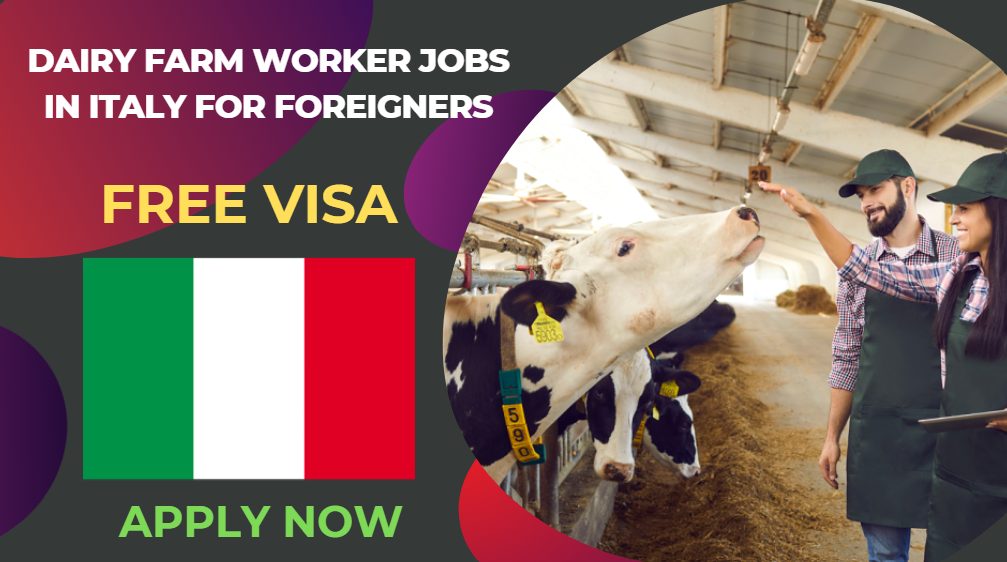
This guide covers everything: what dairy farm workers do, pay rates (€1,200–€2,000 net/month + free accommodation = total package €1,600–€2,500+), which regions have the most opportunities (Lombardy, Emilia-Romagna, Veneto, Campania, Piedmont), visa options for non-EU citizens (including Italy’s decreto flussi programme), working conditions, and exactly how to land a dairy farm job with a legal work permit.
What Are Dairy Farm Worker Jobs in Italy? (Definition & SEO Keywords)
A dairy farm worker (lavoratore/trice in allevamento or allevatore) is an agricultural worker who helps with the daily care of dairy animals (cows, buffalo, sheep, goats). You work under the supervision of the farm owner or manager. Tasks include feeding, milking (often in a milking parlour), cleaning stalls, health monitoring, and general farm maintenance.
Other common titles in Italy:
Allevatore/trice (Livestock Worker)
Mungitore/trice (Milker – specific role)
Operaio/a Agricolo (Agricultural Labourer)
Bracciante Agricolo (Farm Labourer)
Addetto/a alla Stalla (Barn Worker)
Mandriano/a (Herdsman – traditional)
Bovaro/a (Cattle Worker)
Allevatore di Bufale (Buffalo Worker – for mozzarella)
What you are NOT: A veterinarian (requires university degree), a farm manager (requires experience), or a cheese maker (casaro – works in the dairy/cheese production facility).
Critical distinction: Unlike crop harvesting (which is seasonal), dairy farm work is year-round. Cows, buffalo, sheep, and goats need care every single day. This means permanent or long-term contracts are much more common than in fruit and vegetable harvesting. Many dairy farms also offer free accommodation (vitto e alloggio) – a massive benefit.
Core Duties: What Dairy Farm Workers Actually Do
Dairy farm work is varied, physical, and requires attention to animal welfare. Early mornings are standard – cows are milked at 5am or 6am.
By Animal Type:
| Animal | Region | Daily Tasks | Physical Demand |
|---|---|---|---|
| Dairy Cows (vacche da latte) | Lombardy, Emilia-Romagna, Veneto, Piedmont | Milking (2x per day in parlour – 5am and 5pm), feeding (silage, hay, grains), cleaning stalls (removing manure, adding fresh bedding), health monitoring, assisting with calving, cleaning milking equipment. | High (milking, lifting feed sacks, shovelling manure) |
| Buffalo (bufale) | Campania (Mozzarella di Bufala region), Lazio, Puglia | Milking (2x per day – buffalo are stronger and more temperamental), feeding, cleaning, health monitoring, assisting with calving. | Very High (buffalo are large and can be aggressive) |
| Sheep (pecore) | Sardinia, Lazio, Tuscany | Milking (for pecorino cheese), feeding, moving flocks, assisting with lambing, shearing (seasonal). | Medium (sheep are smaller, but shepherding requires walking) |
| Goats (capre) | Sardinia, Piedmont, Lombardy | Milking (for goat cheese), feeding, moving, assisting with kidding. | Medium |
Common Tasks Regardless of Animal:
| Task | Frequency | Details |
|---|---|---|
| Milking (mungitura) | Daily (usually 2x per day – early morning and late afternoon) | Operating milking machines in a parlour, attaching and removing milking units, monitoring milk flow, cleaning teats, checking for mastitis. |
| Feeding (alimentazione) | Daily (1-2x per day) | Mixing feed (silage, hay, grains, protein supplements), filling troughs, checking water lines, cleaning waterers. |
| Cleaning (pulizia) | Daily to weekly | Removing manure (using tractor or by hand), washing floors, changing bedding (straw, sawdust, sand), cleaning milking parlour. |
| Health monitoring (controllo sanitario) | Daily | Observing animals for signs of illness (lameness, coughing, reduced feed intake, abnormal behaviour). Reporting to farm manager. |
| Calving assistance (parto) | As needed (night shifts possible) | Assisting with births (under supervision), cleaning newborn calves, feeding colostrum. |
| Maintenance (manutenzione) | Weekly | Repairing fences, cleaning equipment, maintaining barns. |
The Hierarchy on a Dairy Farm:
| Level | Role | Typical Pay (€/month net) + Accommodation | Experience |
|---|---|---|---|
| 1 | Bracciante (general farm labourer) | €1,200 – €1,500 + free housing | 0-12 months |
| 2 | Mungitore (milker) | €1,300 – €1,700 + free housing | 6-18 months |
| 3 | Addetto alla stalla (barn worker) | €1,400 – €1,800 + free housing | 1-3 years |
| 4 | Capo stalla (barn supervisor) | €1,600 – €2,200 + free housing | 3-5 years |
| 5 | Responsabile di allevamento (farm manager) | €2,000 – €3,000+ + free housing | 5+ years |
The Golden Rule of Dairy Farm Work: The animals come first – always.
Animals cannot wait. If you are sick, tired, or hungover, the animals still need to be fed and milked. Dairy farming is not a 9-to-5 job. It is a way of life.
Why Dairy Farm Worker Jobs Are Available for Foreigners (Market Demand – Deep Search)
Italy’s dairy sector is modernising, but finding reliable, long-term workers is increasingly difficult. Young Italians prefer city jobs, and the rural population is ageing.
Hard data (2024–2026):
| Indicator | Statistic | Source |
|---|---|---|
| Dairy cows in Italy | 1.5+ million | ISTAT |
| Buffalo in Italy | 1+ million | ISTAT |
| Dairy farms in Italy | 50,000+ | ISTAT |
| Foreign workers in dairy | 30%+ (Romania, Morocco, India, Albania) | Industry estimate |
| Average age of Italian farmer | 55+ years (many retiring) | ISTAT |
| Unfilled dairy positions | 10,000+ annually | Coldiretti (Italian Farmers’ Association) |
The result: Dairy farms are increasingly hiring immigrants. Romanians, Moroccans, Indians, and Albanians are common in Italian barns. For workers seeking stable, year-round employment with free accommodation, dairy is an excellent option.
Who hires foreign dairy workers in Italy:
| Employer Type | International Workers? | English Friendly? | Typical Regions | Free Accommodation? | Work Permit Possible? |
|---|---|---|---|---|---|
| Large dairy farms (100+ cows) | Yes – high | No – Italian | Lombardy, Emilia-Romagna, Veneto, Campania | Often (free or subsidised) | Yes – through decreto flussi |
| Buffalo farms (Mozzarella di Bufala) | Yes – high | No – Italian | Campania (Salerno, Caserta), Lazio, Puglia | Often | Yes |
| Sheep/goat farms | Yes – medium | No – Italian | Sardinia, Lazio, Tuscany | Sometimes | Yes |
| Small family farms | Sometimes | No – Italian | All regions | Rare | Unlikely |
Italian Dairy Regions by Animal Type
Dairy Cows (Vacche da Latte) – Northern Italy
| Region | Province(s) | Type of Production | Free Housing? | Notes |
|---|---|---|---|---|
| Lombardy | Cremona, Mantua, Brescia, Bergamo, Lodi | Parmigiano-Reggiano, Grana Padano, milk for other cheeses | Often | Largest dairy region – most jobs |
| Emilia-Romagna | Parma, Reggio Emilia, Modena, Bologna, Piacenza | Parmigiano-Reggiano | Often | Premium cheese region |
| Veneto | Padua, Verona, Vicenza, Treviso | Grana Padano, milk | Sometimes | |
| Piedmont | Cuneo, Turin | Toma, Raschera, milk | Sometimes |
Buffalo (Bufale) – Mozzarella di Bufala
| Region | Province(s) | Type of Production | Free Housing? | Notes |
|---|---|---|---|---|
| Campania | Salerno, Caserta, Naples (Piana del Sele, Paestum, Battipaglia, Capua) | Mozzarella di Bufala Campana DOP | Often | Buffalo heartland – most jobs |
| Lazio | Latina, Frosinone, Rome | Mozzarella di Bufala | Sometimes | |
| Puglia | Foggia, Lecce | Mozzarella di Bufala | Sometimes |
Sheep (Pecore) – Pecorino Cheese
| Region | Province(s) | Type of Production | Free Housing? | Notes |
|---|---|---|---|---|
| Sardinia | Sassari, Nuoro, Cagliari, Oristano | Pecorino Romano (famous), Pecorino Sardo | Sometimes | Largest sheep region – remote |
| Lazio | Viterbo, Rome | Pecorino Romano | Sometimes | Near Rome |
| Tuscany | Siena, Grosseto | Pecorino Toscano | Sometimes |
Best for Foreigners (Job Availability & Free Housing):
| Region | Animal | Job Availability | Free Housing? | Notes |
|---|---|---|---|---|
| Lombardy (Cremona, Mantua, Brescia) | Dairy cows | Very high | Often | Best for jobs |
| Emilia-Romagna (Parma, Reggio Emilia) | Dairy cows | High | Often | Premium region |
| Campania (Salerno, Caserta) | Buffalo | High | Often | Mozzarella region |
| Sardinia | Sheep | Medium | Sometimes | Remote, beautiful |
Pay Rates for Dairy Farm Workers in Italy (2026)
Dairy farm workers are typically paid monthly (permanent contracts) with free or subsidised accommodation often included.
Monthly Salaries (net, after tax – with free accommodation):
| Role | Region | Monthly Net (€) | Free Accommodation Value | Total Package |
|---|---|---|---|---|
| General farm labourer (entry) | Lombardy | €1,200 – €1,500 | €300 – €500 | €1,500 – €2,000 |
| Milker (mungitore) | Lombardy | €1,400 – €1,800 | €300 – €500 | €1,700 – €2,300 |
| Barn worker (experienced) | Lombardy | €1,500 – €2,000 | €300 – €500 | €1,800 – €2,500 |
| Buffalo farm worker | Campania | €1,300 – €1,700 | €300 – €500 | €1,600 – €2,200 |
| Sheep farm worker | Sardinia | €1,200 – €1,600 | €300 – €500 | €1,500 – €2,100 |
Additional Benefits (Legal Contracts):
| Benefit | Typical Value | Notes |
|---|---|---|
| Free accommodation | €300 – €600/month | Massive saving – common on dairy farms |
| Free or subsidised meals | €150 – €300/month | Some farms provide staff meals |
| Transport | Free | Farm vehicle or walking (if live-on-site) |
| Social Security (healthcare) | Free | Legal contract required |
| Pension contributions | Yes | Legal contract only |
| Paid annual leave | 26 days/year | Legal right |
| TFR (severance pay) | Accumulates | Paid at end of employment |
Realistic Monthly Savings (with free accommodation, Lombardy or Emilia-Romagna):
| Expense | Cost (€) | Notes |
|---|---|---|
| Rent (free) | €0 | Massive saving |
| Food (some meals provided) | €100 – €200 | |
| Transport | €0 – €30 | Walking or farm vehicle |
| Mobile phone | €15 – €25 | |
| Leisure | €50 – €150 | |
| Remittances (sending money home) | €200 – €500 | Common for immigrant workers |
| Total expenses | €365 – €905 | |
| Monthly net earnings | €1,400 – €1,900 | |
| Savings (after remittances) | €500 – €1,500+ | Excellent |
Bottom line: Dairy farm work pays modestly, but free accommodation (common on dairy farms) significantly increases savings potential. Over a year, you can save €6,000–€18,000+.
Work Visas & Permits for Dairy Farm Workers (Critical Section)
This is the #1 question for non-EU workers. Here is the detailed answer.
For EU Citizens (Irish, Romanian, German, French, Spanish, etc.):
| Requirement | Status |
|---|---|
| Visa needed? | ❌ No |
| Work permit needed? | ❌ No |
| Registration required? | ✅ Yes – need Codice Fiscale (Italian tax identification number) |
How to work as an EU citizen dairy farm worker:
Travel to Italy (target Lombardy – Cremona, Mantua, Brescia – or Emilia-Romagna).
Find a farm (walk in or contact directly).
Get your Codice Fiscale (at Agenzia delle Entrate – free, takes 1 hour).
Employer registers you for Social Security.
Start work. Move into free accommodation. You are legal.
Note for Romanian citizens: Romanians are the largest group of foreign dairy workers in Italy. Full EU rights.
For Non-EU Citizens – Decreto Flussi (Work Visa)
Italy has a formal decreto flussi (flow decree) programme for work visas for non-EU citizens. Dairy farm work is included in the agricultural sector.
| Requirement | Status |
|---|---|
| Visa needed? | ✅ Yes (work visa) |
| Work permit needed? | ✅ Yes (nulla osta al lavoro – arranged through the decree) |
| Quotas available? | Yes – annual quotas (usually 100,000+ total, with a large portion for agriculture) |
| Visa duration | Up to 2 years (renewable), can lead to residency |
| Countries covered | Morocco (largest), Albania, Tunisia, India, Serbia, Bosnia, Kosovo, Moldova, Ukraine, Philippines, Pakistan, Senegal, etc. |
How the Decreto Flussi works for dairy work:
The Italian government announces annual quotas for work visas (usually between November and February for the following year).
Italian employers (dairy farms, cooperatives, temp agencies) submit applications for workers.
Workers are selected based on agreements with their home countries.
Successful applicants receive a work visa (valid for up to 2 years, renewable).
Workers travel to Italy, work for the sponsoring employer.
After a certain period, workers can apply for residency and change employers.
Important: You cannot simply “apply” for this visa as an individual. The employer must sponsor you. The best way is to have worked in previous seasons (veterans are rehired) or to be hired through an agency that participates in the programme.
Key countries with bilateral agreements for agricultural workers:
Morocco (largest)
Albania (second largest)
Tunisia
India (growing numbers)
Serbia, Bosnia, Kosovo, Moldova
Senegal, Ghana, Nigeria, Pakistan, Philippines (smaller quotas)
Reality check: The decreto flussi is the only legal pathway for many non-EU workers. It is competitive. Most workers are rehired from previous seasons.
For Moroccan, Albanian, Indian, etc., Citizens:
| Pathway | Feasibility | Details |
|---|---|---|
| Decreto Flussi (work visa) | Medium – through bilateral agreements | Contact Italian Embassy in your country. |
For Latin American Citizens:
| Pathway | Feasibility | Details |
|---|---|---|
| Decreto Flussi | Low – small quotas for Latin America | Highly competitive. |
| Student visa + work | Medium – study Italian, work 20-30 hours/week | Expensive. |
For Working Holiday Visa Holders (Australia, Canada, NZ):
| Country | Age Limit | Work Rights | Dairy Farm Feasibility |
|---|---|---|---|
| Australia | 18–30 (35 for some) | Full-time work allowed | ✅ Possible |
| Canada | 18–35 | Full-time work allowed | ✅ Possible |
| New Zealand | 18–30 | Full-time work allowed | ✅ Possible |
| United Kingdom | No WHV with Italy | N/A | ❌ No |
For UK Citizens (Post-Brexit):
Very difficult. The UK does not have a WHV with Italy.
Legal pathway:
Student Visa + part-time work – study Italian (20 hours/week), work 20-30 hours/week. Expensive.
For US Citizens (No WHV):
No practical pathway. Student Visa is expensive and part-time only.
Do You Need to Speak Italian to Work on a Dairy Farm?
Short answer: Yes – Italian is essential for most farms. English is not spoken.
| Language | Reality |
|---|---|
| English | Not spoken on Italian dairy farms |
| Italian | Required (at least basic A2, ideally B1) |
| Romanian | Spoken by many workers – helpful |
| Albanian | Spoken by some workers – helpful |
Reality check: You will be working with Italian-speaking colleagues and a Italian-speaking boss. You need to understand instructions about animal health, safety, and daily tasks. If you don’t speak Italian, you will struggle.
Italian You MUST Learn (Minimum 50 Words):
| English | Italian | Pronounced |
|---|---|---|
| Good morning | Buongiorno | bwon-JOR-no |
| Good evening | Buonasera | bwo-nah-SEH-rah |
| Thank you | Grazie | GRAHT-zyeh |
| Cow | Mucca / Vacca | MOOK-kah / VAHK-kah |
| Buffalo | Bufala | boo-FAH-lah |
| Sheep | Pecora | peh-KOH-rah |
| Goat | Capra | KAH-prah |
| Milk | Latte | LAHT-teh |
| To milk | Mungere | MOON-jeh-reh |
| Milking parlour | Sala di mungitura | SAH-lah dee moon-jee-TOO-rah |
| Feed | Mangime | mahn-JEE-meh |
| Hay | Fieno | fee-EH-noh |
| Silage | Insilato | een-see-LAH-toh |
| Water | Acqua | AH-kwah |
| Clean | Pulito | poo-LEE-toh |
| Dirty | Sporco | SPOR-koh |
| Manure | Letame / Sterco | leh-TAH-meh / STER-koh |
| Stall / Barn | Stalla | STAH-lah |
| Bedding | Lettiera | let-TYEH-rah |
| Health | Salute | sah-LOO-teh |
| Sick | Malato | mah-LAH-toh |
| Vet | Veterinario | veh-teh-ree-NAH-ree-oh |
| Calf | Vitello | vee-TEL-loh |
| Born | Nato | NAH-toh |
| Help | Aiuto | ah-YOO-toh |
Recommendation: Learn basic Italian before you arrive. Use Duolingo. Learn animal husbandry vocabulary specifically. Your employability depends on it.
How to Find Dairy Farm Worker Jobs in Italy (Actionable Steps)
Step 1: Determine Your Visa Status
EU citizens: Travel freely. Go to Lombardy (Cremona, Mantua, Brescia) or Emilia-Romagna (Parma, Reggio Emilia).
Moroccan/Albanian/Indian citizens: The decreto flussi is your pathway.
WHV holders (Australia, Canada, NZ): You can work legally.
UK / US citizens: No legal pathway (Student Visa only).
Step 2: Target Dairy Regions
Best regions for dairy jobs:
Lombardy – Cremona, Mantua, Brescia, Bergamo, Lodi (largest dairy region)
Emilia-Romagna – Parma, Reggio Emilia, Modena (Parmigiano-Reggiano region)
Campania – Salerno, Caserta (buffalo farms – Mozzarella di Bufala)
Veneto – Padua, Verona, Vicenza
Piedmont – Cuneo
Step 3: Contact Farms Directly (For EU & WHV)
How to apply:
Search “azienda agricola allevamento vacche da latte [Lombardia/Emilia-Romagna]”
Search “allevamento di bufale Campania lavoro”
Call or email. Use Italian.
Email template (Italian):
Oggetto: Domanda di lavoro in allevamento
Egregi Signori,
Mi rivolgo a voi per richiedere un lavoro in allevamento. Sono interessato/a a lavorare come bracciante/mungitore/a. Ho esperienza con [mucche/bufale/pecore] (o: sono disposto/a a imparare).
Sono cittadino/a UE / ho permesso di soggiorno (WHV). Sono disponibile a vivere in azienda (alloggio gratuito).
Allego il mio CV.
Grazie mille per la vostra considerazione.
Step 4: Walk Into Farms (For EU & WHV – Old School)
What to do (Lombardy – Cremona or Mantua area):
Travel to Cremona or Mantua (Lombardy) – dairy heartland.
Stay in a cheap hostel or pensione (€20–€30/night) for the first week.
Print 20 copies of your CV (in Italian).
Walk into farms. Look for “Allevamento” signs.
Ask for the farm manager (responsabile) or owner.
Say (in Italian): “Buongiorno, cerco lavoro in allevamento. Cerco un posto con alloggio. Ho esperienza con gli animali.”
Leave your CV. Repeat at 10–20 farms.
What to do (Campania – Salerno area for buffalo farms):
Travel to Salerno or Battipaglia (Campania).
Follow same process as above.
Success rate: Dairy farms hire year-round. Walking into farms will yield a job within 1-4 weeks if you are persistent and speak Italian.
Step 5: Join Facebook Groups
Search these exact names (in Italian):
“Lavoro in allevamento Italia”
“Allevamento vacche da latte – offerte di lavoro”
“Bufale lavoro Campania”
“Braccianti agricoli Lombardia”
“Lavoro in stalla – cercasi personale”
Post template (Italian):
“Cerco lavoro in allevamento di [vacche da latte / bufale / pecore] in [Lombardia/Emilia-Romagna/Campania]. Ho esperienza con gli animali. Posso fare la mungitura, la pulizia della stalla, l’alimentazione. Cerco un posto con alloggio. Permesso di lavoro (UE / WHV). Grazie.”
Step 6: Use Agricultural Employment Agencies
| Agency | Regions | Website | Italian Required? |
|---|---|---|---|
| Gi Group | Nationwide | gi-group.it | Yes |
| Adecco | Nationwide | adecco.it | Yes |
| Manpower | Nationwide | manpower.it | Yes |
| Umana | Nationwide | umana.it | Yes |
Sample Job Ads (Realistic)
Example 1: Dairy Farm Worker – Lombardy (Free Housing)
Title: Bracciante / Mungitore – Allevamento Vacche da Latte – Cremona, Lombardia
Employer: Large dairy farm (200 cows, Parmigiano-Reggiano production)
Contract: Permanent (year-round), full-time (8-10 hours/day, 6 days/week)
Pay: €1,400 net/month + free accommodation (private room) + free meals
Requirements:
EU passport or valid work permit
Codice Fiscale
Physical fitness
Italian (basic)
Willingness to work early mornings (5am milkings)
Duties: Mungitura (2x al giorno), alimentazione, pulizia stalla, assistenza ai parti. (“Milking twice daily, feeding, barn cleaning, calving assistance.”)
Benefits: Free accommodation, free meals, Social Security, paid holidays.
To apply: Walk into farms in Cremona province.
Example 2: Buffalo Farm Worker – Campania (Free Housing)
Title: Allevatore di Bufale – Salerno, Campania (Mozzarella di Bufala)
Employer: Buffalo farm (150 buffalo)
Contract: Permanent (year-round), full-time
Pay: €1,300 net/month + free accommodation + free meals
Requirements:
Valid work permit
Italian (basic)
Physical fitness (buffalo are stronger than cows)
Duties: Mungitura bufale, pulizia stalla, alimentazione, assistenza ai parti.
To apply: Walk into farms in Salerno province.
Example 3: Milker – Emilia-Romagna (Parmigiano-Reggiano)
Title: Mungitore / Addetto alla Stalla – Parma, Emilia-Romagna
Employer: Parmigiano-Reggiano dairy farm
Contract: Permanent (year-round), full-time
Pay: €1,500 net/month + free accommodation + 2 meals/day
Requirements:
Valid work permit
Milking experience (preferred)
Italian (basic)
To apply: Walk into farms in Parma or Reggio Emilia province.
Living on a Dairy Farm: What to Expect
Typical Daily Schedule (Cow Dairy Farm):
| Time | Activity |
|---|---|
| 4:30 AM | Wake up (free accommodation on farm) |
| 5:00 AM – 7:00 AM | Morning milking (prepare parlour, bring in cows, attach milking units, monitor) |
| 7:00 AM – 8:00 AM | Breakfast (provided or cook yourself) |
| 8:00 AM – 11:00 AM | Barn cleaning (remove manure, add bedding), feed cows (silage, hay, grains), check water troughs |
| 11:00 AM – 12:00 PM | Maintenance (repair fences, clean equipment) |
| 12:00 PM – 1:00 PM | Lunch |
| 1:00 PM – 4:00 PM | Free time / rest (cows are in the pasture or resting) |
| 4:00 PM – 5:00 PM | Prepare for evening milking |
| 5:00 PM – 7:00 PM | Evening milking (same as morning) |
| 7:00 PM – 8:00 PM | Final checks: water, feed, health |
| 8:00 PM – 9:00 PM | Dinner |
| 9:00 PM | Sleep (early start tomorrow) |
Accommodation Conditions (Live-in on Farm):
| Aspect | Typical | Notes |
|---|---|---|
| Room type | Private or shared (depending on farm) | Many offer private rooms |
| Bathroom | Shared or ensuite | |
| Kitchen | Shared or staff canteen | Meals often provided |
| Heating | Yes (winter) | |
| Wi-Fi | Sometimes | Rural areas may have poor internet |
| Location | On the farm | You can walk to work |
Pros and Cons of Dairy Farm Work:
| Pros | Cons |
|---|---|
| Free accommodation (save €300–€600/month) | Early mornings (4:30am wake-up) |
| Year-round, stable employment (not seasonal) | Physical labour (milking, cleaning, lifting) |
| Legal contracts possible (EU, WHV, Decreto Flussi) | Work on weekends and holidays (animals need care 365 days/year) |
| Pathway to residency (through work visa or family reunion) | Isolation (farms are rural) |
| Savings potential (€500–€1,500+/month after remittances) | Italian required (no English) |
| Work with animals (rewarding for animal lovers) | Limited days off (dairy cows are milked twice a day, every day) |
| Permanent contracts (unlike seasonal crop work) | Injury risk (animals can be dangerous) |
Common Injuries & How to Avoid Them:
| Injury | Cause | Prevention |
|---|---|---|
| Back injury | Lifting feed sacks, shovelling manure | Use proper lifting technique. Use tractor for heavy loads. |
| Foot injury | Animals stepping on feet (cows, buffalo) | Wear steel-toed boots. |
| Animal kicks | Working near cows, buffalo | Approach animals calmly, from the side, not from behind. Be aware of body language. |
| Slips and falls | Wet floors (barn, milking parlour) | Wear non-slip boots. Clean up spills immediately. |
| Respiratory issues | Dust (hay, silage), ammonia (urine) | Wear a mask when cleaning. Ensure ventilation. |
| Zoonotic diseases | From animals | Wash hands after working with animals. Wear gloves when handling births. |
Animal Safety Tips:
Cows: Approach from the front/side, not from behind. Avoid sudden movements. Watch for kicking signs (weight shifting, tail swishing).
Buffalo: More temperamental than cows. Be extra cautious. Respect their space.
Sheep: Flock animals – they move together. Use gates and pens to direct them.
Goats: Horns can cause injury. Approach carefully.
Career Progression (From Farm Labourer to Manager)
| Timeframe | Role | Pay (€/month net) + Accommodation | Italian Needed? |
|---|---|---|---|
| 0–12 months | Bracciante (labourer) | €1,200 – €1,500 + free housing | Basic (A2) |
| 1–2 years | Mungitore (milker) | €1,400 – €1,700 + free housing | Intermediate (B1) |
| 2–4 years | Addetto alla stalla (barn worker) | €1,500 – €1,800 + free housing | Intermediate (B1) |
| 3–5 years | Capo stalla (supervisor) | €1,600 – €2,200 + free housing | Good (B2) |
| 5+ years | Responsabile di allevamento (manager) | €2,000 – €3,000+ + free housing | Good–Fluent (B2/C1) |
Pro tip: Take certified training courses in Italy (corsi professionali per allevatori). This will increase your pay and sponsorship potential significantly.
Common Interview Questions & Answers
Q: “Ha esperienza con gli animali?” (“Do you have experience with animals?”)
Answer: “Sì, ho lavorato con [mucche/bufale/pecore] nel mio paese. So come avvicinarmi agli animali e come riconoscere quando sono malati.” (“Yes, I have worked with [cows/buffalo/sheep] in my home country. I know how to approach animals and how to recognise when they are sick.”)
Q: “Può lavorare la mattina presto (alle 5)?” (“Can you work early mornings (at 5am)?”)
Answer: “Sì. Capisco che le mucche devono essere munte due volte al giorno, anche la mattina presto. Sono pronto a alzarmi presto.” (“Yes. I understand that cows must be milked twice a day, including early morning. I am ready to wake up early.”)
Q: “Può vivere in azienda?” (“Can you live on the farm?”)
Answer: “Sì. Sono disposto a vivere in azienda. Capisco che l’alloggio è incluso.” (“Yes. I am willing to live on the farm. I understand accommodation is included.”)
Q: “Qual è il suo status di visto?” (“What is your visa status?”)
Answer (EU): “Sono cittadino dell’Unione Europea. Ho il mio Codice Fiscale.” (“I am an EU citizen. I have my Codice Fiscale.”)
Answer (WHV): “Ho un visto Working Holiday. Posso lavorare legalmente.” (“I have a Working Holiday Visa. I can work legally.”)
Q: “Perché vuole lavorare in un allevamento?” (“Why do you want to work on a dairy farm?”)
Answer: “Mi piacciono gli animali e non ho paura del lavoro fisico. Voglio imparare il mestiere.” (“I like animals and I am not afraid of physical work. I want to learn the trade.”)
Legal Traps for Dairy Farm Workers (Critical)
Red Flags (Walk away immediately):
| Red Flag | Why It’s a Problem |
|---|---|
| “We’ll pay you cash. No contract.” | Illegal. No Social Security (no healthcare if injured – animal-related injuries are common). No proof for residency. |
| “We’ll pay you €800/month (below minimum wage).” | Below legal minimum. Exploitation. |
| “You don’t need a Codice Fiscale. Just work.” | Illegal. You have no rights. |
| “You must pay €200 deposit for a job.” | Scam. |
| “Free accommodation but you have no days off.” | Illegal. You are entitled to days off even if you live on the farm. |
| No contract after 1 week | Italian law requires a written contract from day one. |
Your Legal Rights as a Dairy Farm Worker in Italy:
| Right | Details |
|---|---|
| Minimum wage | Set by CCNL (agricultural collective agreement). Approximately €1,200–€1,500 gross/month for entry-level. |
| Maximum working hours | 40 hours/week (overtime paid). |
| Paid annual leave | 26 days/year (pro-rated). |
| Paid public holidays | 12–14 days/year – if you work, you get paid extra. |
| Sick leave | Paid by INPS (Social Security). |
| Health insurance | Free public healthcare (Servizio Sanitario Nazionale – SSN) after registration. |
| Days off | At least 1 day per week (even if you live on the farm). |
| TFR (severance pay) | Accumulates – paid at end of employment. |
How to Protect Yourself:
Never work without a written contract.
Never work without being registered in Social Security. Ask for proof.
Keep copies of your payslips and contract.
Get your Codice Fiscale before you start (or have proof that you applied).
Know your rights regarding days off – live-in workers are still entitled to rest days.
What to Do If You Are Exploited:
Labour Inspectorate (Ispettorato del Lavoro): 06 142 029 (call with Italian-speaking friend)
Trade unions: CGIL, CISL, UIL have offices in every province. They help foreign workers for free.
Your embassy
Pros and Cons (Honest Summary for Foreigners)
✅ Pros:
Free accommodation (save €300–€600/month)
Year-round, stable employment (not seasonal)
Legal contracts possible (EU, WHV, Decreto Flussi)
Work with animals (rewarding for animal lovers)
High savings potential (€500–€1,500+/month with free housing)
Pathway to residency (through work visa or family reunion)
Permanent contracts (unlike seasonal crop work)
Learn animal husbandry skills (valuable for future work)
❌ Cons:
Early mornings (4:30am – 5am starts)
Physically demanding (milking, cleaning, lifting)
Work on weekends and holidays (animals need care 365 days/year)
Isolation (farms are rural, limited social life)
Injury risk (animals can be dangerous)
Italian required (no English)
Limited days off (dairy cows are milked twice a day, every day)
Visa challenges (UK, US citizens have no pathway)
How to Start Today (Checklist)
If you are an EU citizen (Romanian, Irish, German, etc.):
Get your passport and Codice Fiscale.
Book a flight to Milan (MXP or LIN) for Lombardy, or Bologna (BLQ) for Emilia-Romagna.
Book 1 week in a cheap hostel in Cremona or Mantua.
Walk into farms with your CV (in Italian).
Accept a job. Move into free accommodation.
Work year-round. Save €500–€1,500+/month.
If you have a Working Holiday Visa (Australia, Canada, NZ):
Apply for WHV from home country (2–4 months processing).
Once approved, book flight to Milan or Bologna.
Get Codice Fiscale after arrival.
Follow same steps as EU citizens above.
If you are a Moroccan, Albanian, or Indian citizen:
Research the Decreto Flussi (work visa) through the Italian Embassy in your country.
Register with authorised recruitment agencies.
If selected, receive your work visa.
Travel to Italy legally.
If you are a UK or US citizen:
Student Visa is your only practical option (study Italian – 20 hours/week).
Budget €1,000–€2,000 for course + visa fees.
Work 20-30 hours/week legally (part-time).
Final Verdict: Is Dairy Farm Work in Italy Worth It for Foreigners?
Yes – for EU citizens, WHV holders, and those with Decreto Flussi access. Dairy farm work offers stable, year-round employment, free accommodation, and a path to residency.
If you are:
An EU citizen (Romanian, Irish, German) wanting stable, long-term employment with free housing
An Australian, Canadian, or New Zealander with a WHV
A Moroccan, Albanian, or Indian citizen with access to the Decreto Flussi programme
Someone who loves animals and doesn’t mind physical work, early mornings, and farm odours
Someone who speaks Italian (or is willing to learn)
Looking for year-round work, not just seasonal
Wanting to save money (free accommodation = high savings potential)
…then dairy farm work is one of the most stable and rewarding agricultural jobs in Italy.
If you are:
A UK or US citizen without a WHV (no legal pathway)
Someone who cannot handle physical labour, early mornings, weekends, or farm odours
Someone who does not speak Italian
Someone who needs a social life in a big city (dairy farms are rural)
…then dairy farm work is not for you.
One final truth: Dairy farming is not for everyone. You will be tired, muddy, and milk-splattered. You will work when your friends are partying. But you will also form bonds with animals, learn skills that have fed humanity for millennia, and find a kind of peace that only comes from working the land. Your room is free. Your meals are often free. And you will save money. The farm manager who started as a Romanian milker now runs a 200-cow operation. The Indian buffalo worker now has residency and sends money home to his family. It starts with a pair of rubber boots and a willingness to get up at dawn. Buon lavoro! (Good work!)
Disclaimer
This job information is shared for educational and informational purposes only. Any discussion of visa categories is based on general immigration laws and publicly available information.