Rice Field Worker Jobs in Italy: Italy is Europe’s largest rice producer, with over 220,000 hectares of rice paddies concentrated in the Po Valley – particularly in the provinces of Vercelli, Novara, Pavia, and Milan. From the flooded fields of the Vercellese to the historic risaie of Lombardy, Italian rice cultivation produces varieties like Arborio, Carnaroli, Vialone Nano, and Roma – the foundation of classic risotto. Behind this unique agricultural sector is a seasonal workforce of thousands of workers.
Rice cultivation is unlike any other agricultural work in Italy. It involves flooded fields (you work in water), seasonal peaks (planting in spring, harvesting in autumn), and unique methods (transplanting, weeding, and operating machinery). For international workers seeking an authentic, off-the-beaten-path agricultural experience, rice fields offer something genuinely different.
Table of Contents
Rice Field Worker Jobs in Italy
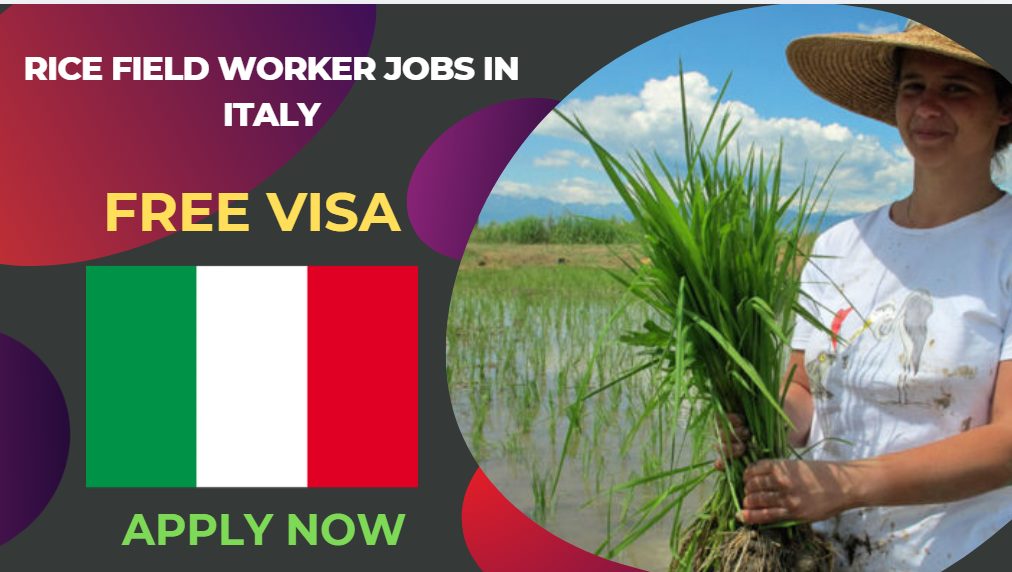
This guide covers everything: what rice field work involves, pay rates (€1,200–€1,800 net/month + often subsidised accommodation), which regions have the most opportunities, visa options for non-EU citizens (including Italy’s decreto flussi seasonal work visa), working conditions, and exactly how to land a rice field job with a legal work permit.
What Are Rice Field Worker Jobs in Italy? (Definition & SEO Keywords)
A rice field worker (lavoratore/trice di risaia or risaiolo) is a seasonal agricultural labourer who performs tasks related to rice cultivation. Unlike dry-land crops, rice is grown in flooded fields (risaie allagate), which makes the work unique and challenging.
Other common titles in Italy:
Lavoratore/trice di Risaia (Rice Field Worker – most common)
Risaiolo (Rice Worker – traditional term)
Addetto alla Risicoltura (Rice Cultivation Worker)
Bracciante Agricolo in Risaia (Agricultural Labourer in Rice Fields)
Pianta-riso (Rice Planter)
Sarchiatore (Weeder – removes weeds from flooded fields)
Raccoltore di Riso (Rice Harvester – usually machine-related)
What you are NOT: A combine harvester operator (requires training), a rice mill worker (post-harvest processing), or an irrigation technician.
Critical distinction: Rice is grown in flooded paddies (risaie) . You will work with water up to your ankles or knees. You will be exposed to sun, mud, and aquatic insects. This is not a job for everyone – but for those who love unique agricultural experiences, it is unforgettable.
Core Duties: What Rice Field Workers Actually Do
Rice cultivation follows a seasonal cycle: flooding and preparation (spring), planting (late spring), maintenance (summer), and harvesting (autumn).
The Rice Cultivation Cycle – Step by Step:
| Season | Month | Task | Details |
|---|---|---|---|
| Spring | April–May | Field preparation | Flooding the fields (allagamento), ploughing, levelling, fertilising |
| Spring | May | Planting (semina) | Sowing seeds (by machine) or transplanting seedlings (trapianto) – traditional method uses hand transplanting in flooded fields |
| Summer | June–July | Maintenance (sarchiatura) | Weeding (removing competing plants – Echinochloa crus-galli, common weed in rice fields), managing water levels (regolazione dell’acqua), pest control |
| Autumn | September–October | Harvesting (raccolta) | Draining fields (scolo dell’acqua), harvesting rice using combine harvesters (mietitrebbia), collecting grain |
| Winter | November–February | Fallow (riposo) | Fields are dry (sometimes left flooded for wildlife), maintenance of irrigation canals |
Worker Roles by Season:
| Role | Season | Duties | Physical Demand |
|---|---|---|---|
| Weeder (sarchiatore) | June–July | Walking through flooded fields, removing weeds (by hand or with hand tools). This is the most labour-intensive task. | High (walking in water, bending) |
| Water manager (addetto all’irrigazione) | Summer | Opening/closing irrigation gates (paratoie), monitoring water levels | Medium |
| Planter (pianta-riso) | May | Hand-transplanting seedlings into flooded fields (traditional method) – less common now | High |
| Harvest assistant (aiuto alla mietitura) | September–October | Guiding combine harvesters, collecting samples, clearing blockages | Medium |
| General labourer (bracciante) | All season | Moving equipment, cleaning canals, general farm maintenance, cleaning drainage ditches | Medium |
The Golden Rule of Rice Field Work: Respect the water.
Rice paddies are flooded for a reason. Never enter a field without knowing the water depth. Never work alone. Watch for deep spots, hidden channels, and slippery mud. Also be aware of zanzare (mosquitoes) – the Po Valley rice fields are famous for them.
Why Rice Field Worker Jobs Are Available for Foreigners (Market Demand – Deep Search)
Italy’s rice sector is stable but labour-intensive. The work is specialised and physically demanding, and local workers are often unavailable.
Hard data (2024–2026):
| Indicator | Statistic | Source |
|---|---|---|
| Italy’s annual rice production | 1.5+ million tonnes | ENTE RISI (National Rice Authority) |
| Rice field area in Italy | 220,000+ hectares | ENTE RISI |
| World ranking (rice production in Europe) | 1st | FAO |
| Main producing regions | Piedmont (Vercelli, Novara), Lombardy (Pavia, Milan), Veneto, Emilia-Romagna | ENTE RISI |
| Seasonal workers needed annually | 8,000+ (for weeding) | Coldiretti / ENTE RISI |
| Foreign workers in rice fields | 30%+ (Romania, Morocco, Tunisia, Albania) | Industry estimate |
| Weed season (summer) workers | Most intensive – June–July |
The result: Rice fields need workers, especially during weeding (sarchiatura) in June and July. This is the most labour-intensive task and the one most likely to hire foreign workers.
Who hires rice field workers in Italy:
| Employer Type | International Workers? | English Friendly? | Typical Regions | Contract Type | Work Visa Possible? |
|---|---|---|---|---|---|
| Large rice farms (500+ hectares) | Yes – medium | No – Italian | Piedmont (Vercelli, Novara), Lombardy (Pavia, Milan) | Seasonal contracts | Yes (sponsorship possible) |
| Cooperatives | Yes – medium | No – Italian | Piedmont, Lombardy | Seasonal contracts | Yes |
| Small family farms | Rarely | No – Italian | All regions | Cash (illegal) – avoid | No |
| Temp agencies (ETTs) | Yes – high | No – Italian | Piedmont, Lombardy | Seasonal contracts | Yes (through agencies) |
Italian Rice Regions & Harvest Calendar
| Region | Province(s) | Main Growing Areas | Planting | Harvest | Notes |
|---|---|---|---|---|---|
| Piedmont | Vercelli, Novara, Biella | Vercellese (the heart of Italian rice – largest area), Novarese | April–May | September–October | Largest producer – most jobs |
| Lombardy | Pavia, Milan, Mantua | Lomellina (Pavia area – second largest), Milanese | April–May | September–October | Second largest – organised farms |
| Veneto | Verona, Rovigo | Isola della Scala (Verona), Polesine (Rovigo) | April–May | September–October | Smaller production |
| Emilia-Romagna | Ferrara, Bologna | Ferrara area | April–May | September–October | Smaller production |
Best Regions for International Workers:
| Region | Job Availability | Accommodation | Work Visa Possible? | English Friendly? |
|---|---|---|---|---|
| Piedmont (Vercelli, Novara) | High (largest area) | Sometimes (farm housing) | Yes (sponsorship rare) | No |
| Lombardy (Pavia, Milan) | High (second largest) | Sometimes | Yes | No |
Pay Rates for Rice Field Workers in Italy (2026)
Rice field workers are typically paid daily or hourly, with a minimum wage guarantee. Weeding (sarchiatura) is often paid per day or per hectare.
Daily & Hourly Rates (by region & task):
| Role | Region | Daily Rate (€) (8 hours) | Hourly Rate (€) | Notes |
|---|---|---|---|---|
| Weeder (sarchiatore) | Piedmont | €50 – €70 | €6.25 – €8.75 | Most common job |
| Weeder (sarchiatore) | Lombardy | €50 – €70 | €6.25 – €8.75 | |
| General labourer | Piedmont | €55 – €75 | €6.90 – €9.40 | |
| Harvest assistant | Piedmont | €55 – €70 | €6.90 – €8.75 | |
| Water manager | Piedmont | €50 – €65 | €6.25 – €8.10 |
Minimum Wage Guarantee:
Under Italian agricultural CCNL, rice field workers are guaranteed the minimum daily wage (approx €45–€55 for an 8-hour day). Most rice field work pays above minimum.
Additional Benefits (Legal Contracts):
| Benefit | Typical Value | Notes |
|---|---|---|
| Subsidised accommodation | €100 – €200/month | Some larger farms in Piedmont and Lombardy provide |
| Transport to fields | Free | Farm bus |
| One meal per day | €5 – €10/day | Some farms provide lunch |
| Social Security (healthcare) | Free | Legal contract required |
| Pension contributions | Yes | Legal contract only |
| Paid annual leave | Pro-rated for seasonal workers |
Realistic Monthly Savings (with subsidised accommodation, Piedmont or Lombardy):
| Expense | Cost (€) | Notes |
|---|---|---|
| Rent (farm accommodation) | €100 – €200 | Shared room |
| Food | €150 – €250 | |
| Transport | €0 – €20 | Farm bus |
| Mobile phone | €15 – €25 | |
| Leisure | €50 – €100 | |
| Total expenses | €315 – €595 | |
| Monthly net earnings (weeding season, 22 days) | €1,200 – €1,600 | |
| Monthly savings | €600 – €1,200+ | Excellent for a short season |
Bottom line: Rice field work pays modestly but offers excellent savings potential because the season is short and intense, and accommodation is sometimes subsidised. Over 6-8 weeks (weeding season), you can save €1,000–€2,500+.
Work Visas & Permits for Rice Field Workers (Critical Section)
This is the #1 question for international workers. Here is the detailed answer.
For EU Citizens (Irish, Romanian, German, French, Spanish, etc.):
| Requirement | Status |
|---|---|
| Visa needed? | ❌ No |
| Work permit needed? | ❌ No |
| Registration required? | ✅ Yes – need Codice Fiscale (Italian tax identification number) |
How to work as an EU citizen rice field worker:
Travel to Italy (target Piedmont – Vercelli, Novara – or Lombardy – Pavia – in May/June for weeding, or September for harvest).
Find a farm or cooperative (walk in or through agency).
Get your Codice Fiscale (at Agenzia delle Entrate – free, takes 1 hour).
Employer registers you for Social Security.
Start work. You are legal.
Note for Romanian citizens: Romanians are a significant part of the rice field workforce in Italy. Full EU rights.
For Non-EU Citizens – Decreto Flussi (Seasonal Work Visa)
Italy has a formal decreto flussi (flow decree) programme for seasonal work visas for non-EU citizens. Rice field work is included in the agricultural sector.
| Requirement | Status |
|---|---|
| Visa needed? | ✅ Yes (seasonal work visa) |
| Work permit needed? | ✅ Yes (nulla osta al lavoro – arranged through the decree) |
| Quotas available? | Yes – annual quotas (usually 100,000+ total, with a large portion for agriculture) |
| Visa duration | Up to 9 months (seasonal) |
| Countries covered | Morocco (largest), Albania, Tunisia, India, Serbia, Bosnia, Kosovo, Moldova, Ukraine, Philippines, Pakistan, Senegal, etc. |
How the Decreto Flussi works for rice field work:
The Italian government announces annual quotas for seasonal work visas (usually between November and February for the following year).
Italian employers (rice farms, cooperatives, temp agencies) submit applications for workers.
Workers are selected based on agreements with their home countries.
Successful applicants receive a seasonal work visa (valid for up to 9 months).
Workers travel to Italy, work the rice season (weeding in June–July, harvest in September–October).
At the end of the contract, they return to their home country (required).
Important: You cannot simply “apply” for this visa as an individual. The employer must sponsor you. The best way is to have worked in previous seasons (veterans are rehired) or to be hired through an agency that participates in the programme.
Key countries with bilateral agreements for agricultural workers:
Morocco (largest)
Albania (second largest)
Tunisia
India (growing numbers)
Serbia, Bosnia, Kosovo, Moldova
Senegal, Ghana, Nigeria, Pakistan, Philippines (smaller quotas)
Reality check: The decreto flussi is the only legal pathway for many non-EU workers. It is competitive. Most workers are rehired from previous seasons. Rice has smaller quotas than other crops.
For Moroccan Citizens (Largest Non-EU Group):
| Pathway | Feasibility | Details |
|---|---|---|
| Decreto Flussi | Medium – rice has smaller quotas than tomatoes or olives | Contact Italian Embassy in Morocco. |
For Albanian Citizens:
| Pathway | Feasibility | Details |
|---|---|---|
| Decreto Flussi | Medium | Contact Italian Embassy in Albania. |
For Indian Citizens:
| Pathway | Feasibility | Details |
|---|---|---|
| Decreto Flussi | Growing – quotas for India | Contact authorised agencies. |
For Latin American Citizens:
Italy does not have special agreements for Latin American workers. Primary pathway:
| Pathway | Feasibility | Details |
|---|---|---|
| Decreto Flussi | Low – small quotas | Highly competitive. |
| Student visa + work | Medium – study Italian, work 20-30 hours/week | Expensive. |
For Working Holiday Visa Holders (Australia, Canada, NZ):
| Country | Age Limit | Work Rights | Rice Field Feasibility |
|---|---|---|---|
| Australia | 18–30 (35 for some) | Full-time work allowed | ⚠️ Possible but rare |
| Canada | 18–35 | Full-time work allowed | ⚠️ Possible |
| New Zealand | 18–30 | Full-time work allowed | ⚠️ Possible |
| United Kingdom | No WHV with Italy | N/A | ❌ No |
For UK Citizens (Post-Brexit):
Very difficult. The UK does not have a WHV with Italy.
Legal pathway:
Student Visa + part-time work – study Italian (20 hours/week), work 20-30 hours/week. Expensive.
For US Citizens (No WHV):
No practical pathway. Student Visa is expensive and part-time only.
Do You Need to Speak Italian to Work in a Rice Field?
Short answer: Yes – Italian is essential for most farms. English is not spoken.
| Language | Reality |
|---|---|
| English | Not spoken in Italian rice fields |
| Italian | Required (at least basic A2, ideally B1) |
| Romanian | Spoken by many workers – helpful |
| Albanian | Spoken by some workers – helpful |
Italian You MUST Learn (Minimum 30 Words):
| English | Italian | Pronounced |
|---|---|---|
| Good morning | Buongiorno | bwon-JOR-no |
| Thank you | Grazie | GRAHT-zyeh |
| Rice | Riso | REE-soh |
| Rice field | Risaia | ree-ZAH-yah |
| Flooded field | Campo allagato | KAM-po al-lah-GAH-toh |
| Water | Acqua | AH-kwah |
| Mud | Fango | FAHN-goh |
| Weed (noun) | Erbaccia | er-BAH-chah |
| To weed | Sarchiare | sar-KYAH-reh |
| Plant | Pianta | PYAHN-tah |
| Plant (verb) | Piantare | pyan-TAH-reh |
| Harvest | Raccolta | rak-KOL-tah |
| Boots (waterproof) | Stivali | stee-VAH-lee |
| Sun | Sole | SOH-leh |
| Hat | Cappello | kap-PEL-loh |
| Mosquito | Zanzara | dzan-DZAH-rah |
| Insect repellent | Repellente per insetti | reh-pel-LEN-teh per een-SET-tee |
Recommendation: Learn basic Italian before the season. Use Duolingo. Learn agricultural vocabulary specifically. If you work in Piedmont, you may hear the local dialect (Piedmontese), but standard Italian is used.
How to Find Rice Field Worker Jobs in Italy (Actionable Steps)
Step 1: Determine Your Visa Status
EU citizens: Travel freely. Go to Piedmont (Vercelli, Novara) in May/June for weeding, or September for harvest.
Moroccan/Albanian/Indian citizens: The decreto flussi is your pathway.
WHV holders (Australia, Canada, NZ): You can work legally.
UK / US citizens: No legal pathway for casual seasonal work (Student Visa only).
Step 2: Target Rice Regions
Best regions for rice field jobs:
Piedmont – Vercelli (largest rice area), Novara, Biella
Lombardy – Pavia (Lomellina area), Milan (Milanese)
Step 3: Contact Cooperatives and Farms Directly (For EU & WHV)
How to apply:
Search “risaia [Vercelli/Novara/Pavia] lavoro stagionale”
Search “cooperativa risicola [Piedmont/Lombardy]”
Call or email. Use Italian.
Email template (Italian):
*Oggetto: Domanda per lavoro stagionale in risaia – Sarchiatura / Raccolta 2026*
Egregi Signori,
*Mi rivolgo a voi per richiedere un lavoro come bracciante agricolo in risaia per la stagione 2026. Sono disponibile per la sarchiatura (giugno–luglio) e/o per la raccolta (settembre–ottobre).*
Sono cittadino/a UE / ho permesso di soggiorno (WHV).
Allego il mio CV.
Grazie mille per la vostra considerazione.
Step 4: Walk Into Farms (For EU & WHV – Old School)
What to do (Piedmont – Vercelli area):
Travel to Vercelli or Novara (Piedmont) in late May or early June (before weeding season).
Stay in a cheap hostel or pensione (€20–€30/night) for the first week.
Print 20 copies of your CV (in Italian).
Walk into rice farms. Ask for the foreman (capo) or owner.
Say (in Italian): “Buongiorno, cerco lavoro in risaia per la sarchiatura. Sono disponibile a camminare nell’acqua. Posso lasciare il mio CV?”
Leave your CV. Repeat at 10–20 farms.
Success rate: In late May/early June (pre-season), walking into farms works. By mid-June, positions fill quickly.
Step 5: Use Temp Agencies (ETTs) – For EU & WHV
| Agency | Region | Website | Italian Required? |
|---|---|---|---|
| Gi Group | Piedmont, Lombardy | gi-group.it | Yes |
| Adecco | Nationwide | adecco.it | Yes |
| Manpower | Nationwide | manpower.it | Yes |
| Umana | Nationwide | umana.it | Yes |
How to register:
Register online (use Google Translate).
Search “risaia,” “sarchiatura,” or “lavoro stagionale riso.”
Apply online.
Call the local branch in Vercelli or Pavia after 24 hours.
Step 6: Join Facebook Groups
Search these exact names (in Italian):
“Lavoro in risaia Italia”
“Sarchiatura riso – cercasi lavoratori”
“Raccolta riso lavoro stagionale”
“Braccianti agricoli Vercelli”
“Lavoro agricolo Lombardia”
Post template (Italian):
“Cerco lavoro in risaia per la sarchiatura (giugno–luglio) o per la raccolta (settembre–ottobre) in [Piemonte/Lombardia]. Permesso di lavoro (UE / WHV). Disponibile a lavorare nell’acqua. Grazie.”
Step 7: Use Word of Mouth
Rice farming is a community. Once you have one job, ask the foreman: “Conosci un altro risicoltore che cerca lavoratori per la sarchiatura?”
Sample Job Ads (Realistic)
Example 1: Rice Weeder – Piedmont (EU / WHV)
Title: Sarchiatore/trice in Risaia – Vercelli, Piemonte
Employer: Large rice farm
Contract: Seasonal (June–July), full-time (8 hours/day, 6 days/week)
Pay: €65/day + subsidised accommodation (€5/day)
Requirements:
EU passport or valid work permit (WHV)
Codice Fiscale
Physical fitness (walking in water)
Italian (basic)
Duties: Camminare nelle risaie allagate, rimuovere le erbacce a mano. (“Walk through flooded rice fields, remove weeds by hand.”)
Benefits: Subsidised accommodation, farm transport, Social Security.
To apply: Walk into farms in Vercelli province in late May.
Example 2: Rice Field Worker – Lombardy (Pavia)
Title: Bracciante Agricolo in Risaia – Pavia, Lombardia
Employer: Medium-sized rice farm
Contract: Seasonal (June–July), full-time
Pay: €60/day + accommodation (subsidised)
Requirements:
Valid work permit
Physical fitness
Italian (basic)
To apply: Walk into farms in Pavia province in late May.
Example 3: Harvest Assistant – Piedmont
Title: Aiuto Mietitura – Raccolta del Riso – Novara, Piemonte
Employer: Rice farm
Contract: Seasonal (September–October), full-time
Pay: €70/day
Requirements:
Valid work permit
Physical fitness
Italian (basic)
To apply: Walk into farms in Novara province in September.
Living as a Rice Field Worker: What to Expect
Typical Weeding Day Schedule (June–July, Piedmont):
| Time | Activity |
|---|---|
| 6:00 AM | Wake up (staff accommodation) |
| 6:30 AM | Farm bus to rice fields |
| 7:00 AM – 9:30 AM | First weeding session (walking through flooded fields, removing weeds) |
| 9:30 AM – 10:00 AM | Breakfast break (coffee, bread) |
| 10:00 AM – 1:00 PM | Second weeding session |
| 1:00 PM – 2:00 PM | Lunch break (bring your own or provided) |
| 2:00 PM – 4:00 PM | Third weeding session |
| 4:00 PM | Finish. Farm bus back to accommodation. |
| 5:00 PM – 7:00 PM | Rest, shower |
| 7:00 PM – 8:00 PM | Dinner |
| 8:00 PM – 9:00 PM | Socialise with other workers (Romanian, Italian, Moroccan) |
| 9:00 PM | Sleep |
What It’s Like Working in Flooded Fields:
| Factor | Reality |
|---|---|
| Water depth | Ankle to knee-deep (10–40 cm) |
| Footwear | You will wear waterproof boots (stivali di gomma) – sometimes provided, sometimes you buy your own |
| Mud | The bottom is soft mud. Walking is slow and requires effort. |
| Sun exposure | High – no shade in rice fields. Hat, long sleeves, sunscreen essential. |
| Mosquitoes | Significant – rice fields breed mosquitoes. Bring insect repellent (zanzare are notorious in the Po Valley). |
| Water quality | Standing water can cause skin irritation. Wash your legs and feet after work. |
| Temperature | Warm to hot (25–35°C) – but working in water keeps you cooler |
Mosquito Safety (Critical for Po Valley Rice Fields):
Use insect repellent (DEET or picaridin) – the Po Valley has zanzare tigre (tiger mosquitoes) which are aggressive daytime biters.
Wear long sleeves and pants – despite the heat, it helps.
Use mosquito nets at night (if staff accommodation doesn’t have screens).
Staff Accommodation (if provided):
| Aspect | Typical | Notes |
|---|---|---|
| Room type | Shared (2–6 people) | Basic – like a hostel |
| Bathroom | Shared | |
| Kitchen | Shared | Basic utensils |
| Heating/cooling | Fans (summer) | |
| Wi-Fi | Unlikely | Use mobile data |
| Mosquito protection | Bring your own net |
Pros and Cons of Rice Field Work:
| Pros | Cons |
|---|---|
| Unique, authentic agricultural experience | Working in water (can be uncomfortable) |
| No per-kilo pressure (daily rate) | Physically demanding (walking in mud, bending, carrying) |
| Legal contracts possible (EU, WHV, Decreto Flussi) | Mosquitoes (especially in Po Valley – tiger mosquitoes) |
| Subsidised accommodation (some larger farms) | Sun exposure (no shade) |
| Good savings potential (short season, low expenses) | Short season (weeding only 4-6 weeks, harvest 4-6 weeks) |
| Beautiful landscapes (risaie of Vercelli are UNESCO, interesting) | Italian required |
| Combine with other harvests (rice weeding → olives or grapes?) | Visa challenges (non-EU) |
| No night shifts | Isolation (rice fields are rural) |
Common Injuries & How to Avoid Them:
| Injury | Cause | Prevention |
|---|---|---|
| Back pain | Bending to remove weeds, lifting | Stretch. Use correct posture. |
| Foot/leg skin irritation | Standing in water for hours | Wash feet after work. Use waterproof boots. Dry feet thoroughly. |
| Sunburn / heat stress | No shade, summer sun | Hat, sunscreen, long sleeves, drink 2-3 litres of water per day. |
| Mosquito bites | Standing water breeds mosquitoes | Insect repellent (DEET or picaridin). Wear long sleeves/pants. |
| Slips and falls | Muddy, uneven ground | Wear boots with good grip. Walk carefully. |
| Hand blisters | Hand tools for weeding | Wear gloves. |
Common Interview Questions & Answers
Q: “Ha mai lavorato in una risaia?” (“Have you worked in a rice field before?”)
Answer: “No, ma ho lavorato nei campi prima. Sono fisicamente robusto. Posso camminare nell’acqua. Imparo in fretta.” (“No, but I have worked in fields before. I am physically strong. I can walk in water. I learn quickly.”)
Q: “Non ha paura delle zanzare?” (“Are you afraid of mosquitoes?”)
Answer: “No. Uso il repellente. Sono preparato.” (“No. I use repellent. I am prepared.”)
Q: “Può lavorare sotto il sole?” (“Can you work in the sun?”)
Answer: “Sì. Userò cappello, crema solare e berrò molta acqua.” (“Yes. I will use a hat, sunscreen, and drink lots of water.”)
Q: “Qual è il suo status di visto?” (“What is your visa status?”)
Answer (EU): “Sono cittadino dell’Unione Europea. Ho il mio Codice Fiscale.” (“I am an EU citizen. I have my Codice Fiscale.”)
Answer (WHV): “Ho un visto Working Holiday. Posso lavorare legalmente.” (“I have a Working Holiday Visa. I can work legally.”)
Q: “Può lavorare da giugno a luglio (sarchiatura)?” (“Can you work from June to July (weeding season)?”)
Answer: “Sì. Sono disponibile per tutta la stagione della sarchiatura.” (“Yes. I am available for the entire weeding season.”)
Legal Traps for Rice Field Workers (Critical)
Red Flags (Walk away immediately):
| Red Flag | Why It’s a Problem |
|---|---|
| “We’ll pay you cash. No contract.” | Illegal. No Social Security (no healthcare if injured). No proof for future visa applications. |
| “We’ll pay you €40 per day (below minimum wage).” | Below legal minimum (€45–€55/day). Exploitation. |
| “You don’t need a Codice Fiscale. Just work.” | Illegal. You have no rights. |
| “You must pay €200 deposit for a job.” | Scam. |
| No contract after 1 week | Italian law requires a written contract from day one. |
Your Legal Rights as a Rice Field Worker in Italy:
| Right | Details |
|---|---|
| Minimum wage | Set by CCNL (agricultural collective agreement) – approx €7.50–€9/hour. |
| Maximum working hours | 40 hours/week (overtime paid). |
| Paid annual leave | Pro-rated for seasonal workers. |
| Sick leave | Paid by Social Security. |
| Health insurance | Free public healthcare (SSN) after registration. |
How to Protect Yourself:
Never work without a written contract.
Never work without being registered in Social Security. Ask for proof.
Keep copies of your payslips and contract.
Get your Codice Fiscale before you start (or have proof that you applied).
Know the minimum wage. If you’re being paid less, report it.
What to Do If You Are Exploited:
Labour Inspectorate (Ispettorato del Lavoro): 06 142 029 (call with Italian-speaking friend)
Trade unions: CGIL, CISL, UIL – they help foreign workers for free.
Your embassy
Pros and Cons (Honest Summary for International Workers)
✅ Pros:
Unique, authentic agricultural experience (unlike any other crop)
Legal contracts possible (EU, WHV, Decreto Flussi)
Minimum wage guarantee
Subsidised accommodation (on some larger farms – Piedmont, Lombardy)
Good savings potential (short, intense season)
Beautiful landscapes (risaie of Vercelli – UNESCO Biosphere Reserve)
Combine with other harvests (grapes, olives)
No night shifts
WHV possible for Australians, Canadians, NZ citizens
❌ Cons:
Working in water (can be uncomfortable)
Physically demanding (walking in mud, bending)
Mosquitoes (especially tiger mosquitoes in Po Valley)
Short season (weeding 4-6 weeks, harvest 4-6 weeks – not year-round)
Sun exposure (no shade)
Italian required (no English)
Visa challenges (UK, US citizens have no pathway)
Accommodation not always provided
Isolation (rural areas)
How to Start Today (Checklist)
If you are an EU citizen:
Get your passport and Codice Fiscale.
Book a flight to Milan (MXP or LIN) or Turin (TRN) in late May.
Take a train to Vercelli or Novara (Piedmont) – 1 hour from Milan.
Book 1 week in a cheap hostel.
Walk into rice farms with your CV (in Italian).
Accept a job. Move into subsidised accommodation (if offered).
Work June–July (weeding) or September–October (harvest). Save €600–€1,200+/month.
If you have a Working Holiday Visa (Australia, Canada, NZ):
Apply for WHV from home country (2–4 months processing).
Once approved, book flight to Milan in late May.
Get Codice Fiscale after arrival.
Follow same steps as EU citizens above.
If you are a Moroccan, Albanian, or Indian citizen:
Research the Decreto Flussi (seasonal work visa) through the Italian Embassy in your country.
Register with authorised recruitment agencies.
If selected, receive your seasonal work visa.
Travel to Italy legally.
If you are a UK or US citizen:
Student Visa is your only practical option (study Italian – 20 hours/week).
Budget €1,000–€2,000 for course + visa fees.
Work 20-30 hours/week legally (part-time).
Final Verdict: Is Rice Field Work in Italy Worth It?
Yes – for EU citizens, WHV holders, and those with Decreto Flussi access who seek a truly unique agricultural experience.
If you are:
An EU citizen (Romanian, Irish, German) wanting an authentic Italian agricultural experience
An Australian, Canadian, or New Zealand WHV holder looking for something off the beaten path
A Moroccan, Albanian, or Indian citizen with access to the Decreto Flussi programme
Someone who doesn’t mind working in water, mud, and sun
Someone who speaks Italian (or is willing to learn)
Looking for a short, intense season to save money (4-6 weeks of weeding plus 4-6 weeks of harvest)
…then rice field work in Italy is a unique and rewarding seasonal option.
If you are:
A UK or US citizen without a WHV (no legal pathway)
Someone who cannot work in water, mud, or heat
Someone who hates mosquitoes (the Po Valley has tiger mosquitoes)
Someone who does not speak Italian
Looking for year-round work (rice is seasonal)
…then rice field work is not for you.
One final truth: Rice field work is not glamorous. You will be wet, muddy, and sunburned. Your legs will ache from walking through thick mud. You will curse the mosquitoes. But you will also watch the sun rise over the risaie, eat risotto made from the rice you helped grow, and learn a trade that has fed Italy for centuries. It is hard, wet, honest work – and in Italy, it is unforgettable. Buon lavoro in risaia! (Good work in the rice field!
Disclaimer
This job information is shared for educational and informational purposes only. Any discussion of visa categories is based on general immigration laws and publicly available information.





Job, visa, salary, deadline and eligibility details can change. Check the employer or relevant government/official source before applying, paying money or making travel arrangements.
If you spot an outdated or inaccurate detail, please contact us with the article URL.