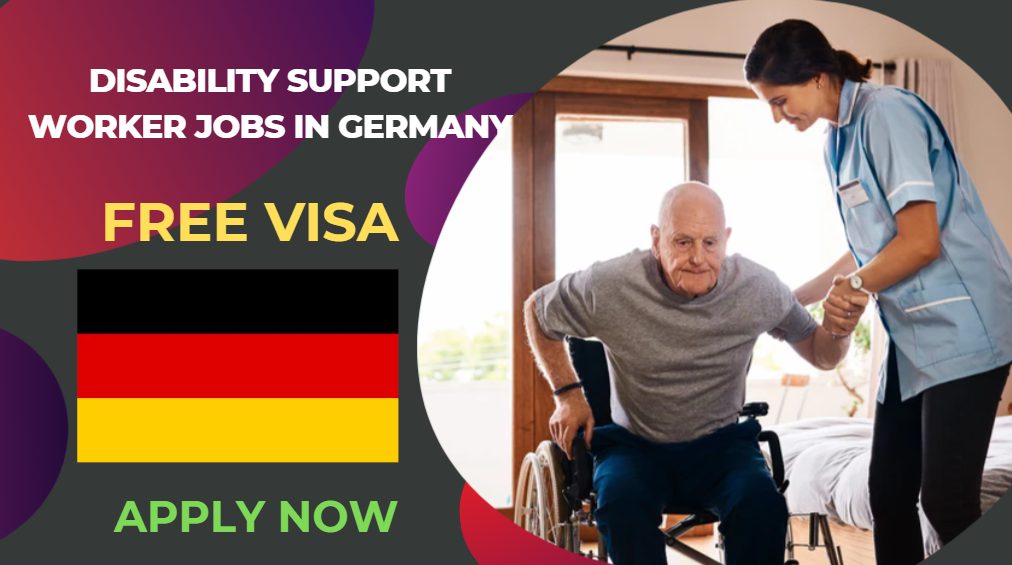
Disability Support Worker Jobs in Germany: In a quiet workshop in Hildesheim, Ole Tomhave helps a young man with multiple disabilities fold laundry—a task that builds confidence and fine motor skills. Later, he visits a client living independently in the city, assisting with grocery shopping and budgeting. This is the daily reality of a Heilerziehungspfleger (disability support worker)—one of Germany‘s most meaningful and in‑demand professions .
Germany is committed to inclusion. The UN Convention on the Rights of Persons with Disabilities has driven significant investment in community‑based living, vocational training, and support services. As a result, the demand for qualified disability support workers has never been higher. Unlike many other countries, Germany has a formal, state‑recognised training pathway specifically for this profession—opening doors for international applicants who are passionate about making a difference.
Table of Contents
Disability Support Worker Jobs in Germany
This comprehensive guide covers everything: what disability support workers do, the two main training pathways (2‑year and 3‑year programmes), salary expectations (€3,800–€4,700+ monthly), visa options for international applicants, German language requirements, and exactly how to start your career in Germany.
What Is a Disability Support Worker (Heilerziehungspfleger) in Germany?
A Heilerziehungspfleger (disability support worker) is a state‑recognised professional who supports people with mental, physical, or multiple disabilities. Unlike a nursing assistant, who focuses primarily on medical care, a Heilerziehungspfleger takes a holistic, educational, and social approach. You help individuals lead self‑determined lives—whether they live in residential homes, shared apartments, or independently.
Other related titles:
Sozialbetreuer (Social Carer – similar, but not identical)
Heilerziehungspflegeassistent (Disability Support Assistant – entry‑level)
Alltagsbegleiter (Daily Companion)
What you are NOT: A nurse (Krankenpfleger), a social worker (Sozialarbeiter), or a curative teacher (Heilpädagoge). Heilerziehungspfleger work under the supervision of these specialists and focus on practical, everyday support.
The golden rule of disability support in Germany: „So normal wie möglich, so speziell wie nötig.“ (As normal as possible, as specialised as necessary.) The goal is inclusion and participation, not isolation.
Core Duties: What Disability Support Workers Actually Do
The work is incredibly varied. You might support a child with learning disabilities in a group home, help a young adult with physical disabilities find a job, or assist an elderly person with dementia in a day centre.
Typical Responsibilities:
| Task Category | Specific Duties |
|---|---|
| Basic Care (Grundpflege) | Assisting with personal hygiene, dressing, eating, and mobility. |
| Educational Support | Promoting independence through daily activities (cooking, cleaning, budgeting). |
| Social Integration | Accompanying clients to appointments, shopping, cultural events, and leisure activities. |
| Vocational Support | Assisting clients in sheltered workshops or supported employment programmes . |
| Documentation | Writing daily reports on client progress and well‑being. |
| Team Collaboration | Working with social workers, therapists, and family members. |
A Real‑World Example:
Ole Tomhave, a Heilerziehungspfleger in training, works three to four days per week in a residential facility. His tasks include:
Morning care for residents with multiple disabilities.
Supporting a young man with autism in a shared apartment.
Accompanying a client to a doctor‘s appointment.
Documenting progress and challenges in daily reports.
Two days per week, he attends a specialised college to study psychology, pedagogy, medicine, and law .
Where You Can Work:
| Setting | Typical Duties |
|---|---|
| Residential homes (Wohngruppen) | 24/7 support in group homes, often with shift work. |
| Outpatient services (Ambulante Dienste) | Visiting clients in their own homes. |
| Day centres (Tagesförderstätten) | Supporting clients during the day, including activities and meals. |
| Workshops for people with disabilities (WfbM) | Assisting with vocational training and daily structure. |
| Schools | Integrating children with disabilities into mainstream classrooms. |
Why Germany Needs Foreign Disability Support Workers (Market Demand)
Germany‘s disability support sector is expanding rapidly due to three main factors:
The UN Convention (2009) – Germany committed to de‑institutionalisation and community‑based living.
An ageing population – More elderly people with disabilities require support.
Staff shortages – Many German workers are retiring, and not enough young people are entering the field.
The result: Employers like Lebenshilfe (a nationwide charity) and Stiftung Sankt Johannes are actively seeking applicants. Some offer free pre‑internships (Hospitation) to help you test if the profession is right for you .
Current job openings (2026):
| Employer | Location | Type | Details |
|---|---|---|---|
| Lebenshilfe Kirchheim | Kirchheim unter Teck | Apprenticeship | Starts 01.09.2026, 3 years, middle school certificate required |
| Stiftung Sankt Johannes | Marxheim (Bavaria) | Apprenticeship | Starts 01.09.2026, 3 years |
| bfz Memmingen | Memmingen (Bavaria) | Apprenticeship | Starts 03.08.2026, 3 years, school‑based with practice phases |
| Thüringen (Bad Salzungen) | Bad Salzungen | Apprenticeship | Starts 17.08.2026, 3 years, state school |
Training Pathways: How to Become a Disability Support Worker
Unlike many other countries, Germany has a formal, state‑recognised training programme for this profession. There are two main pathways: 2‑year and 3‑year programmes.
Pathway 1: 3‑Year Full Training (Heilerziehungspfleger/in)
This is the standard route for most applicants.
| Feature | Details |
|---|---|
| Duration | 3 years |
| Structure | A mix of theoretical instruction at a Fachschule (specialist college) and practical work in a facility |
| Scholarship | Many employers pay a training wage (Ausbildungsvergütung) during the practical phases |
| Requirements | Middle school certificate (Mittlere Reife) PLUS one of the following : – Completed 2‑year relevant vocational training (e.g., social assistant) |
| Background check | Extended police clearance certificate (erweitertes Führungszeugnis) – required |
| Medical certificate | Proof of health suitability for the profession |
Pathway 2: 2‑Year Accelerated Training
This pathway is for applicants who already have significant relevant experience.
| Feature | Details |
|---|---|
| Duration | 2 years (full‑time) |
| Requirements | Middle school certificate + at least 2 years of relevant work experience OR a completed 2‑year vocational training in a related field (e.g., social assistant, nursing assistant) |
| Admission | Requires approval from the school authorities |
Pathway 3: 1‑Year Heilerziehungspflegeassistent (Entry‑Level Helper)
| Feature | Details |
|---|---|
| Duration | 1 year |
| Requirements | Middle school certificate + 2 years of relevant work experience OR 4 years of running a household |
| Role | Supports qualified Heilerziehungspfleger, similar to a nursing assistant |
Real‑Life Admission Examples:
For the 3‑year programme at bfz Memmingen:
Middle school certificate
Completed 2‑year relevant vocational training OR 2 years of relevant work experience
For Lebenshilfe Kirchheim:
Middle school certificate
Completed voluntary service (FSJ/BFD)
Training Pay (Ausbildungsvergütung)
Most employers pay a training wage during the practical phases of the apprenticeship. Exact figures depend on the employer, but here are typical ranges:
| Training Year | Monthly Gross (€) |
|---|---|
| 1st year | €1,200 – €1,400 |
| 2nd year | €1,300 – €1,500 |
| 3rd year | €1,400 – €1,600 |
Note: School‑based programmes without a sponsoring employer may not include a salary. Always check the terms of the specific offer.
Salary Expectations for Qualified Disability Support Workers (2026)
Once you are a fully qualified Heilerziehungspfleger, salaries are competitive and come with excellent benefits.
Salary Overview:
| Statistic | Monthly Gross (€) | Annual Gross (€) |
|---|---|---|
| Lower quartile | €3,828 | €45,936 |
| Median | €4,256 | €51,072 |
| Upper quartile | €4,731 | €56,772 |
Source: Gehalt.de based on aggregated salary data
Salary by Experience Level:
| Experience | Typical Monthly Gross (€) |
|---|---|
| 0–2 years | €3,500 – €3,900 |
| 3–5 years | €4,000 – €4,300 |
| 5–10 years | €4,300 – €4,700 |
| 10+ years | €4,700 – €5,200+ |
Additional Benefits (Common):
| Benefit | Typical Value | Notes |
|---|---|---|
| 13th month salary | €3,500 – €4,500 | Many employers pay an additional month‘s salary at Christmas |
| Shift allowances | +15–30% | For night, weekend, and holiday shifts |
| Paid annual leave | 30 days | Standard in the social sector |
| Company pension | Employer‑supported | |
| Training budget | €500 – €1,500/year | For continuing education |
| Job ticket | Subsidised public transport |
Realistic Monthly Budget (Medium City):
| Expense | Cost (€) |
|---|---|
| Rent (shared room) | €450 – €700 |
| Food | €200 – €300 |
| Health insurance | ~€200 (deducted) |
| Transport (subsidised job ticket) | €30 – €50 |
| Mobile | €15 – €25 |
| Total expenses | €895 – €1,275 |
| Monthly net (€4,200 gross) | €2,600 – €2,800 |
| Monthly savings | €1,300 – €1,800+ |
Takeaway: A qualified disability support worker earning €4,200–€4,700/month can save €1,300–€1,800+ per month, making this a financially sustainable career with excellent benefits.
Work Visas & Permits for International Applicants
This is the most important section for non‑EU applicants. Germany has specific pathways for vocational training and qualified professionals.
For EU Citizens (Polish, Romanian, French, etc.):
| Requirement | Status |
|---|---|
| Visa needed? | ❌ No |
| Work permit needed? | ❌ No |
| Registration required? | ✅ Yes – Anmeldung and Tax ID |
How to work as an EU citizen: Travel to Germany → apply for an apprenticeship or job → register your address → start work.
For Non‑EU Citizens – Vocational Training Visa (Ausbildung)
The most common pathway for international applicants is to secure an apprenticeship position (Ausbildungsplatz) and then apply for a vocational training visa.
| Feature | Details |
|---|---|
| Valid for | Duration of the apprenticeship (2–3 years) |
| Work rights | You can work in the practical training facility |
| Requirements | Confirmed apprenticeship offer; German language certificate (B1/B2); school certificates recognised; proof of financial means |
| Pathway to permanent residency | After completing the apprenticeship and working for 2 years |
This is the route to target for 2026: Apply directly to employers offering Heilerziehungspfleger apprenticeships (e.g., Lebenshilfe Kirchheim) from abroad.
For Non‑EU Citizens – Skilled Worker Visa (§18a AufenthG)
If you are already a qualified disability support worker (your foreign qualification has been recognised as equivalent to the German standard), you can apply for the Skilled Worker Visa.
| Feature | Details |
|---|---|
| Qualification | Recognised foreign qualification in disability support or a related field |
| Job offer | Concrete contract from a German employer |
| German language | B2 recommended |
| BA approval | Required (Federal Employment Agency) |
| Pathway to permanent residency | After 4–5 years |
For Non‑EU Citizens – Opportunity Card (Chancenkarte)
If you have a relevant qualification but no job offer yet, the Opportunity Card allows you to enter Germany to search for work.
| Feature | Details |
|---|---|
| Points needed | Minimum 6 |
| Work rights | Up to 10 hours/week while searching |
| Valid for | Up to 1 year |
| Pathway | Convert to work visa once hired |
Language Requirements: German Proficiency
Short answer: B2 German is strongly recommended for qualified roles; B1 may be accepted for apprenticeship applications.
Language Levels Explained:
| Level | What it allows |
|---|---|
| A2 | Basic understanding – not sufficient for professional work |
| B1 | Minimum for some apprenticeship applications |
| B2 | Standard for qualified professionals – required for independent work |
| C1 | Advanced roles, management positions |
What the Job Ads Say:
Lebenshilfe Kirchheim: No explicit level stated, but requires “Einfühlungsvermögen” (empathy) and “Bereitschaft, pflegerische Aufgaben zu übernehmen” – B1 implied
bfz Memmingen: Comprehensive application process implies B2 standard
Recommendation: Aim for B2 German before you start applying. This is the level expected in most care facilities.
How to Find Disability Support Worker Jobs with Visa Sponsorship (Actionable Steps)
Step 1: Determine Your Pathway
| Your Situation | Recommended Pathway |
|---|---|
| No prior training, have middle school certificate | Apply for a 3‑year apprenticeship (Ausbildung) |
| Have relevant work experience or training | Apply for 2‑year accelerated training or direct employment |
| Already qualified (recognition) | Apply for Skilled Worker Visa |
Step 2: Get Your German Language Certificate (B2 Minimum)
Aim for B2 German – the standard for social care professions
Take courses at Goethe‑Institut, TELC, or ÖSD
Start learning at least 12 months before you plan to apply
Step 3: Apply for Apprenticeships Directly (Target for 2026)
Active apprenticeship openings (2026):
| Employer | Location | Application Deadline | How to Apply |
|---|---|---|---|
| Lebenshilfe Kirchheim | Kirchheim unter Teck | Not specified | Call or email directly |
| Stiftung Sankt Johannes | Marxheim (Bavaria) | Not specified | Apply via the employer |
| bfz Memmingen | Memmingen (Bavaria) | Start 03.08.2026, ongoing | Contact Tanja Haag (08331 / 958419) |
| Thuringia (Bad Salzungen) | Bad Salzungen | 30 June 2026 | Contact Andreas Schwanz (03695 / 692815) |
Step 4: Prepare Your Application Documents
For apprenticeship applications:
CV (German‑style, with photo)
Cover letter (in German)
Certified copy of your school leaving certificate
German language certificate (B1–B2)
Extended police clearance certificate (may be requested later)
Medical certificate (may be requested later)
Step 5: Consider a Voluntary Service (FSJ/BFD) as a First Step
Many German employers, like Lebenshilfe, offer voluntary services (Freiwilliges Soziales Jahr – FSJ, or Bundesfreiwilligendienst – BFD). This is an excellent way to test the profession, gain experience, and build connections.
Ole Tomhave‘s story: He entered the field through a BFD, then decided to pursue the full training .
Step 6: Apply for Visa at German Embassy
Once you have an apprenticeship offer, apply for the vocational training visa (Ausbildungsvisum) at the German embassy in your home country.
Required documents:
Confirmation of apprenticeship from employer
German language certificate (B1–B2)
School certificates (translated and certified)
Police clearance certificate
Medical certificate
Proof of financial means (e.g., blocked account for the first months, if the training wage is low)
Step 7: Travel to Germany and Complete Registration
After visa approval:
Travel to Germany
Register your address (Anmeldung) at the local Bürgeramt
Apply for a residence permit at the local Ausländerbehörde
Start your apprenticeship
Sample Job Ads (Realistic – Visa Sponsorship Eligible)
Example 1: Apprenticeship – Lebenshilfe Kirchheim (Baden‑Württemberg)
Title: Ausbildung Heilerziehungspfleger*in (m/w/d) 2026
Location: Kirchheim unter Teck
Start: 1 September 2026
Requirements:
Middle school certificate
Completed voluntary service (FSJ/BFD)
Empathy, patience, responsibility
Willingness to take on nursing tasks
Teamwork and flexibility
Benefits:
Pay based on TVAöD (public sector collective agreement)
Shift work in residential home
Theory at Diakonisches Institut
To apply: Contact Lebenshilfe Kirchheim directly.
Example 2: Apprenticeship – bfz Memmingen (Bavaria)
Title: Heilerziehungspfleger*in in gegliederter Ausbildungsform
Location: Memmingen, Bavaria
Start: 3 August 2026
Duration: 3 years
Requirements:
Middle school certificate
Completed 2‑year relevant vocational training OR 2 years of relevant work experience
Health certificate (not older than 3 months)
Extended police clearance certificate (not older than 3 months)
Pay: Training wage (details not specified)
To apply: Contact Tanja Haag at bfz Memmingen (08331 / 958419, tanja.haag@bfz.de)
Example 3: Apprenticeship – Stiftung Sankt Johannes (Bavaria)
Title: Ausbildung 2026 – Praktikum möglich
Location: Marxheim, Bavaria
Start: 1 September 2026
Requirements:
Middle school certificate
Christian values (organisation is church‑based)
Interest in disability support
To apply: Contact Stiftung Sankt Johannes directly.
Living as a Disability Support Worker in Germany: What to Expect
Typical Daily Schedule (Residential Home, Early Shift):
| Time | Activity |
|---|---|
| 6:30 AM | Arrival, handover from night shift |
| 7:00 AM – 8:30 AM | Morning care: help residents wake up, wash, dress, prepare breakfast |
| 8:30 AM – 10:00 AM | Accompany residents to day centre or workshop |
| 10:00 AM – 12:00 PM | Documentation, team meeting |
| 12:00 PM – 1:00 PM | Lunch service |
| 1:00 PM – 2:30 PM | Support with activities (e.g., shopping, cooking) |
| 2:30 PM – 3:00 PM | Handover to late shift |
Shift Patterns:
Early shift: 6:00 AM – 2:00 PM
Late shift: 2:00 PM – 10:00 PM
Night shift: 10:00 PM – 6:00 AM (in some residential homes)
Career Progression (From Assistant to Specialist)
| Timeframe | Role | Pay (€/month) | Qualifications |
|---|---|---|---|
| 0–1 years | Heilerziehungspflegeassistent (1‑year training) | €2,800 – €3,200 | 1‑year certificate |
| 0–3 years | Apprentice (Ausbildung) | €1,200 – €1,600 | In training |
| 3+ years | Heilerziehungspfleger (qualified) | €4,000 – €4,700 | State certification |
| 5+ years | Team leader / Shift supervisor | €4,700 – €5,500 | Leadership training + C1 German |
| 7+ years | Facility manager / Specialist consultant | €5,500 – €7,000+ | Further qualifications, degree |
Pro tip: After completing the 3‑year training, you can also study Social Work (Soziale Arbeit) at a university of applied sciences – often with credits transferred .
Legal Traps for International Applicants (Critical)
Red Flags (Walk away immediately):
| Red Flag | Why It‘s a Problem |
|---|---|
| “Pay us €5,000 for visa sponsorship” | Illegal. German employers and training providers do not charge for sponsorship. |
| “We will sponsor you without any German” | Untrue. B1–B2 German is required for training and work. |
| “No contract – we pay cash” | Illegal. No Social Security, no proof of employment. |
| “You don‘t need a police clearance” | Untrue. An extended police clearance is legally required . |
| “We can‘t provide a written contract” | Illegal. German law requires a written contract from day one. |
Your Legal Rights as a Disability Support Worker in Germany:
| Right | Details |
|---|---|
| Minimum wage during training | Training wage varies, but legally required |
| Maximum working hours | 40 hours/week (overtime paid) |
| Paid annual leave | 20 days minimum; 30 days is standard |
| Paid public holidays | 9–12 days/year – if you work, double pay |
| Sick leave | Paid by health insurance (6 weeks full pay from employer) |
| Health insurance | Mandatory – covered during training and employment |
| Written contract | Must be provided before starting work |
What to Do If You Are Exploited:
Labour Inspectorate (Zoll): Customs office handles illegal employment
Trade union: Ver.di (services) – helps foreign workers for free
Your embassy
How to Start Today (Checklist)
If you are an EU citizen:
Get your passport
Get your school certificates translated into German
Apply to Lebenshilfe Kirchheim, Stiftung Sankt Johannes, or bfz Memmingen directly
Once accepted, travel to Germany
Register your address
Start your apprenticeship
If you are a non‑EU citizen with a middle school certificate and German B1:
Learn German to B1–B2 level (Goethe‑Institut, TELC)
Prepare your application documents (CV, cover letter, school certificates translated)
Apply to apprenticeship positions from abroad
Secure an offer
Apply for a vocational training visa at the German embassy
Travel to Germany, start your training (2–3 years)
If you are already a qualified disability support worker (non‑EU):
Get your foreign qualification recognised in Germany
Learn German to B2 level
Apply for qualified positions (target salary €4,000+)
Secure a job offer
Apply for a Skilled Worker Visa at the German embassy
Travel to Germany, start working
If you are unsure about the profession:
Apply for a voluntary service (FSJ/BFD) with an employer like Lebenshilfe
This allows you to work in the field for 6–12 months without a full training commitment
If you like it, transition into the full apprenticeship
Final Verdict: Is Disability Support Worker Work in Germany Worth It?
Yes – for compassionate, resilient individuals who want to make a difference and are willing to learn German. The profession offers a clear training pathway, competitive pay (€4,000–€4,700/month), strong benefits, and a pathway to permanent residency.
If you are:
An EU citizen looking for a meaningful career
A non‑EU citizen with a middle school certificate and B1–B2 German
Someone who is empathetic, patient, and physically resilient
Looking for €4,000+ per month with 30 days holiday and a Christmas bonus
Wanting a career with advancement opportunities (to team leader, social worker, or facility manager)
…then disability support work is one of the most rewarding professions in Germany.
If you are:
Someone unwilling to learn German (B1–B2 is essential for training and work)
Expecting a “visa sponsorship” without a concrete apprenticeship or job offer
Only seeking an “unskilled” role without training (not possible for this profession)
…then this pathway may not be for you.
One final truth: Disability support work is not easy. You will face challenging behaviours, physical demands, and emotional strain. You will work shifts, including nights and weekends. But you will also be part of one of the most meaningful professions in Germany, earn a salary that supports a family, and build a life in a country that values inclusion and diversity. The German government has created the legal pathways. The employers are waiting. Your journey starts with a language course and an application. Viel Glück und Erfolg! (Good luck and success!
Disclaimer
This job information is shared for educational and informational purposes only. Any discussion of visa categories is based on general immigration laws and publicly available information.





Job, visa, salary, deadline and eligibility details can change. Check the employer or relevant government/official source before applying, paying money or making travel arrangements.
If you spot an outdated or inaccurate detail, please contact us with the article URL.