
Food Factory Jobs in Poland for Foreign Workers: Poland has emerged as one of Europe‘s fastest-growing manufacturing hubs, and the food processing sector is at the heart of this expansion. From global giants like Mondelēz (Milka, Oreo) and Cargill to major poultry producers like Plukon, Polish food factories are producing for the entire European market. With a booming economy and a demographic decline, the country is facing a critical labour shortage—and it is actively looking abroad to fill these positions.
Table of Contents
Food Factory Jobs in Poland for Foreign Workers
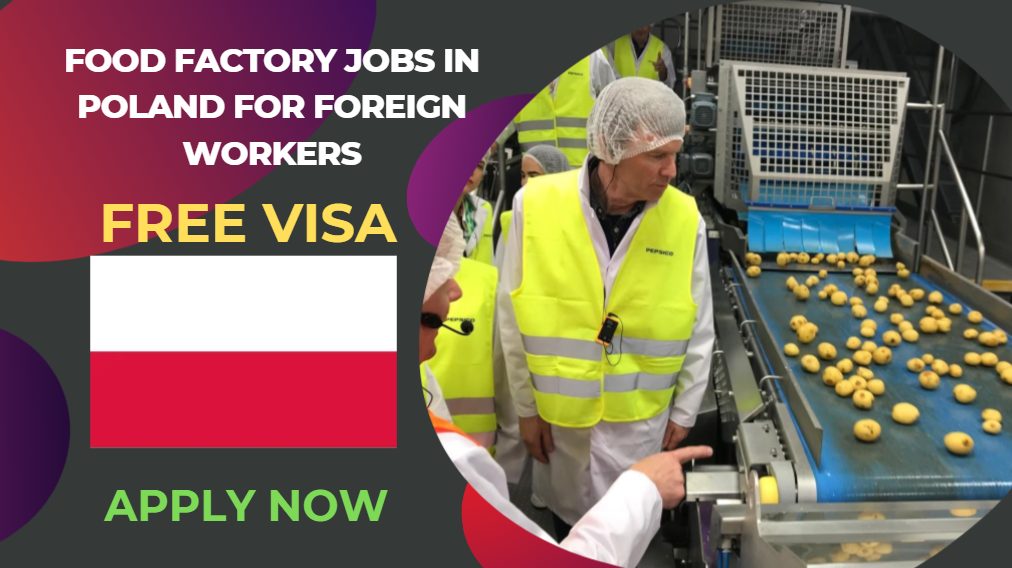
For international workers, food factory jobs in Poland offer a unique opportunity: a legal pathway to work in the EU (via the Polish Type D national visa), competitive pay (PLN 27.70–PLN 40+ per hour), free or subsidised accommodation, and the chance to build a new life in the heart of Europe. This guide covers everything: what food factory workers do, pay rates, the work permit system, language requirements, and exactly how to land a food factory job with a legal work permit.
What Are Food Factory Jobs in Poland?
A food factory worker (pracownik produkcji / operator linii produkcyjnej) is responsible for processing, packaging, and quality-checking food products on a production line. You work in a modern manufacturing facility, ensuring that everything from poultry and confectionery to ready meals meets European safety and quality standards.
Common job titles in Poland:
-
Production Worker (Pracownik Produkcji)
-
Line Operator (Operator Linii Produkcyjnej)
-
Packing Worker (Pakowacz)
-
Meat Cutter / Poultry Processor
-
Quality Control Assistant
-
Food Packaging Line Operator
What you are NOT: A food technologist, engineer, or lab technician. These are entry-level to semi-skilled production roles focused on physical tasks and machine operation.
The golden rule of food factory work in Poland: “Czystość to podstawa” (Cleanliness is the foundation). Food safety is paramount. Strict hygiene protocols must be followed at all times.
Core Duties: What Food Factory Workers Actually Do
The work varies by product, but core responsibilities are consistent across most food factories.
Typical Responsibilities (based on current Plukon job ad) :
| Task | Details |
|---|---|
| Portioning | Cutting and separating poultry parts according to specifications |
| Packaging | Packing finished products into trays, bags, or boxes |
| Foil wrapping | Operating packaging machines to seal products |
| Stacking | Loading packed products onto pallets |
| Processing | Working on the production line to ensure smooth flow |
| Cleaning | Maintaining hygiene standards at your workstation |
| Quality checks | Examining products for defects or contamination |
A Typical Day in a Food Factory (Shift Work):
| Time | Activity |
|---|---|
| 6:00 AM | Shift start, team briefing |
| 6:00 AM – 10:00 AM | Production work (processing, packing) |
| 10:00 AM – 10:15 AM | Break |
| 10:15 AM – 2:00 PM | Continue production work |
| 2:00 PM – 3:00 PM | Lunch break |
| 3:00 PM – 6:00 PM | Final shift tasks, cleaning |
| 6:00 PM | Shift end |
Shift Patterns:
Most factories operate on a 3-shift system :
-
Morning shift: 06:00 – 14:00
-
Afternoon shift: 14:00 – 22:00
-
Night shift: 22:00 – 06:00
Some factories use a 4-on/1-off or 4-on/2-off schedule , especially for night shifts.
Why Poland Needs Foreign Food Factory Workers (Market Demand)
Poland’s manufacturing sector is booming, but the native workforce is shrinking due to low birth rates and emigration to Western Europe.
Key Indicators:
| Indicator | 2026 Status |
|---|---|
| Foreign workers in Poland | Over 1.05 million (as of February 2025) |
| Key hiring sectors | Food processing, manufacturing, logistics, construction |
| Top employers hiring | Mondelēz (Milka, Oreo), Cargill, Plukon Food Group, Mondelez |
| Labour shortage severity | Critical — especially for entry-level production roles |
What This Means for You:
Factories are desperate for reliable workers. Many are offering:
-
Stable employment contracts
-
Free or subsidised accommodation
-
Overtime and shift bonuses
-
Work permit sponsorship (via employer)
Pay Rates for Food Factory Workers in Poland (2026)
Pay varies by region, employer, and shift. Food factory jobs in Poland typically pay above the minimum wage, with significant bonuses for night and weekend work.
Salary Overview:
| Role | Hourly Rate (PLN) | Monthly Gross (PLN) | Monthly Net (approx, PLN) |
|---|---|---|---|
| Production Worker (entry) | 27.70 – 30.00 | 4,432 – 4,800 | 3,200 – 3,500 |
| Experienced line operator | 30.00 – 35.00 | 4,800 – 5,600 | 3,500 – 4,000 |
| Night shift (+20%) | 33.24 – 36.00 | 5,318 – 5,760 | 3,800 – 4,200 |
| Weekend (+50–100%) | 41.55 – 55.40 | 6,648 – 8,864 | 4,600 – 6,000 |
Real-world example (Plukon Food Group, Gruszczyce) :
-
Salary range: PLN 3,600 – 6,000 gross/month
-
Shift allowances including night, weekend, and climatic bonuses
Real-world example (Mondelēz production line) :
-
Base rate: 27.70 PLN/hour
-
Night shift: +20%
-
Overtime: +50%
-
Weekends/holidays: +100%
Additional Benefits (Common):
| Benefit | Typical Value | Notes |
|---|---|---|
| Free accommodation | PLN 0 – 250 utilities | Many factories provide |
| Shift transport | Free | Company shuttle buses |
| Meal vouchers | PLN 250 – 500/month | Some employers |
| Private health insurance | Yes | Larger companies (Cargill, Mondelēz) |
| Life insurance | Yes | |
| MyBenefit / MultiSport card | PLN 100 – 300 value | Wellness programmes |
| Christmas bonus | Yes | Some employers |
| PPE (uniform, gloves, boots) | Free | Health and safety requirement |
Realistic Monthly Savings (with free accommodation):
| Expense | Cost (PLN) |
|---|---|
| Rent (free) | 0 |
| Utilities | 100 – 250 |
| Food | 400 – 800 |
| Transport | 0 – 100 (company shuttle) |
| Mobile | 50 – 100 |
| Total expenses | 550 – 1,250 |
| Monthly net (night shift) | 3,800 – 4,200 |
| Monthly savings | 2,500 – 3,600+ |
Takeaway: Food factory workers with free accommodation can save 2,500–3,600+ PLN per month—an excellent opportunity for those seeking to build savings while working in the EU.
The Polish Work Visa System (Critical Section)
This is the #1 question for non-EU applicants. Poland has a two-step system for work authorisation :
-
Employer obtains a Work Permit (Zezwolenie na pracę)
-
Worker applies for a Type D National Visa (Wiza krajowa)
Step 1: The Work Permit (Sponsorship)
The employer is responsible for obtaining the work permit before you can apply for a visa .
| Feature | Details |
|---|---|
| Application | Employer submits to Voivodeship Office |
| Processing time | 1–3 months (depending on office workload) |
| Cost | 400 PLN (for permit exceeding 3 months) |
| Types of permits | Type A: most common for factory workers |
| Labour market test | Employer must prove no Polish/EU candidate available (exceptions apply) |
| Salary requirement | Cannot be lower than Polish minimum wage |
| Fast-track (2026) | Available for strategic companies or shortage professions |
Step 2: The Type D National Work Visa
Once the work permit is approved, you apply for a Type D visa at the Polish embassy in your home country .
| Feature | Details |
|---|---|
| Valid for | Up to 1 year (renewable) |
| Work rights | Full-time employment with the sponsoring employer |
| Schengen travel | Yes — visa allows travel to 26 Schengen countries for up to 90/180 days |
| Pathway to long-term residence | Yes — after 5 years |
| Processing time | 4–6 weeks (average) |
Required Documents for Type D Visa :
-
Completed visa application form
-
Valid passport (2 blank pages, 12 months validity)
-
Work permit approval letter
-
Employment contract
-
Proof of accommodation (often provided by employer)
-
Travel health insurance (30,000 EUR coverage)
-
Proof of sufficient funds (bank statement, 3 months)
-
Passport photos
-
Police clearance certificate (varies by embassy)
Who Can Apply?
The Polish Type D work visa is open to applicants from all countries . There are no nationality restrictions. However, the employer must sponsor the work permit, so the opportunity depends on finding a willing employer.
Work Permit Fees (2026) :
| Permit Type | Fee (PLN) |
|---|---|
| Up to 3 months | 200 |
| Over 3 months | 400 |
| Seasonal work permit | 100 |
| Declaration of entrusting work | 400 |
New Regulations for 2026 :
Several changes are coming into effect in 2026:
-
Online applications: All work permit applications must be submitted via praca.gov.pl
-
No labour market test required for most cases (employer no longer needs to prove no Polish/EU candidates first — significant simplification)
-
Fast-track processing for strategic companies and shortage professions
-
Faster processing for returning workers
-
Increased penalties for illegal employment (fines up to 50,000 PLN)
Language Requirements
Short answer: Polish language skills are not required for the work permit or visa . However, basic Polish is highly recommended for daily life and workplace safety.
English in Polish Factories:
| Employer | Language Requirement | Source |
|---|---|---|
| Plukon Food Group | Basic Polish or English (communicative) | |
| Cargill (technical roles) | Fluent Polish and English | |
| Mondelēz (production) | Basic English sufficient |
Polish You Should Learn (Basic Phrases):
| English | Polish | Pronounced |
|---|---|---|
| Hello | Dzień dobry | JEN dob-ri |
| Thank you | Dziękuję | Jen-koo-yeh |
| Please | Proszę | PRO-sheh |
| Yes / No | Tak / Nie | tahk / nyeh |
| Work | Praca | PRAH-tsa |
| Production | Produkcja | pro-DOOK-tsya |
| Shift | Zmiana | ZMYAH-nah |
| Break | Przerwa | PSHEH-rva |
Recommendation: Learn basic Polish phrases. Your employer will not require fluency, but it will make daily life in Poland easier and safer.
How to Find Food Factory Jobs with Work Permit Sponsorship (Actionable Steps)
Step 1: Determine Your Pathway
| Your Situation | Recommended Pathway |
|---|---|
| Non-EU citizen, has experience | Apply directly to factories via job portals |
| Non-EU citizen, no experience | Apply via recruitment agencies specialising in international placements |
| Already in Poland on a visa | Work permit still required; can be easier to find employer |
| EU citizen | Travel freely, apply directly (no visa needed) |
Step 2: Research Major Food Factories Actively Hiring
Major food manufacturers in Poland regularly hiring foreign workers:
| Employer | Location | Products | Website |
|---|---|---|---|
| Mondelēz International | Skarbimierz, Bielany, Plonsk | Milka, Oreo, Prince Polo | mondelezinternational.com |
| Plukon Food Group | Gruszczyce (near Wrocław) | Poultry products | plukon.com |
| Cargill | Września, Słupca | Meat processing | cargill.com |
Step 3: Apply to Active Job Postings
Current opportunities (2026):
| Position | Employer | Location | Pay | Apply Via |
|---|---|---|---|---|
| Production Worker | Plukon | Gruszczyce | 3,600–6,000 PLN gross | rekrutacja@plukon.pl |
| Line Operator | Mondelēz | Skarbimierz | 27.70 PLN/hour + bonuses | Recruitment agencies |
Step 4: Use Recruitment Agencies Specialising in Polish Work Permits
Recruitment agencies can help match you with employers willing to sponsor work permits.
Example (from Mondelēz posting) :
-
Agency makes work permit in 2 months
-
Cost: 1,500 USD (first payment 500 USD)
-
Accommodation provided (utilities: 250 PLN/month)
-
Transport provided
Warning: Be cautious of agencies charging upfront fees without a verifiable job offer. Verify the employer and agency before paying.
Step 5: Prepare Your Documents
Essential documents for job applications:
-
CV (in English or Polish)
-
Proof of any relevant experience (optional)
-
Passport (valid)
For visa application (after job offer):
-
Valid passport (12 months validity)
-
Work permit approval letter
-
Employment contract
-
Proof of accommodation
-
Travel health insurance (30,000 EUR)
-
Bank statement (proof of funds)
Step 6: Application Submission Process
-
Apply directly to the employer or through a recruitment agency
-
If selected, employer applies for your work permit (1–3 months)
-
Once approved, you apply for Type D visa at Polish embassy
-
Upon approval, travel to Poland
-
Register with local authorities (address registration)
-
Obtain PESEL (national identification number)
-
Start working
Living as a Food Factory Worker in Poland: What to Expect
A Typical Day (Skarbimierz Factory, Mondelēz) :
| Time | Activity |
|---|---|
| 6:00 AM | Wake up (staff accommodation) |
| 6:30 AM | Company shuttle to factory |
| 7:00 AM – 10:00 AM | Work on production line |
| 10:00 AM – 10:20 AM | Break (20 minutes) |
| 10:20 AM – 2:00 PM | Continue production |
| 2:00 PM – 3:00 PM | Lunch break |
| 3:00 PM – 6:00 PM | Final shift, cleaning |
| 6:00 PM – 6:30 PM | Return to accommodation |
Accommodation Provided:
| Feature | Typical Details |
|---|---|
| Type | Shared rooms (2–4 people per room) |
| Cost | Free or 250 PLN/month for utilities |
| Utilities | Electricity, water, heating, internet |
| Transport | Company shuttle buses |
Working Conditions:
| Factor | Reality |
|---|---|
| Environment | Factory floor, can be cold (food processing) or warm |
| Physical demands | Medium-high (standing 8+ hours, lifting 3–9 kg) |
| Pace | Fast — production targets to meet |
| Safety | Strict hygiene protocols (hairnets, gloves, uniforms) |
Pros and Cons of Food Factory Work in Poland:
| Pros | Cons |
|---|---|
| Work permit sponsorship available | Polish language not required but helpful |
| Free or low-cost accommodation | Physical and repetitive work |
| Competitive pay (27–55 PLN/hour) | Shift work (including nights, weekends) |
| Overtime pay (up to 100% extra) | Cold environment (food processing) |
| Pathway to long-term residency | Limited career progression without further training |
| EU work experience | Initial upfront costs (visa fees, agency fees) |
| Multinational environment |
Career Progression (From Production Worker to Supervisor)
| Timeframe | Role | Pay (PLN/hour) | Qualifications |
|---|---|---|---|
| 0–2 years | Production Worker | 27 – 30 | On-the-job training |
| 2–4 years | Line Operator | 30 – 35 | Experience |
| 3–5 years | Shift Leader / Team Leader | 35 – 45 | Leadership training |
| 5+ years | Production Supervisor | 45 – 60 | Polish language B1 + experience |
Pro tip: Learn Polish. English is fine for starting, but Polish opens doors to supervisory roles and higher pay.
Legal Traps for Food Factory Applicants (Critical)
Red Flags (Walk away immediately):
| Red Flag | Why It‘s a Problem |
|---|---|
| “Pay us 1,500 USD for a work permit guarantee” | Be extremely cautious. Work permits are employer-sponsored, not sold to individuals. Verify the employer before paying. |
| “We will sponsor you without a job offer” | Impossible. A concrete job offer is mandatory for a work permit. |
| “No contract – we pay cash” | Illegal. No legal protections, no proof of employment, no visa compliance. |
| “You don’t need a work permit” | Untrue. Non‑EU citizens require a work permit to work legally in Poland. |
| “Fake diploma accepted” | Illegal. Use of forged documents results in deportation and entry ban. |
Your Legal Rights as a Factory Worker in Poland:
| Right | Details |
|---|---|
| Minimum wage | Check current rate (approx 3,600–4,000 PLN/month). Factory workers typically earn more |
| Maximum working hours | 40 hours/week + overtime (paid extra) |
| Paid annual leave | 20–26 days/year (depending on experience) |
| Paid public holidays | 13 days/year — if you work, you get extra pay or day in lieu |
| Sick leave | Paid by ZUS (Social Insurance Institution) |
| Health insurance | NFZ (National Health Fund) — access to public healthcare |
| Employment contract | Must be in writing |
| Overtime pay | Legally required (50–100% extra) |
| Work permit | Must be obtained BEFORE you start working |
What to Do If You Are Exploited:
-
Państwowa Inspekcja Pracy (PIP): Labour Inspectorate handles illegal employment
-
ZUS: Social Insurance Institution for benefit issues
-
Your embassy
How to Start Today (Checklist)
If you are a non-EU citizen seeking sponsorship:
-
Find a job offer (Plukon, Mondelēz, Cargill, or via recruitment agency)
-
Employer applies for work permit (Type A) at Voivodeship Office
-
Wait for permit approval (1–3 months)
-
Apply for Type D National Visa at Polish embassy in your country
-
Provide required documents: work permit, employment contract, passport, insurance, proof of funds
-
Wait for visa approval (4–6 weeks)
-
Book flight to Poland
-
Register address, obtain PESEL
-
Start working
If you are already in Poland on a visa:
-
Find employer willing to sponsor work permit
-
Same process as above — work permit still required
-
Once permit approved, you can start working
If you are an EU citizen:
-
No visa or work permit needed
-
Apply directly to factories
-
Register for PESEL and ZUS
-
Start working
Final Verdict: Is Food Factory Work in Poland Worth It for Foreigners?
Yes – for non-EU citizens seeking a legal pathway to work in the EU with accommodation provided, competitive pay, and a route to long-term residency.
If you are:
-
A non-EU citizen with a valid passport and willingness to work
-
Physically fit, reliable, and not afraid of shift work
-
Looking for employer-sponsored work permit and free accommodation
-
Comfortable with basic English (Polish not required)
-
Looking to save 2,500–3,600+ PLN per month
…then food factory work in Poland is one of the most accessible entry-level jobs in the EU.
If you are:
-
Seeking visa sponsorship without a genuine job offer (impossible)
-
Looking for skilled professional work (this is entry-level production)
-
Unwilling to work shifts or weekends
…then food factory work may not be for you.
One final truth: Food factory work is not glamorous. You will stand on a production line, pack thousands of products, and work night shifts. Some days it will be repetitive and cold. But you will also have a legal job in the EU, free accommodation, and a path to long-term residency. The food factories of Poland are hiring. Your European journey starts now. Powodzenia! (Good luck!)
Disclaimer
This job information is shared for educational and informational purposes only. Any discussion of visa categories is based on general immigration laws and publicly available information.
What to Check Before Applying to a Food Factory Role in Poland
Food production vacancies can cover very different environments, including ingredient preparation, packing, production-line support, warehouse work, sanitation, quality checks, and machine assistance. Read the actual vacancy rather than assuming that every food factory job has the same duties. Pay attention to shift patterns, physical requirements, temperature-controlled areas, hygiene rules, language expectations, transport arrangements, and whether previous food-industry experience is requested.
Prepare evidence that matches the role
A useful CV for this type of work should describe practical experience clearly. Mention production tasks, packing or labelling experience, safe handling of equipment, quality checks, cleaning procedures, stock handling, teamwork, and shift work when those skills are genuine. If you have no factory experience, describe transferable experience honestly rather than adding an invented factory position. Employers can usually understand basic transferable skills when they are explained with concrete examples.
Understand the employment and permission steps
For applicants who need immigration permission, the employment offer is only one part of the process. The correct work authorisation depends on the person’s nationality, job, employer, duration and applicable Polish rules. Confirm the current requirements through official Polish or EU information before paying anyone for assistance. A recruiter cannot turn an ineligible vacancy into an eligible immigration route simply by calling it sponsored work.
Questions worth asking
Before accepting a vacancy, ask who the legal employer is, where the workplace is located, what the normal shift pattern is, what documents are required, whether accommodation or transport is actually provided, and which authority handles the relevant work permission. Ask for important terms in writing. Be especially cautious when a person asks for money for a job or sponsorship is not guaranteed, visa, invitation letter, or appointment. A legitimate application should leave you with enough information to verify the employer, the vacancy, and the official process independently.
Daily Work in a Food Production Environment
A food factory can be organised around several connected stages. Workers may receive ingredients or packaging, prepare materials, support a production line, check labels, pack finished products, clean work areas, and move completed goods. The vacancy should explain which stage the role covers. Some jobs are repetitive and closely timed, while others require more movement between tasks. Applicants should understand the actual work pattern before accepting an offer.
Hygiene and quality routines
Food workplaces normally place strong emphasis on cleanliness, personal hygiene, safe handling and following documented procedures. The exact rules depend on the product and workplace. An applicant can demonstrate suitability by describing genuine experience with cleanliness checks, following instructions, maintaining an organised work area, or reporting problems promptly. Do not claim food-safety qualifications that you do not hold.
Shift planning and transport
Some production facilities operate early, late, overnight or rotating shifts. Before travelling, confirm the start and finish times, break arrangements and transport options. If accommodation is mentioned, ask whether it is optional, where it is located and what written terms apply. Keep the information in writing so that an informal message cannot later be confused with an employment condition.
Application checklist
- Read the complete vacancy and identify the real duties.
- Prepare an honest CV focused on relevant practical experience.
- Confirm the legal employer and workplace location.
- Check work-authorisation requirements through official sources.
- Ask important questions before paying money or travelling.
- Keep copies of the vacancy, application and written offer.
Additional Practical Guidance
Good preparation means checking the details that can change and keeping expectations realistic. Start by identifying the exact service, role, program or process involved. Then check its current requirements rather than relying only on an older article, copied screenshot or social-media summary.
Documents and records
Keep relevant documents organized and make sure names, dates and other important details are consistent. Save confirmation messages and reference numbers for important submissions. Never share passwords, one-time codes or unnecessary private information with third parties.
Costs and timing
Before committing, identify any application fees, recurring charges, deposits, travel expenses or other possible costs. Also consider processing times and deadlines. If a source does not clearly state a cost or time estimate, do not assume that the service is free or immediate.
Questions worth asking
Ask who makes the final decision, what evidence is required, what happens if an application or request is unsuccessful, and where official support is available. These questions help distinguish a genuine process from an informal claim that has not been verified.
Review and follow-up
After completing a step, review the confirmation carefully. If something is missing or incorrect, contact the responsible organization through its official channel. Keep a record of follow-up messages so that you can explain the history of the issue if it takes time to resolve.
Maintaining the article
Time-sensitive information should be reviewed whenever the underlying rules, prices, websites or procedures change. A detailed guide is most useful when it clearly separates stable background information from details that readers should verify again before acting.
Final Reader Checklist
- Identify the exact requirement.
- Verify the current official information.
- Check eligibility, documents, costs and deadlines.
- Protect private information.
- Save confirmations and records.
- Follow up through official channels when needed.
- Recheck time-sensitive information before relying on it.
Following these steps does not guarantee a particular outcome, but it can reduce avoidable mistakes and help a reader approach the subject with better information and realistic expectations.