
Food Sorting and Grading Jobs in the USA for Overseas Applicants: Food sorting and grading is one of the most accessible entry points into the American agricultural workforce. From potato grading in New York to cucumber sorting in Ohio and fruit grading in California, these jobs are essential to getting quality food from farms to tables. For overseas applicants, this sector offers genuine opportunities through established visa programs. The work does not require a college degree, and employers are often willing to train the right candidates who demonstrate reliability and attention to detail.
This guide will walk you through everything you need to know about food sorting and grading jobs in the USA for overseas applicants, including visa options, salary expectations, what the work involves, and step-by-step guidance on how to find employers who sponsor international workers.
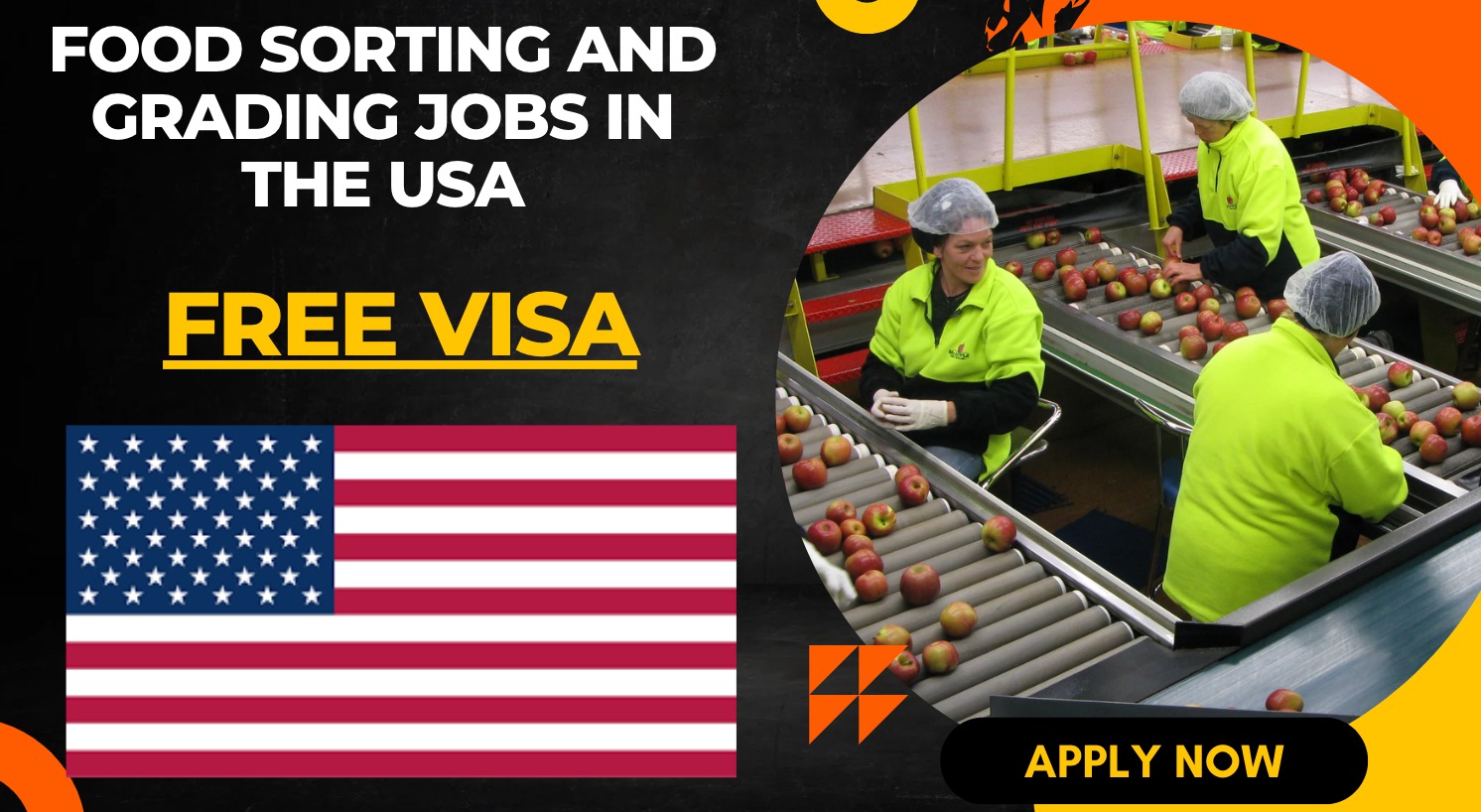
Table of Contents
What Does a Food Sorter and Grader Do?
Food sorters and graders are the quality control experts of the agricultural industry. You work on processing lines where fresh fruits, vegetables, and other agricultural products are inspected, sorted, and graded before they move to packaging or further processing.
Your daily responsibilities would include grading, sorting, or classifying unprocessed food and other agricultural products by size, weight, color, or condition . In potato processing facilities, you direct the unloading of potatoes, hand pick foreign material like rocks and dirt that has gotten past the grader, and clean up crop pieces and foreign material from around the line to maintain appropriate food and worker safety .
In cucumber sorting operations, you stand on each side of the conveyor and pull out debris, damaged product, and anything else that is not edible or acceptable . This is a fast-paced area where workers have seconds to make a judgment call as to what goes through . Each station must be manned from the time the first cucumber is unloaded until the last one is boxed, and you will need to document and keep track of dates and times of the loads .
In fruit sorting facilities, you sort fruit by quality and grade, identify different grades of fruit, and safely and efficiently place undesired grades into appropriate bins . You also maintain your assigned area clean and may need to walk up and down stairs throughout your shift .
The work environment is typically indoors in processing facilities, but you may be exposed to cold temperatures, dust, and noise. The pace can be fast, especially during peak harvest seasons. The physical demands include standing for extended periods, lifting up to 50 pounds, and performing repetitive movements with your hands and arms .
Salary Expectations
Let us talk about money. Food sorting and grading salaries in the USA vary based on location, employer, and experience.
According to real job postings, entry-level sorter and grader positions pay between $15 and $18 per hour. A Graders and Sorters position in New York pays $15.66 per hour under H-2A visa sponsorship . A similar position in the same New York facility pays $17.80 per hour for the following season . A Graders and Sorters position in Ohio pays $17.17 per hour . A Sorter position in Delano, California pays $16.90 to $16.91 per hour .
For food preparation roles that involve sorting and grading as part of their duties, wages are higher. A Food Preparation Worker position in Maine pays $18.15 per hour under H-2B visa sponsorship, with bonuses possible at the end of the contract based on performance . Another Food Preparation Worker position in Maine pays $18.15 to $23.00 per hour, with overtime rates of $27.23 to $34.50 per hour .
Beyond base pay, H-2A and H-2B positions come with substantial benefits that reduce your living costs:
Visa fee reimbursement: Workers are reimbursed in the first workweek for all visa, visa processing, border crossing, and other related fees mandated by the government (excluding passport fees) .
Transportation: Transportation to the place of employment is provided, or its cost is reimbursed, if the worker completes half of the employment period .
Subsistence during travel: Daily subsistence is provided at a minimum of $16.28 per day without receipts, up to $68.00 per day with receipts .
Return transportation: Upon completion of the work contract or if the worker is dismissed early, the employer pays for reasonable transportation and subsistence costs to return home .
Tools and equipment: The employer provides at no charge all tools, supplies, and equipment required to perform the job .
Housing: Optional housing is often available at a cost of $100 to $150 per week, deducted from paychecks .
Three-fourths guarantee: The employer guarantees to offer work for hours equal to at least three-fourths of the workdays in each 12-week period of the employment contract .
The combination of base wage, low-cost housing, and reimbursed travel expenses means that workers can save a significant portion of their earnings.
Visa Options for Food Sorters and Graders
This is the most important section. Overseas applicants have specific visa pathways for food sorting and grading positions, depending on where the work takes place.
H-2A Visa: Temporary Agricultural Work
The H-2A visa is the primary pathway for food sorting and grading work that takes place in agricultural settings or immediately after harvest . This visa allows US employers to hire foreign workers for temporary agricultural jobs when there are not enough local workers available.
Key facts about the H-2A visa:
There is no annual cap on H-2A visas
The employer must provide free housing that meets federal standards
The employer pays the Adverse Effect Wage Rate (AEWR) or prevailing wage
The employer guarantees employment for at least 75% of the contract hours
The employer pays all transportation costs
Real H-2A Food Sorting and Grading Positions
A Graders and Sorters position in Pike, New York runs under H-2A sponsorship from September to July, paying $15.66 to $17.80 per hour . Duties include grading and sorting potatoes by size, weight, color, and condition, performing manual hand labor, sweeping, raking, shoveling, and stacking potatoes in a controlled fashion .
A Graders and Sorters position in Bowling Green, Ohio runs under H-2A sponsorship from June to October, paying $17.17 per hour . Workers sort cucumbers on conveyor lines, pulling out debris and damaged product in a fast-paced environment where they have seconds to make judgment calls . Employees must document and keep track of dates and times of loads .
H-2A Requirements
To qualify for H-2A positions, you typically need some verifiable experience. The New York positions require one month of recent and verifiable experience . The Ohio position requires three months of experience and a regular driver’s license . You must also be able to lift up to 50 pounds and may be required to take a random drug test at the employer’s expense .
H-2B Visa: Temporary Non-Agricultural Work
The H-2B visa is for food preparation and processing roles that are not directly tied to agricultural harvest. This includes food sorting and grading that takes place in processing facilities, commercial kitchens, and food service operations .
Key facts about the H-2B visa:
There is an annual cap of 66,000 visas per fiscal year
The visa is typically valid for the duration of the seasonal need
Employers must provide transportation and visa fee reimbursement
The three-fourths guarantee applies
Real H-2B Food Preparation and Processing Positions
A Food Preparation Worker position in Lyman, Maine runs under H-2B sponsorship from March to November, paying $18.15 per hour . Duties include washing, peeling, and cutting such foods as poultry, fruits, and vegetables, making sandwiches, keeping kitchen areas clean and sanitized, and stocking shelves . No experience is necessary .
A Food Preparation Worker position in York, Maine runs from April to November under H-2B sponsorship, paying $18.15 to $23.00 per hour with overtime rates up to $34.50 per hour . Duties include washing, peeling, and cutting vegetables, meats, poultry, and seafood, storing products properly, and taking garbage out to dumpsters . Optional housing is available for $150 per week .
A Short Order Cook position in Ogunquit, Maine runs from April to October under H-2B sponsorship, paying competitive wages with the same visa fee reimbursement and transportation benefits .
EB-3 Visa: Permanent Residency Path
The EB-3 visa is for workers seeking permanent residency in the USA. This is an employment-based immigrant visa that leads to a Green Card and eventual citizenship.
The EB-3 “Other Workers” category is for positions requiring less than two years of training or experience. Food processing, agriculture, and manufacturing roles qualify. No college degree is required.
The EB-3 process involves several steps. First, you need a permanent job offer from a US employer. The employer must obtain a PERM labor certification, testing the US labor market to prove no qualified American workers are available. This process takes 1 to 2 years. Then, you file Form I-140 and wait for your priority date to become current. For the EB-3 Other Workers category, there is a backlog, so waiting periods apply depending on your country of origin.
Companies Using EB-3 for Food Processing Roles
According to the search results, food processing companies like Ready Pac Produce, Innophos, and Northline Seafoods hire for quality assurance and food safety roles . While these specific positions require degrees and experience, they demonstrate that the food industry is open to sponsoring foreign workers. For entry-level sorting and grading roles, EB-3 sponsorship is less common than H-2A and H-2B, but it exists through large agricultural employers.
Quality Control Roles with Sponsorship
For overseas applicants with more education and experience, there are quality control and food safety positions that offer visa sponsorship. The Indeed search results show that companies are hiring for roles such as:
Quality Auditor: Requires 5+ years of experience in food manufacturing or auditing
Food Safety and Quality Assurance Manager: Requires 5+ years of experience in food safety roles
Quality Assurance Specialist: Requires 2+ years of experience in quality within a regulated environment and familiarity with 21 CFR, FSMA, cGMP, SQF, HACCP
Many of these positions require bachelor’s degrees in food science, chemistry, biology, or related fields . Some are open to STEM OPT and TN visa sponsorship .
Finding Food Sorting and Grading Jobs with Sponsorship
Finding the right employer takes strategy. Here is practical advice based on real opportunities.
Target H-2A Job Postings
Focus your search on job boards that list H-2A positions. El Portal Migrante is a specialized job board that lists verified H-2A positions, including the potato sorter jobs in New York and the cucumber sorter jobs in Ohio .
When searching, use specific keywords like:
“H-2A sorter jobs USA”
“Agricultural grader H2A visa”
“Food sorting H2A sponsorship”
“Graders and sorters H2A”
Target H-2B Job Postings
For food preparation and processing roles, focus on the Department of Labor’s Seasonal Jobs website (seasonaljobs.dol.gov). The Food Preparation Worker positions in Maine were listed on this official government site . State workforce agency websites like Maine JobLink also list H-2B positions .
When searching, use keywords like:
“H-2B food preparation jobs USA”
“Food processing H2B visa”
“Kitchen worker H2B sponsorship”
Target States with Strong Agricultural Industries
Focus your search on states with significant agricultural production and processing. New York is a major potato-producing state . Ohio is a major cucumber-producing state . California is a major fruit-producing state . Maine has a strong food processing industry .
Work with State Workforce Agencies
State workforce agencies like the Maine JobLink, the York County Career Center, and the Springvale Career Center actively list H-2B positions and can help connect workers with employers . Contact these agencies directly for assistance.
Prepare a Strong Application
When applying, make sure you have:
A valid passport with at least 12 months validity
Documentation of any agricultural or food processing experience
Ability to lift 50 pounds
Clean criminal record
The Ohio cucumber sorter position requires three months of verifiable experience . The New York positions require one month of experience . If you do not have experience, consider the Maine food preparation positions that require no experience .
What to Watch Out For
Be cautious of job postings that ask you to pay money upfront for visa processing. Legitimate H-2A and H-2B sponsors never ask workers to pay for visa filing fees. The employer bears the costs of the petition and related fees, and workers are actually reimbursed for visa fees in the first workweek .
Be aware that the H-2B cap can fill quickly. Apply early and work with reputable employers. The H-2A program has no cap, so there are more opportunities available year-round .
Also be aware that many sorting and grading positions on general job boards like Indeed and Randstad require existing work authorization . The Sorter position in Delano, California requires candidates to be authorized to work in the US . Focus only on employers who specifically advertise H-2A or H-2B positions.
Worker Rights and Protections
If you come to the USA as a food sorter or grader, understand your rights. All workers in America, regardless of immigration status, have legal protections under federal and state laws.
You have the right to be paid at least minimum wage. For hours worked beyond forty in a week, you must be paid overtime at one and a half times your regular rate .
You have the right to work in a safe and healthy environment. Your employer must provide safety training, necessary protective equipment, and follow OSHA standards.
If you work under the H-2A or H-2B visa, your employer has additional obligations:
They must reimburse you for visa processing fees in the first workweek
They must provide or pay for transportation to and from the worksite upon completion of 50% of the contract
They must provide tools, supplies, and equipment at no charge
They must guarantee to offer work for hours equal to at least three-fourths of the workdays in each 12-week period
Upon completion of the work contract, they must pay for return transportation and subsistence
If you work under the H-2A visa, the employer must also provide free housing that meets federal standards.
Do not accept work on a tourist visa. Using a tourist visa to work is illegal and considered visa fraud. It can result in deportation and a ban from entering the USA in the future.
Step-by-Step Action Plan
If you are serious about pursuing a food sorting and grading job in the USA with sponsorship, here is a practical roadmap.
Step One: Determine Your Visa Pathway
If you are seeking work in agricultural sorting and grading, the H-2A visa is your best option. Real H-2A positions are available in New York and Ohio . If you are seeking work in food preparation and processing, the H-2B visa is appropriate, with positions available in Maine . If you are seeking permanent residency, the EB-3 visa is available, though it requires finding an employer willing to sponsor and waiting through the backlog.
Step Two: Gather Your Documents
Prepare your documents in advance. You need a valid passport with at least 12 months validity. If you have any agricultural or food processing experience, gather reference letters. Obtain a police clearance certificate. Prepare for a physical examination and TB test.
Step Three: Get Experience if Possible
While the Maine food preparation positions require no experience , the sorting positions in New York and Ohio require one to three months of verifiable experience . If you can gain experience in your home country, do so. Any experience with agricultural work, food processing, or quality control is valuable.
Step Four: Research Employers
Focus on H-2A and H-2B job postings on specialized platforms like El Portal Migrante and the Department of Labor’s Seasonal Jobs website. Target states with strong agricultural industries like New York, Ohio, California, and Maine. Contact state workforce agencies for assistance.
Step Five: Prepare Your Application
Make sure your resume clearly highlights any agricultural or food processing experience, your physical ability to lift 50 pounds, your English proficiency, and your reliability. Your cover letter should demonstrate your work ethic and willingness to work in a fast-paced environment.
Step Six: Apply Through Official Channels
Submit your applications directly through employer websites or job portals. For the New York positions, contact the employer at the address listed . For the Maine positions, apply through the York County Career Center or mail your resume to the employer . Do not pay third-party agents who promise visas.
Step Seven: Consult an Immigration Attorney
This is strongly recommended, especially for EB-3 applications. Immigration law is complex, and mistakes can delay or derail your application. A qualified attorney can help you find legitimate employers, ensure your paperwork is correct, and guide you through the H-2A, H-2B, or EB-3 process.
Step Eight: Be Patient and Apply Early
The H-2A and H-2B processes take several months from application to travel. The H-2B cap fills quickly, so applying early is essential. The H-2A program has no cap, but seasonal positions fill quickly. Do not quit your current job or make major life changes until you have your visa approved.
Final Thoughts
Food Sorting and Grading Jobs in the USA for Overseas Applicants: Food sorting and grading jobs in the USA with visa sponsorship are real opportunities for overseas applicants willing to work hard and pay attention to detail. The H-2A visa provides a pathway for agricultural sorting work, with real positions currently available in New York and Ohio at wages between $15.66 and $17.80 per hour . The H-2B visa provides a pathway for food preparation and processing work, with positions available in Maine at wages up to $23 per hour with overtime . The EB-3 visa offers a permanent path to a Green Card for those willing to wait and find an employer willing to sponsor.
The food sorting and grading industry in America relies on seasonal workers to ensure that only the highest quality products reach consumers. From potatoes in New York to cucumbers in Ohio and fruit in California, these jobs are essential to the nation’s food supply chain. The US government supports this need through the H-2A and H-2B visa programs, which provide legal pathways for international workers.
Start by getting any agricultural or food processing experience you can, gathering your documents, and researching H-2A and H-2B job postings on specialized platforms like El Portal Migrante and the Department of Labor’s Seasonal Jobs website. Target states with strong agricultural industries like New York, Ohio, California, and Maine. For those seeking permanent residency, consult with an immigration attorney about EB-3 sponsorship.
The road requires patience. The H-2A and H-2B processes take months, and the EB-3 process takes years. But for those who are willing to work hard, follow the legal process, and maintain their focus on quality, the opportunity to build a new life in America through food sorting and grading work is within reach.
Disclaimer
This job information is shared for educational and informational purposes only.
Any discussion of visa categories is based on general immigration laws and publicly available information