
Seafood Packer Jobs in the USA for Foreigners: The seafood processing industry in the United States is a vital part of the nation’s food supply chain, particularly in coastal states like Alaska, Louisiana, and Maine. For foreigners looking to work in the USA, this sector offers genuine opportunities through established visa pathways. The work is physically demanding, but the compensation often includes benefits that make it attractive for international workers.
This guide will walk you through everything you need to know about seafood packer jobs in the USA for foreigners, including visa options, salary expectations, what the work involves, and step-by-step guidance on how to find employers who sponsor international workers.
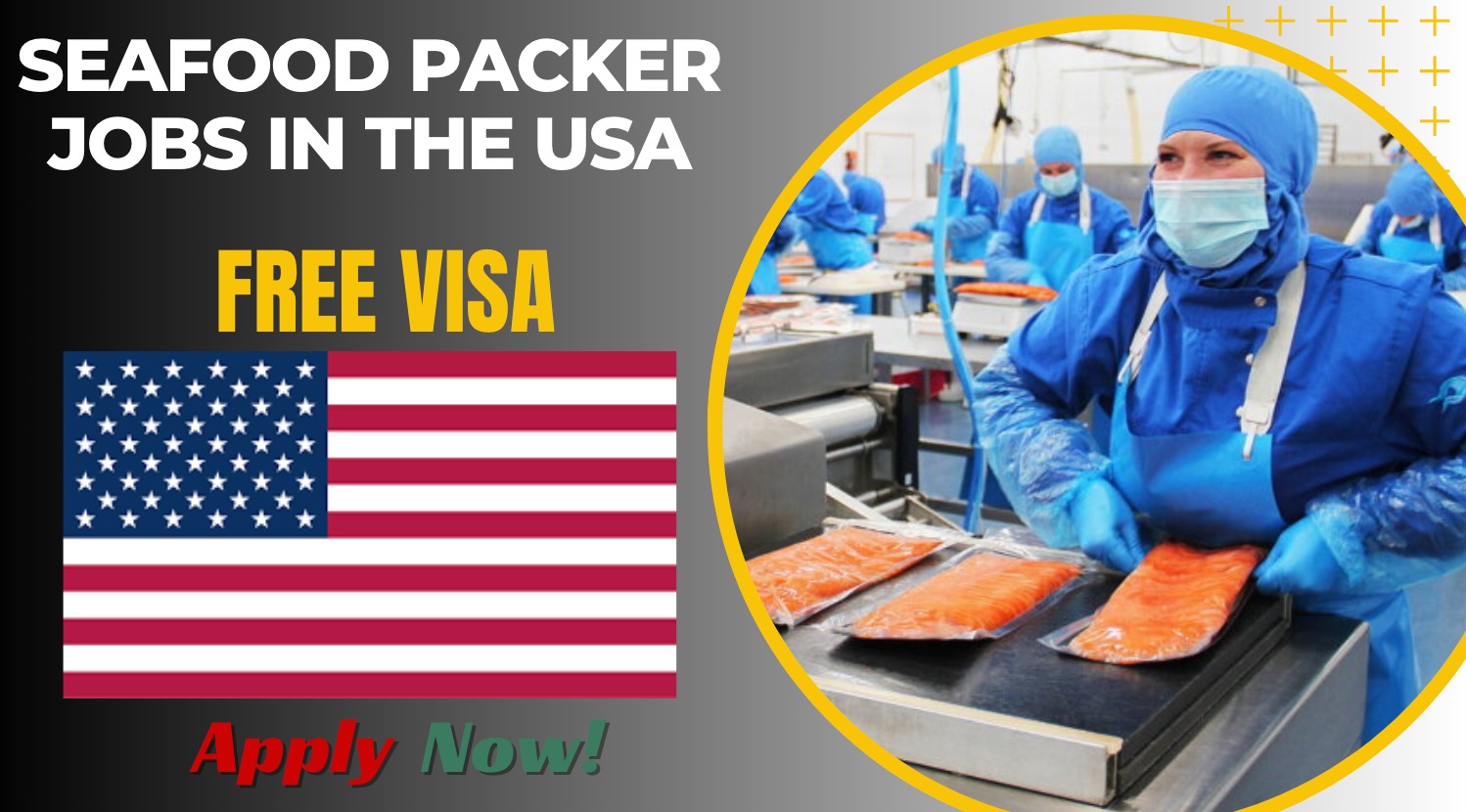
Table of Contents
What Does a Seafood Packer Do?
Seafood packing work takes place in processing plants located in coastal communities, particularly in Alaska, Louisiana, Mississippi, and other states with active fishing industries. You work on production lines where fresh or frozen fish, oysters, crab, and other seafood are transformed into finished products ready for distribution.
Your daily responsibilities would include handling and processing fish and seafood products efficiently, including gutting, cleaning, filleting, trimming, and boxing various seafood products . You inspect fish products to meet quality standards and separate them according to size and color that determines their destination within the plant .
In oyster processing operations, workers gently place oysters on shaking tables, open oyster shells and remove the meat, then pack, weigh, and label packages . If oysters remain in the shell, workers gently wash the outer shell to remove dirt, algae, or slime to avoid cross-contamination before packing .
You also pack and ice seafood, operate plant machinery, and may assist with forklift operation . Sorting, butchering, cleaning, cutting, and trimming various seafood products are all part of the job . After processing, you package the finished product efficiently and in accordance with customer specifications.
The work environment is unique. Processing plants are cold and wet, and you will be on your feet for extended periods. You must be comfortable working in a cold and wet environment and standing to perform work duties . The work can involve rotating shifts, including overnight shifts, with schedules like 6:00 AM to 2:00 PM, 2:00 PM to 10:00 PM, or 10:00 PM to 6:00 AM .
The physical demands are significant. You need to be able to stand for long hours, perform repetitive arm and hand movements, and lift heavy loads. Workers must be versatile and willing to perform a variety of tasks including gutting, cleaning, packing, and icing of seafood .
Salary Expectations
Let us talk about money. Seafood packer salaries in the USA vary based on location and the employer. However, the total compensation package often includes benefits that significantly increase your take-home savings.
According to real job postings, seafood processing positions pay between $18 and $23 per hour. A Temporary Seafood Plant Worker position at Dulac Oyster & Seafood in Houma, Louisiana pays $18.46 per hour under H-2B sponsorship . The job includes 40 hours per week on rotating shifts, with potential for overtime.
According to PERM visa data, Processors, Inc., a seafood processing company in Breaux Bridge, Louisiana, hired workers for Meat, Poultry, and Fish Cutters and Trimmers positions at an average salary of $23,492, and Packers and Packagers, Hand positions at $24,794 .
Beyond base pay, seafood processing positions come with substantial benefits that reduce your living costs. These typically include:
Visa fee reimbursement: H-2B workers are reimbursed in the first workweek for all visa processing, border crossing, and other related fees, including those mandated by the government (excluding passport fees) .
Transportation: Transportation for workers to the place of employment is provided, or its cost is reimbursed within the first week of arrival .
Housing: Daily transportation is provided to workers at no cost. Some employers also provide housing accommodations.
Meals: During travel, daily meals are paid at $15.88 per day to a maximum of $59.00 per day with receipts .
Tools and equipment: Tools, supplies, and equipment required to perform duties are provided to workers at no cost .
Return transportation: Upon completion of the work contract or when the worker is dismissed earlier, the employer pays for reasonable transportation and subsistence costs to return home .
The combination of base wage, free or low-cost housing, meals, and paid transportation means that workers can save a significant portion of their earnings. Many workers return home after the fishing season with substantial savings.
Visa Options for Seafood Packers
This is the most important section. Foreigners have one primary visa pathway for seafood packer positions, with additional options for those seeking permanent residency.
H-2B Visa: Temporary Non-Agricultural Work
The H-2B visa is the primary and most realistic pathway for seafood packers and processors . This visa allows US employers to hire foreign workers for temporary non-agricultural jobs when there are not enough local workers available.
The H-2B program is widely relied upon in sectors such as hospitality, construction, landscaping, recreation, and seafood processing, where seasonal or peak demand creates staffing shortages . Seafood processing is explicitly listed as one of the industries that regularly uses the H-2B visa program.
Why Seafood Processing is Special
The seafood industry has been advocating for special treatment under the H-2B program. The Save Our Seafood Act, proposed in the US Senate, would exempt fish processors from the annual visa cap entirely . The bill defines “processor” broadly to include anyone engaged in handling, storing, preparing, heading, eviscerating, shucking, freezing, changing into different market forms, manufacturing, preserving, packing, labeling, dockside unloading, holding, and all other processing activities .
The Commercial Fishing and Seafood Business Act of 2023 similarly proposes to exempt workers employed in processing fish or fishery products from the H-2B numerical limitations . While these bills are still pending, they demonstrate the recognized importance of foreign labor to the seafood industry.
Even without the proposed legislation, the Department of Homeland Security and Department of Labor have recognized the importance of the seafood industry by allocating supplemental H-2B visas specifically for seafood processing. In January 2026, the Trump administration released a temporary final rule authorizing 35,000 supplemental work visas for seasonal jobs primarily in landscaping, hospitality, and seafood processing . Shortly after, the government announced an additional 64,716 H-2B visas for fiscal year 2026, roughly doubling the annual cap of 66,000 visas .
Key Facts About the H-2B Visa
The H-2B program is capped at 66,000 visas per fiscal year, divided into two halves: 33,000 visas for jobs starting between October 1 and March 31, and 33,000 for jobs starting between April 1 and September 30 . When applications exceed available numbers, USCIS conducts a random selection (lottery) .
The visa is typically valid for up to one year, depending on the employer’s certified need. Extensions are possible in increments of up to one year, capped at three years. After three years, the worker must depart and remain outside the US for three consecutive months before applying again .
Employer Requirements
To sponsor H-2B workers, a US employer must demonstrate that its need for labor is temporary and falls into one of the recognized categories: seasonal, peak load, intermittent, or one-time occurrence . The employer must obtain a Temporary Labor Certification from the Department of Labor, which involves:
Providing evidence that there are not enough US workers who are able, willing, qualified, and available to perform the work
Showing that hiring foreign nationals will not negatively affect the wages and working conditions of similarly employed US workers
Carrying out required recruitment efforts in the US, including job postings through the State Workforce Agency
Worker Protections Under H-2B
H-2B workers are protected under federal labor standards, including wage, safety, and anti-discrimination laws . Key rights include:
Payment of at least the prevailing wage and the terms set out in the certified job order
Safe and healthy workplaces that meet Occupational Safety and Health Administration (OSHA) standards
Freedom from discrimination, harassment, and retaliation for reporting violations
Access to enforcement agencies such as the Department of Labor’s Wage and Hour Division to lodge complaints
Workers cannot be charged recruitment or placement fees. Employers must reimburse inbound travel and subsistence costs once a worker completes 50% of the job order and must cover outbound travel and subsistence if the worker completes the contract or is terminated early .
Real H-2B Seafood Packer Positions
A real example of an H-2B seafood packing position is the Temporary Seafood Plant Worker role at Dulac Oyster & Seafood in Houma, Louisiana. The employer requested 40 workers at $18.46 per hour . The job duties include:
Placing oysters on shaking tables and separating them according to size and color
Opening oyster shells and removing meat
Packing, weighing, and labeling packages
Washing oyster shells to remove dirt and algae before packing
Working rotating shifts (6:00 AM to 2:00 PM, 2:00 PM to 10:00 PM, or 10:00 PM to 6:00 AM)
The employer provides daily transportation to and from the plant at no cost, reimburses visa processing fees, and pays for return transportation upon completion of the contract .
EB-3 Visa: Permanent Residency Path
The EB-3 visa is another pathway for seafood packers seeking permanent residency in the USA. This is an employment-based immigrant visa that leads to a Green Card and eventual citizenship.
Why the EB-3 visa works for seafood packers is that the role falls under the “Other Workers” category. This category is for positions requiring less than two years of training or experience. Food processing, manufacturing, and packing roles qualify for this category. No college degree is required.
Real employers are using the EB-3 program for seafood processing positions. Processors, Inc. in Breaux Bridge, Louisiana has hired a total of 11 Perm Visa employees, with positions including Meat, Poultry, And Fish Cutters And Trimmers (9 employees) and Packers And Packagers, Hand (2 employees) . The average salary for these positions was $23,561 .
What the EB-3 visa offers is significant. You receive a ten-year Green Card for yourself. Your spouse and unmarried children under 21 can join you. Spouses can work independently. Children under 21 receive free public education. After five years as a Green Card holder, you can apply for US citizenship.
The EB-3 process involves several steps and takes time. First, you need a permanent, full-time job offer from a US employer willing to sponsor you. The employer must obtain a PERM labor certification from the Department of Labor, which involves testing the US labor market to prove no qualified American workers are available. This process can take 1 to 2 years.
Once the labor certification is approved, the employer files Form I-140 with USCIS. When your priority date becomes current under the Visa Bulletin, you complete consular processing at a US embassy in your home country. For the EB-3 Other Workers category, there is a backlog, so waiting periods apply depending on your country of origin.
The Reality Check
Here is an important truth. Many seafood packing positions advertised online require applicants to already have work authorization. The Indeed job listings show positions that require the ability to handle and process fish and seafood products, but most do not explicitly mention visa sponsorship .
This does not mean there are no opportunities. It means you need to focus your search on employers who specifically participate in the H-2B program for seasonal seafood processing work. The good news is that the US government has recognized the importance of the seafood industry by allocating supplemental H-2B visas specifically for seafood processing. The 2026 supplemental allocation of 35,000 visas included seafood processing as a priority industry , and the overall increase of 64,716 visas for fiscal year 2026 will benefit seafood processors .
Finding Seafood Packer Jobs with Sponsorship
Finding the right employer takes strategy. Here is practical advice based on real opportunities and industry knowledge.
Target H-2B Job Postings
Focus your search on job boards that list H-2B positions. The U.S. Department of Labor’s Seasonal Jobs website (seasonaljobs.dol.gov) is the official source for H-2B job postings. The Dulac Oyster & Seafood position was listed on this site .
El Portal Migrante is another specialized job board that lists verified H-2B positions, including seafood processing roles.
When searching, use specific keywords like:
“H-2B seafood packer jobs USA”
“Fish processor H2B visa”
“Seafood plant worker H2B sponsorship”
“Oyster shucker H2B jobs”
Target States with Strong Seafood Industries
Focus your search on states with significant seafood processing operations. Louisiana is a major seafood processing state, with the Dulac Oyster & Seafood plant in Houma and Processors, Inc. in Breaux Bridge . Alaska is another major seafood processing state, with the Alaska Job Center Network providing seafood employer resources . Other states with strong seafood industries include Maine, Mississippi, and Washington.
Use State Workforce Agency Resources
The Alaska Job Center Network provides seafood employer resources and can help connect workers with employers . They coordinate with the Foreign Labor Certification program to help recruit and refer workers to H-2B seafood processor job orders . Contact your target state’s workforce agency for assistance.
Prepare a Strong Application
When applying, make sure your resume highlights:
Any seafood processing or food production experience, even if informal
Physical ability to stand for extended periods and work in cold, wet environments
English proficiency
Willingness to work rotating shifts, including overnight shifts
Reliability and ability to work in a fast-paced environment
Your cover letter should demonstrate your work ethic, reliability, and willingness to complete the full contract period. Be honest about your visa sponsorship needs.
What to Watch Out For
Be cautious of job postings that ask you to pay money upfront for visa processing. Legitimate H-2B sponsors never ask workers to pay for visa filing fees. The employer bears the costs of the petition and related fees. H-2B workers are actually reimbursed for visa fees by the employer in the first workweek .
Be aware that the H-2B cap fills quickly. In fiscal year 2026, the government authorized supplemental visas, but demand remains high. Apply early and work with reputable employers.
Also be aware that some seafood processing positions explicitly state they do not offer sponsorship. Focus only on employers who specifically advertise H-2B positions or work with state workforce agencies.
Worker Rights and Protections
If you come to the USA as a seafood packer, understand your rights. All workers in America, regardless of immigration status, have legal protections under federal and state laws.
You have the right to be paid at least minimum wage. For hours worked beyond forty in a week, you must be paid overtime at one and a half times your regular rate.
You have the right to work in a safe and healthy environment. Your employer must provide safety training, necessary protective equipment, and follow OSHA standards.
If you work under the H-2B visa, your employer has additional obligations. They must reimburse you for visa processing fees in the first workweek . They must provide or pay for transportation to and from the worksite. They must guarantee to offer work for hours equal to at least three-fourths of the workdays in each 12-week period of the total employment period . Upon completion of the work contract, the employer pays for reasonable transportation and subsistence costs to return home .
Do not accept work on a tourist visa. Using a tourist visa to work is illegal and considered visa fraud. It can result in deportation and a ban from entering the USA in the future.
Step-by-Step Action Plan
If you are serious about pursuing a seafood packer job in the USA with sponsorship, here is a practical roadmap.
Step One: Determine Your Visa Pathway
The H-2B visa is your best option for temporary seasonal work. Real H-2B seafood packing positions are currently available or have been recently posted in Louisiana . If you are seeking permanent residency, the EB-3 visa is available, with companies like Processors, Inc. having sponsored workers .
Step Two: Gather Your Documents
Prepare your documents in advance. You need a valid passport with at least 12 months validity. If you have any seafood processing or food production experience, gather reference letters. Obtain a police clearance certificate. Prepare for a physical examination and TB test.
Step Three: Get Experience if Possible
While many H-2B positions do not require experience, having it makes you a stronger candidate. The Dulac Oyster & Seafood position requires 3 months of work-related experience . Any experience with food processing, manufacturing, or physical labor is valuable.
Step Four: Research Employers
Focus on H-2B job postings on the Department of Labor’s Seasonal Jobs website. Target seafood processing companies in Louisiana, Alaska, and other coastal states. Research companies like Processors, Inc. for EB-3 opportunities .
Step Five: Prepare Your Application
Make sure your resume clearly highlights any seafood processing or food production experience, your physical ability, your English proficiency, and your reliability. Your cover letter should demonstrate your work ethic and willingness to work rotating shifts.
Step Six: Apply Through Official Channels
Submit your applications directly through employer websites or job portals. For the Dulac Oyster & Seafood position, applications were accepted by phone at +19855184367 or email at dulacoysterplant@gmail.com . For EB-3 positions, apply through employer career pages.
Step Seven: Consult an Immigration Attorney
This is strongly recommended. Immigration law is complex, and mistakes can delay or derail your application. A qualified attorney can help you find legitimate employers, ensure your paperwork is correct, and guide you through the H-2B or EB-3 process.
Step Eight: Be Patient and Apply Early
The H-2B process takes several months from application to travel, and the cap fills quickly. The 2026 supplemental visas were announced in January 2026 , so applying early is essential. Do not quit your current job or make major life changes until you have your visa approved.
Final Thoughts
Seafood Packer Jobs in the USA for Foreigners: Seafood packer jobs in the USA with visa sponsorship are real opportunities for foreigners willing to work hard in challenging conditions. The H-2B visa provides a clear, well-established pathway for temporary seasonal work, with real positions currently available in Louisiana at $18.46 per hour plus visa fee reimbursement, transportation, and other benefits . The EB-3 visa offers a permanent path to a Green Card, with companies like Processors, Inc. having sponsored workers for fish cutter and packer positions .
The seafood processing industry in America relies on foreign labor, particularly in remote coastal communities where local workers are scarce. The US government has recognized this by allocating supplemental H-2B visas specifically for seafood processing in fiscal year 2026 . The proposed Save Our Seafood Act would exempt fish processors from the visa cap entirely, demonstrating the recognized importance of foreign workers to the industry .
Start by getting any seafood processing or food production experience you can, gathering your documents, and researching H-2B job postings on the Department of Labor’s Seasonal Jobs website. Target seafood processing companies in Louisiana, Alaska, and other coastal states. For those seeking permanent residency, explore EB-3 sponsorship through companies like Processors, Inc. Consult with an immigration attorney to understand your options.
The road requires patience. The H-2B process takes months, and the EB-3 process takes years. But for those who are willing to work hard, follow the legal process, and handle the physical demands of the job, the opportunity to build a new life in America through seafood packing work is within reach.
Disclaimer
This job information is shared for educational and informational purposes only.
Any discussion of visa categories is based on general immigration laws and publicly available information