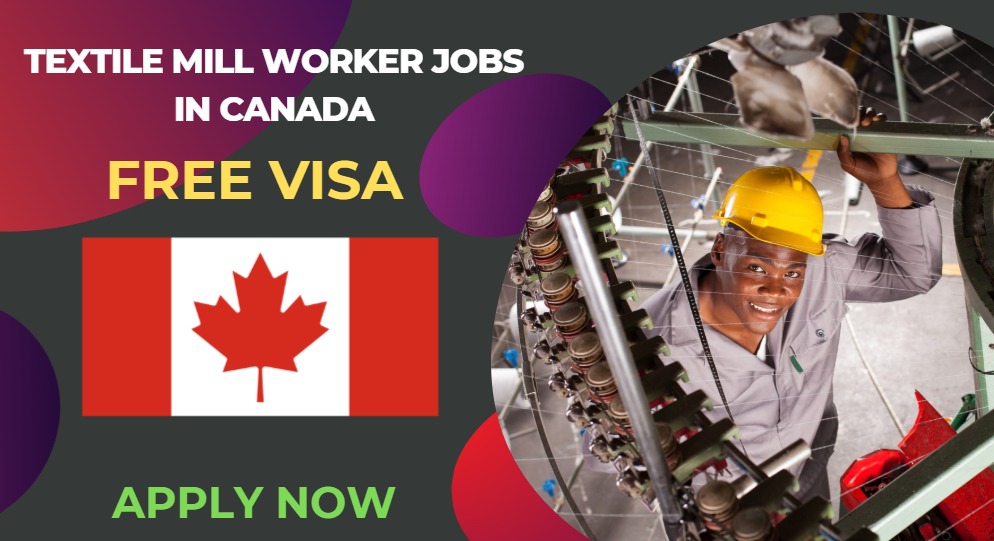
Textile Mill Worker Jobs in Canada: While the clatter of looms once defined the industrial landscapes of cities like Montreal and Toronto, the Canadian textile industry has undergone a massive transformation. Today, it is a sector driven by specialization, automation, and high-quality niche production.
For job seekers—including newcomers and skilled tradespeople—textile mill work in Canada offers stable employment with specific physical demands and technical requirements. Here is what you need to know about working in Canada’s textile processing and manufacturing industry in 2026.
Table of Contents
Textile Mill Worker Jobs in Canada
What Textile Mill Workers Actually Do
The term “textile mill worker” covers a range of occupations, from entry-level labourers to skilled machine operators. According to the National Occupational Classification (NOC) system, these roles generally fall under two categories.
Labourers in Textile Processing (NOC 95105.01) are the backbone of the daily operations. Their duties are primarily manual and support-based. They load and off-load machines, push carts of fibers between work areas, clean textile machinery, and assist machine operators as required . This role requires significant stamina and static strength, as workers consistently perform repetitive tasks and handle heavy materials like fabric rolls .
Machine Operators (often NOC 94131) handle the technical side. These workers set up looms or processing machines, operate batteries of knitting machines to produce fabric or garments, and patrol machines to check for defects. Unlike general labourers, operators are expected to investigate machine stoppages and repair minor mechanical problems, such as broken needles .
Current Wages and Earning Potential
Wages for textile work vary significantly based on skill level, province, and specific duties.
General Labourers: Entry-level positions or general manufacturing labourers in textile companies typically start around $18.00 per hour .
Skilled Operators: Experienced machine operators earn a premium. For example, job postings for Machine Operators in Quebec list wages ranging from 23.89to35.01 per hour, depending on experience and the complexity of the machinery .
Regional Variance: Looking specifically at weavers, knitters, and other fabric makers (NOC 94131), the median wage in Canada is $19.26 per hour. However, rates vary by province:
Quebec: Low 16.25∣Median∗∗21.00** | High $27.00
Ontario: Low 17.60∣Median∗∗19.18** | High $24.07
Key Skills and Physical Demands
This is not a desk job. Success in a textile mill requires a specific set of physical attributes and soft skills.
Physical Stamina: Workers spend the majority of their shift standing, walking, and making repetitive motions. Many roles require bending, crouching, and handling loads of up to 13.5 kg (30 lbs) or more .
Mechanical Knowledge: For operators, understanding fibre properties (cotton, synthetic, blends), spinning techniques, and weaving methods is crucial .
Attention to Detail: Quality control is a major aspect of the job. Workers must constantly examine products for defects, check for colour consistency, and ensure adherence to quality standards .
Team Collaboration: Mills are loud, fast-paced environments where labourers and operators must work closely to ensure efficient operation .
The Job Market and Immigration Landscape
The Canadian textile industry is currently in a period of slow but steady transition. According to the Canadian Occupational Projection System (COPS) , employment in the textile, clothing, and furniture sector is projected to increase by only 0.1% annually between 2024 and 2033 .
While growth is stagnant, the industry is facing a wave of retirements and a shift toward automation. The industry is heavily concentrated in Ontario (39%) and Quebec (36%) .
For Immigrants: Textile manufacturing is a viable path for foreign workers. Many employers are actively utilizing the Labour Market Impact Assessment (LMIA) process to hire internationally, specifically for roles categorized as Machine Operators. These job postings often indicate that the employer is ready to support a work permit application .
How to Secure a Job in a Canadian Textile Mill
If you are looking to enter this field, strategy matters.
Target the Right Provinces: Focus your job search on Ontario and Quebec, where the majority of production facilities are located .
Look for LMIA Postings: If you require a work permit, look specifically for job ads that mention “LMIA” or “Employer willing to obtain a Labour Market Impact Assessment.” Companies like Fempro Consumer Products and Beaulieu Canada are examples of firms using this pathway .
Leverage Government Resources: Use the Job Bank (jobbank.gc.ca) to find wages and local job fairs. Immigrant-serving organizations also offer resume workshops tailored to Canadian manufacturing standards .
Prepare for the Environment: Be honest about your physical capabilities in your interview. Mentioning your ability to handle heavy loads, stand for long periods, and work in a noisy environment will signal that you understand the reality of the role .
Conclusion
Textile mill worker jobs in Canada are not for everyone; they require physical resilience and mechanical aptitude. However, for those seeking stable, permanent employment with benefits, they offer a reliable pathway.
With median wages reaching over $27 per hour for specialized roles and strong employer support for immigration in regions like Quebec, the Canadian textile industry remains a robust, if niche, pillar of the manufacturing economy.
Disclaimer
This job information is shared for educational and informational purposes only. Any discussion of visa categories is based on general immigration laws and publicly available information.





Job, visa, salary, deadline and eligibility details can change. Check the employer or relevant government/official source before applying, paying money or making travel arrangements.
If you spot an outdated or inaccurate detail, please contact us with the article URL.