Dairy Farm Jobs in Ireland: Ireland is known as the “Emerald Isle” for a reason — its lush, green pastures are home to over 1.5 million dairy cows, producing some of the world‘s finest milk and dairy products. The Irish dairy industry is booming, but there’s a critical problem: not enough workers. With a growing labour shortage and a government that has created dedicated work permit quotas for dairy assistants, Ireland is actively recruiting farm workers from abroad.
Table of Contents
Dairy Farm Jobs in Ireland
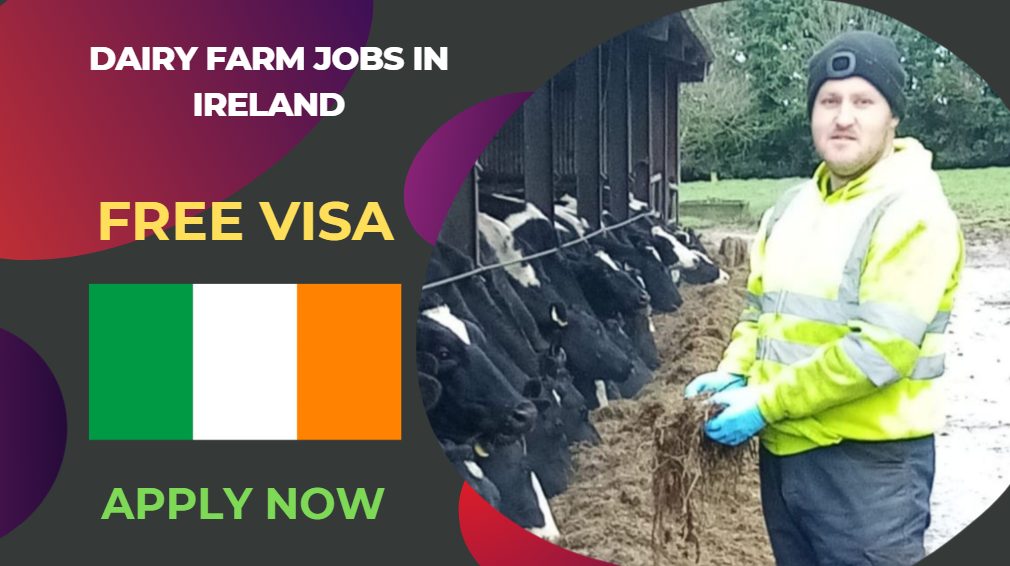
For international applicants, dairy farm jobs offer a unique opportunity: competitive pay (€34,000–€44,000+ per year), free or subsidised accommodation, employer-sponsored work permits, and the chance to live and work in the Irish countryside. This guide covers everything: what dairy farm workers do, salary expectations, the work permit system with its specific quotas, language requirements, and exactly how to land a dairy farm job with a legal work permit.
What Is a Dairy Farm Worker in Ireland?
A dairy farm worker (also called a dairy farm assistant) helps with the daily operation of a dairy farm. You work outdoors and in barns, caring for cows, milking, feeding, and maintaining the farm. Unlike seasonal crop work, dairy farming is year-round, 365 days a year — cows need to be milked every single day, regardless of weather or holidays.
Common job titles:
Dairy Farm Assistant
Dairy Herdsperson
Farm Labourer (Dairy)
Milking Technician
Dairy Farm Operative
What you are NOT: A farm manager (requires experience), a veterinarian, or a seasonal crop picker. Dairy farm work is consistent, physical, and requires dedication.
The golden rule of dairy farming in Ireland: “The cows come first.” Milking happens twice a day, every day — rain or shine, Christmas or Easter. Reliability is the most important trait in a dairy worker.
Core Duties: What Dairy Farm Workers Actually Do
Dairy farm work is varied, physical, and outdoors in all weather conditions. No two days are exactly the same.
Typical Responsibilities:
| Task | Frequency | Details |
|---|---|---|
| Milking | Twice daily (early morning and evening) | Operating milking machinery, attaching and removing milking units, monitoring cow health during milking |
| Feeding | Daily | Mixing and distributing feed, checking water troughs, ensuring proper nutrition |
| Cleaning | Daily | Washing milking parlour, scraping yards, cleaning cubicles |
| Calf care | During calving season (spring) | Feeding calves, monitoring health, assisting with births |
| Animal health | Daily | Checking for signs of illness, treating minor ailments, assisting veterinarian |
| Grassland management | Spring to autumn | Moving cows to fresh paddocks, monitoring grass growth |
| Fencing & maintenance | Weekly | Checking and repairing fences, maintaining farm machinery |
| Record keeping | Daily | Logging milk yields, health treatments, breeding data |
Real job examples from current listings:
| Location | Pay | Hours | Duties |
|---|---|---|---|
| Fitzgerald Family Farm, Cork | €36,605/year | 39 hours/week | Milking, cleaning, AI, grassland management, animal husbandry |
| Tipperary dairy farm | €34,000/year | 39 hours/week | Milking, animal husbandry, farm maintenance, machinery operation |
| Riverville Dairy, Galway | €34,000/year | Not specified | All dairy farm duties, including AI, grassland management |
| Aidan Finn DAC, Longford | €34,000/year | 40 hours/week | Milking, cleaning, AI, grassland management, machinery operation |
A Typical Day on a Dairy Farm:
| Time | Activity |
|---|---|
| 5:30 AM | Wake up |
| 6:00 AM – 8:30 AM | Morning milking |
| 8:30 AM – 9:00 AM | Breakfast |
| 9:00 AM – 11:00 AM | Feeding, cleaning, scraping yards |
| 11:00 AM – 12:00 PM | Calf feeding, health checks |
| 12:00 PM – 1:00 PM | Lunch |
| 1:00 PM – 4:00 PM | Grassland management, fencing, machinery maintenance |
| 4:00 PM – 6:00 PM | Evening milking |
| 6:00 PM – 7:00 PM | Final checks, cleaning, records |
| 7:00 PM | Dinner, rest |
Why Ireland Needs Foreign Dairy Farm Workers (Market Demand)
Ireland‘s dairy sector is facing a serious labour shortage. After EU milk quotas were abolished in 2015, the industry expanded rapidly — but the workforce didn‘t keep pace.
Hard data (2026):
| Indicator | Statistic |
|---|---|
| Dairy work permit quota (2025) | 350 initial, increased to 850 |
| Meat processing quota | 1,000+ |
| Minimum salary for dairy assistants | €34,000/year |
| Salary increase for 2026 | €36,605/year for Cork farm |
| Employment permit fee (General) | €1,000 for permits over 6 months |
Work permit quota updates:
In December 2025, the quota for dairy farm assistants (350 permits) was exhausted, along with the meat processing quota (1,000 permits) . The Department responded by increasing the dairy quota to 850 and the meat quota by another 1,000, available immediately .
Why this matters for you: The Irish government recognises the labour shortage and has increased the quota. This means more opportunities for non-EU workers to get work permits for dairy roles.
What the industry says: According to the Irish Farmers Journal, the entire agri-food sector is facing a labour challenge. Labour issues are now the third biggest concern for food exporters, behind only the cost of labour itself — ranking higher than tariffs, regulations, and supply chain disruption .
Pay Rates for Dairy Farm Workers in Ireland (2026)
Dairy farm pay is competitive, with accommodation often provided or subsidised.
Salary Overview:
| Role | Annual Salary (€) | Hourly Equivalent (€) | Weekly Hours |
|---|---|---|---|
| Dairy Farm Assistant (minimum) | €34,000 | €16.77 | 39 hours |
| Dairy Farm Assistant (Cork, 2026) | €36,605 | Not specified | 39 hours |
| Salary range (general) | €28,000 – €44,000 | Varies | Varies |
| Lakeland Dairies Graduate Programme | Competitive | Market rate | Full-time |
Real-world examples:
| Farm/Employer | Location | Salary (€/year) | Hours/Week | Accommodation | Source |
|---|---|---|---|---|---|
| Tipperary dairy farm | Cashel, Co Tipperary | 34,000 | 39 | Provided if needed | |
| Waterford dairy farm | Stradbally, Co Waterford | 34,000 | 39 | Not specified | |
| Fitzgerald Family Farm | Kildinan, Co Cork | 36,605 | 39 | Not specified | |
| Aidan Finn DAC | Ballymahon, Co Longford | 34,000 | 40 | Not specified |
Additional Benefits (Common):
| Benefit | Typical Value | Notes |
|---|---|---|
| Accommodation | Free or subsidised | Many farms provide housing |
| Training | Free | Full training provided, previous experience not essential |
| Career progression | Opportunities to advance | Cork farm offers “opportunities to progress their career” |
| Annual leave | 4 weeks/year | Legal minimum |
| Public holidays | 10 days/year | Additional pay if worked |
| Employer pension | Sometimes | Larger farms and co-ops may offer |
Realistic Monthly Savings (with free accommodation):
| Expense | Cost (€) | Notes |
|---|---|---|
| Rent (free accommodation) | 0 | Many farms provide |
| Food | 200 – 350 | |
| Transport | 50 – 150 | Rural, may need a car |
| Mobile | 20 – 40 | |
| Leisure | 100 – 200 | |
| Total expenses | 370 – 740 | |
| Monthly net (€34,000/year) | 2,500 – 2,700 | After tax |
| Monthly savings | 1,700 – 2,300+ | Excellent |
Takeaway: A dairy farm worker earning €34,000–€36,600/year with free accommodation can save €1,700–€2,300+ per month — one of the best savings opportunities among entry‑level jobs in Europe.
Work Visas & Permits for Dairy Farm Workers (Critical Section)
This is the #1 question for international applicants. Ireland has a dedicated quota system for dairy farm workers.
For EU/EEA/Swiss Citizens (Polish, Romanian, French, German, Spanish, etc.):
| Requirement | Status |
|---|---|
| Visa needed? | ❌ No |
| Work permit needed? | ❌ No |
| Registration required? | ✅ Yes – PPSN (Personal Public Service Number) and address registration |
How to work as an EU citizen: Travel to Ireland → apply to dairy farms → register for PPSN → start work. No sponsorship required.
For Non‑EU Citizens – General Employment Permit (GEP) with Dairy Quota
The General Employment Permit is the primary pathway for non‑EU dairy farm workers. Ireland has a specific quota for dairy farm assistants.
| Feature | Details | Source |
|---|---|---|
| Dairy quota (2026) | 850 permits | |
| Previous quota | 350 (exhausted Dec 2025) | |
| Minimum salary | €34,000/year (€36,605 from March 2026) | |
| Labour Market Test | Required — employer must advertise for 28 days | |
| Employment permit fee | €1,000 for permits over 6 months | |
| Permit duration | 2 years (initial), renewable | |
| Processing time | 4–8 weeks | |
| Pathway to long-term residence | Yes — after 5 years of legal residence |
The “Stamp” System Explained :
| Stamp Type | Who It‘s For | Work Rights | Source |
|---|---|---|---|
| Stamp 1 | Work permit holders (General & Critical Skills) | Full-time work with sponsoring employer | |
| Stamp 2 | Non‑EU students | 20 hours/week during term; full‑time during holidays | |
| Stamp 3 | Dependents of permit holders, volunteers | No work rights | |
| Stamp 4 | Long‑term residents (after 5 years) | Full work rights, no permit needed |
Employers must be careful: Hiring a worker on a Stamp 2 visa for full‑time farm work is illegal and can result in prosecution or fines .
The Quota System – How It Works
Ireland has set a specific quota for General Employment Permits for dairy farm assistants.
| Year | Initial Quota | Additional | Total |
|---|---|---|---|
| 2025 | 350 | 500 (added Dec 2025) | 850 |
| 2026 | 850 (available from January) | TBC | – |
The process:
Employer applies for a work permit under the dairy quota. They must prove that no suitable Irish or EU citizen was available (Labour Market Test) .
If approved, you receive a Stamp 1 work permit .
You apply for a long‑stay D‑Type visa at the Irish embassy in your home country.
After visa approval, travel to Ireland, register your address, and obtain your PPSN (tax number).
You can work only for the employer named on your permit .
Important note: The dairy quota was exhausted in December 2025, but the government increased it to 850 . Apply early — the quota may fill again quickly.
Language Requirements
Short answer: Good spoken English is required for dairy farm work.
What the job ads say:
| Position | English Requirement | Source |
|---|---|---|
| Tipperary dairy farm assistant | “must have experience” — English implied | |
| Waterford dairy farm assistant | “full training will be provided” — English necessary | |
| General agriculture jobs | “need to speak English to be able to receive instructions and communicate” |
English for Dairy Farming – Essential Vocabulary:
| English | Context |
|---|---|
| Milking parlour | Building where cows are milked |
| Teat / Udder | Parts of the cow involved in milking |
| Mastitis | Common udder infection |
| Calving | Giving birth to a calf |
| Silage | Fermented grass used as animal feed |
| Paddock | Field for grazing |
| Cubicule | Individual cow stall |
| Slurry | Liquid manure |
| AI (Artificial Insemination) | Breeding technique |
| Trough | Water container |
Recommendation: B1–B2 English is sufficient. No formal English test is required for the General Employment Permit, but you must demonstrate your ability to communicate during the interview process.
How to Find Dairy Farm Jobs with Work Permit Sponsorship (Actionable Steps)
Step 1: Determine Your Pathway
| Your Situation | Recommended Pathway |
|---|---|
| EU/EEA citizen | Travel freely, apply directly to farms |
| Non‑EU citizen | General Employment Permit (dairy quota) |
| Student in Ireland (Stamp 2) | Cannot work full‑time on a farm; you risk violating your visa |
| Dependent of permit holder (Stamp 3) | No work rights |
Step 2: Target Active Job Postings
Current vacancies (2026):
| Position | Location | Pay | Contact | Source |
|---|---|---|---|---|
| Dairy farm assistant | Cashel, Co Tipperary | €34,000+ | newfarmjobs@gmail.com | |
| Dairy farm assistant | Cork (Fitzgerald Family Farm) | €36,605 | via CareersPortal | |
| Dairy farm assistant | Longford (Aidan Finn DAC) | €34,000 | via CareersPortal | |
| Dairy farm assistant | Galway (Riverville Dairy) | Not specified | via CareersPortal |
Step 3: Apply to Farms Directly
Email template for job applications:
Subject: Dairy Farm Assistant Application – [Your Name]
Dear Hiring Manager,
I am writing to apply for the dairy farm assistant position at your farm. I have [X] years of experience with [dairy cows/calving/milking] or am willing to learn. I am physically fit, reliable, and available for early morning and weekend work.
I speak English [fluently/well]. I hold a valid work permit for Ireland ([EU passport / open to employer sponsorship]).
My CV is attached. I am available for an interview at your convenience.
Thank you for your consideration.
Step 4: Prepare Your Application Documents
Essential for job applications:
CV (Irish‑style, with photo)
Cover letter (in English)
Proof of any previous farm experience (if available)
For visa application (after job offer):
| Document | Notes |
|---|---|
| Valid passport | 12 months validity |
| Employment contract | Signed by employer |
| Work permit approval | Employer applies |
| Visa application form | From Irish embassy |
| Medical certificate | Fitness for work |
| Police clearance certificate | From your home country |
| Proof of accommodation | Often provided by employer |
Step 5: Understand the Employer‘s Role
Your employer must:
Prove they tried to hire locally (Labour Market Test) — advertising for 28 days
Apply for the work permit under the dairy quota
Pay the €1,000 fee for permits over 6 months
Ensure you have suitable accommodation
Comply with all employment laws
You cannot apply for the work permit yourself. The employer initiates the process.
Step 6: Wait for Work Permit Approval
Processing time: 4–8 weeks . Check the official Employment Permits Online System (EPOS) for status updates.
Step 7: Apply for Entry Visa (If Required)
If you are from a visa‑required country, apply for a long‑stay D‑Type visa at the Irish embassy in your home country.
Visa fees :
| Visa Type | Fee (€) |
|---|---|
| Single entry | 60 |
| Multiple entry | 100 |
Step 8: Travel to Ireland and Register
After visa approval:
Travel to Ireland
Register your address
Apply for PPSN (Personal Public Service Number)
Register with immigration to receive your Irish Residence Permit (IRP)
Start working
Living on a Dairy Farm: What to Expect
Accommodation:
| Feature | Typical |
|---|---|
| Cost | Free or subsidised |
| Type | House or apartment on the farm |
| Location | Rural, may require a car |
| Utilities | Often included |
Working Conditions:
| Factor | Reality |
|---|---|
| Environment | Outdoors and in barns; can be cold, wet, muddy |
| Physical demands | High – lifting, standing, walking |
| Hours | Early starts (5:30–6:00 AM) |
| Weekends | Yes — cows need milking 7 days/week |
| Holidays | Milking still happens — shifts are rotated |
| Safety | PPE often provided (boots, gloves) |
The Irish Farm Culture:
Punctuality is critical — cows must be milked on schedule
Teamwork — you work closely with the farm owner and other staff
Respect for animals — cow welfare is a priority
Community — farming communities in Ireland are welcoming
Weather — Ireland is rainy; you will work in wet conditions
Pros and Cons:
| Pros | Cons |
|---|---|
| Employer-sponsored work permit (dairy quota) | Labour Market Test required |
| Competitive pay (€34,000–€44,000/year) | Physical and outdoor work (rain, mud, cold) |
| Free accommodation (save €1,000+/month) | Early starts (5:30 AM) |
| Paid annual leave (4 weeks) | Weekend and holiday work (cows need milking) |
| Pathway to long‑term residence (Stamp 4 after 5 years) | Isolation (rural locations) |
| No formal qualifications needed | English required |
| EU work experience | Quota limited (850 permits) |
| Skills training provided | Visa processing takes time |
Career Progression (From Dairy Farm Assistant to Manager)
| Timeframe | Role | Pay (€/year) | Qualifications |
|---|---|---|---|
| 0–2 years | Dairy Farm Assistant | 34,000 – 37,000 | On‑the‑job training |
| 2–4 years | Experienced Herdsperson | 38,000 – 42,000 | Experience |
| 3–5 years | Herd Manager / Team Leader | 42,000 – 48,000 | Leadership training |
| 5+ years | Farm Manager | 48,000 – 60,000+ | Experience + management skills |
| Lakeland Dairies Graduate Programme | Graduate rotational programme | Competitive | Food Science, Engineering, Supply Chain, IT, Sales & Marketing |
Pro tip: The Lakeland Dairies Graduate Programme is a great path for qualified graduates. The two‑year rotational programme gives you exposure to different areas of the business, from operations to supply chain to sales .
Legal Traps for Dairy Farm Applicants (Critical)
Red Flags (Walk away immediately):
| Red Flag | Why It‘s a Problem |
|---|---|
| “Pay us €5,000 for visa sponsorship” | Illegal. Legitimate Irish employers do not charge for sponsorship. |
| “We will sponsor you without a job offer” | Impossible. A concrete job offer is mandatory. |
| “No contract – we pay cash” | Illegal. No legal protections, no proof of employment. |
| “You don’t need a work permit” | Untrue. Non‑EU citizens require a valid employment permit . |
| “Stamp 2 visa is fine for full‑time work” | Illegal. Stamp 2 allows only 20 hours/week during term . |
Your Legal Rights as a Dairy Farm Worker in Ireland:
| Right | Details |
|---|---|
| Minimum wage | €34,000/year for dairy assistants (€36,605 from March 2026) |
| Maximum working hours | 48 hours/week average (over 4 months) |
| Paid annual leave | 4 weeks/year (20 days) |
| Paid public holidays | 10 days/year — if you work, you get extra pay or day in lieu |
| Sick leave | Statutory sick pay (up to 3 days/year initially, increasing) |
| Employment contract | Must be in writing within 5 days of starting work |
| Safe workplace | Employer must provide health and safety training |
| Accommodation standards | Employer must provide suitable housing if offered |
What to Do If You Are Exploited:
Workplace Relations Commission (WRC): Handles employment complaints
Health and Safety Authority (HSA): For safety violations
Citizens Information Centre (CIC): Free advice for workers
Your embassy
How to Start Today (Checklist)
If you are an EU/EEA citizen (Polish, Romanian, French, Spanish, etc.):
Get your passport
Book flight to Dublin, Cork, or Shannon
Apply to dairy farms directly (use Farmers Journal job listings)
Register for PPSN (Personal Public Service Number)
Open a bank account (for salary)
Start working within 1–2 weeks
If you are a non‑EU citizen seeking sponsorship:
Research current dairy farm vacancies (Irish Farmers Journal, CareersPortal)
Prepare your CV (in English)
Apply to farms actively hiring
Secure a job offer
Employer applies for work permit under the dairy quota
Wait for permit approval (4–8 weeks)
Apply for long‑stay D‑Type visa at Irish embassy
Wait for visa approval (4–6 weeks)
Book flight to Ireland
Register address, obtain PPSN
Start working — enjoy the Irish countryside
If you are a graduate (degree required):
Explore the Lakeland Dairies Graduate Programme
Specialisations: Food Science, Engineering, Supply Chain, Sales & Marketing, IT
Apply directly through Lakeland Dairies careers page
If you are already in Ireland on a Stamp 2 visa (student):
You cannot work full‑time on a farm
Maximum 20 hours/week during term
Full‑time only during holidays
Violating your visa can lead to deportation
Final Verdict: Is Dairy Farm Work in Ireland Worth It for Non‑EU Applicants?
Yes – for physically fit, reliable individuals with good English and a sponsoring employer. Ireland offers a dedicated work permit quota (850 permits), competitive pay (€34,000–€44,000/year), free accommodation, and a clear route to long‑term residence.
If you are:
A non‑EU citizen with a valid passport and good English
An EU citizen looking for immediate work (no visa needed)
Someone who is physically fit, loves the outdoors, and doesn‘t mind early mornings
Looking for employer‑sponsored work permit and free accommodation
Interested in EU work experience and a pathway to Irish residency
Wanting to save €1,700–€2,300+ per month
…then dairy farm work in Ireland is one of the best agricultural opportunities in Europe.
If you are:
Seeking visa sponsorship without a genuine job offer (impossible)
Unwilling to work outdoors in Irish weather (rain is common)
Looking for city life (farms are rural)
Unable to work weekends or early mornings
…then dairy farm work may not be for you.
One final truth: Dairy farming is not for everyone. You will wake up at 5:30 AM, work in the rain, and get muddy. Some days it will be exhausting. But you will also have a legal job in the EU, a roof over your head at no cost, and a pathway to permanent residency. The cows don‘t care about the weather — they need to be milked every day. And the farms of Ireland are waiting for you. Ádh mór! (Good luck!)
Disclaimer
This job information is shared for educational and informational purposes only. Any discussion of visa categories is based on general immigration laws and publicly available information.





Job, visa, salary, deadline and eligibility details can change. Check the employer or relevant government/official source before applying, paying money or making travel arrangements.
If you spot an outdated or inaccurate detail, please contact us with the article URL.