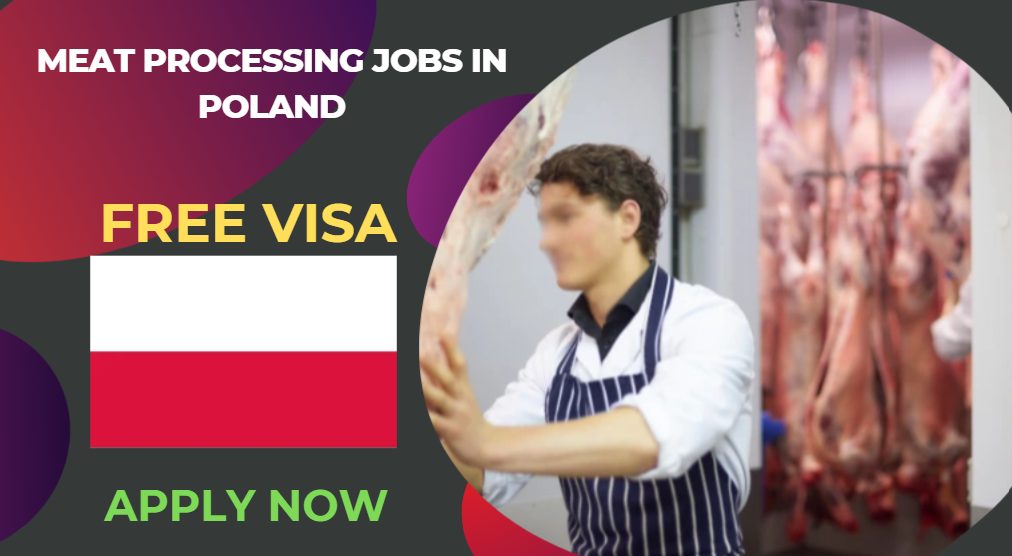
Meat Processing Jobs in Poland: Poland is one of Europe’s largest meat producers, supplying pork, poultry, and beef to markets across the continent. The Polish meat industry is a powerhouse—and it is facing a critical labour shortage. For international workers, meat processing jobs offer a stable, legal pathway to work in the European Union, with employer-sponsored work permits, competitive pay, and often free accommodation.
Table of Contents
Meat Processing Jobs in Poland
This comprehensive guide covers everything: what meat processing workers do, pay rates (PLN 31–40+ per hour, PLN 3,600–7,500+ monthly), how the work permit system works, language requirements, and exactly how to land a meat processing job with a legal work permit.
What Are Meat Processing Jobs in Poland?
A meat processing worker (pracownik produkcji mięsnej) is responsible for cutting, trimming, packing, and preparing meat products on a production line. You work in a modern processing facility, ensuring that products meet European safety and quality standards.
Common job titles:
Production Worker (Meat Processing)
Meat Cutter / Trimmer
Poultry Processor
Packaging Line Operator
Slaughterhouse Worker
Food Processing Operative
What you are NOT: A butcher (skilled trade) or a quality control specialist. These are entry-level to semi-skilled production roles focused on physical tasks and machine operation.
The golden rule of meat processing work: “Hygiena to podstawa” (Hygiene is the foundation). Food safety is paramount. Strict sanitation protocols must be followed at all times.
Core Duties: What Meat Processing Workers Actually Do
The work varies by product (pork, poultry, beef), but core responsibilities are consistent across most facilities.
Real-world example from Sokołów Podlaski :
| Task | Details |
|---|---|
| Meat processing (pork) | Trimming and cleaning meat from tendons |
| Processing into finished products | Preparing meat for packaging |
| Packing | Working at automated packaging lines |
| Disassembly | Working at lines with raw products |
| Loading goods onto pallets | Physical stacking of finished products |
| Automated line control | Monitoring production line operations |
Real-world example from Plukon Food Group (poultry) :
| Task | Details |
|---|---|
| Portioning | Cutting poultry into specified portions |
| Packaging | Packing finished products |
| Foil wrapping | Operating wrapping machines |
| Stacking | Loading packed products onto pallets |
| Selecting poultry parts | Quality sorting on the line |
Work environment:
Cold temperatures: +5°C to +7°C in processing areas
Cold storage: Below freezing for frozen products
Wet conditions: Frequent cleaning and sanitation
Fast-paced: Production line targets
A Typical Day (12-hour shift, Sokołów Podlaski) :
| Shift | Hours |
|---|---|
| First shift | 06:00 – 18:00 |
| Second shift | 18:00 – 06:00 |
Work is 5-6 days per week
Paid breaks included
Work within 3-5 days after arrival
Why Poland Needs Foreign Meat Processing Workers (Market Demand)
Poland’s meat industry is facing a critical labour shortage. The country has a shrinking workforce, and meat processing plants are struggling to fill positions.
Key indicators:
| Indicator | 2026 Status |
|---|---|
| Labour market | No oversupply in any profession |
| Deficit professions | Production workers, line operators |
| Foreign workers in Poland | Over 1 million |
| Key hiring sectors | Food processing, manufacturing, logistics |
| Recruitment channels | Hiring from India, Nepal, Philippines |
What the industry says: The Polish meat industry is facing “braki kadrowe” (staff shortages) that are “najbardziej niedocenianych zagrożeń” (among the most underestimated threats) . High turnover and reliance on foreign workers increase operational risk.
The result: Employers are desperate for reliable workers. Many are offering:
Employer-sponsored work permits
Free or subsidised accommodation
Overtime and shift bonuses
Paid training
Pay Rates for Meat Processing Workers in Poland (2026)
Pay varies by employer, shift, and experience. Meat processing jobs typically pay above the minimum wage, with significant bonuses for night and weekend work.
Real-world examples:
| Employer | Pay Rate | Monthly Gross | Source |
|---|---|---|---|
| Meat processing plant (Sokołów Podlaski) | PLN 31.40/hour | ~PLN 5,000+ | |
| Plukon Food Group (Gruszczyce) | PLN 3,600 – 6,000/month | PLN 3,600 – 6,000 | |
| General factory worker | PLN 5,500 – 7,500/month | PLN 5,500 – 7,500 |
Hourly Rate Breakdown (PLN 31.40/hour, 12-hour shifts):
| Shift Type | Hours/Week | Weekly Gross (PLN) | Monthly Gross (approx) |
|---|---|---|---|
| Day shift (5 days) | 60 | 1,884 | 7,500+ |
| Night shift (5 days) | 60 | 1,884 + night bonus | 8,000+ |
Additional Benefits:
| Benefit | Value | Notes |
|---|---|---|
| Free meals | 2 per day | Provided at Sokołów Podlaski |
| Free workwear | Provided | Sanitary clothing, PPE |
| Accommodation | 700 PLN/month | Deducted from salary |
| Transport | 50 PLN/month | Deducted from salary |
| Overtime pay | Higher rates | Available |
| Night shift bonus | Extra pay | Available |
| Christmas bonus | 13th month | Some employers |
| Health insurance | NFZ | Access to public healthcare |
Realistic Monthly Savings (with employer-provided accommodation):
| Expense | Cost (PLN) | Notes |
|---|---|---|
| Rent (shared accommodation) | 700 | Deducted |
| Transport | 50 | Deducted |
| Food | 0 | 2 free meals daily |
| Personal expenses | 500 – 1,000 | Optional |
| Total expenses | 1,250 – 1,750 | |
| Monthly net (approx, PLN 5,500 gross) | 3,800 – 4,200 | |
| Monthly savings | 2,000 – 3,000+ | Excellent |
Takeaway: Meat processing workers with free accommodation can save 2,000–3,000+ PLN per month—one of the best savings opportunities among entry-level jobs in Europe.
Work Visas & Permits for Meat Processing Workers (Critical Section)
This is the #1 question for non-EU applicants. Poland has a two-step system for work authorisation :
Employer obtains a Work Permit (Zezwolenie na pracę)
Worker applies for a National D-Type Work Visa (Wiza krajowa)
For EU Citizens (Polish, Romanian, etc.):
| Requirement | Status |
|---|---|
| Visa needed? | ❌ No |
| Work permit needed? | ❌ No |
| Registration required? | ✅ Yes – PESEL (national ID) and tax number |
How to work as an EU citizen: Travel to Poland → apply to meat processing plants → register for PESEL → start work. No sponsorship required.
For Non-EU Citizens – The Type D Work Visa
The National Work Visa (Type D) is the most common pathway for non-EU workers in meat processing .
| Feature | Details | Source |
|---|---|---|
| Target Group | General labour and production workers | |
| Permit Required | Work Permit (Type A) | |
| Typical Sectors | Food processing, manufacturing, logistics | |
| Salary Requirement | Minimum wage or sector standard | |
| Maximum Stay | Up to 3 years | |
| Processing time | Work permit: 1–3 months; Visa: 4–6 weeks | |
| Cost | Work permit: 400 PLN; Visa: ~€80 |
Work permit types: For meat processing, the employer typically applies for a Type A work permit (foreigner works for a Polish entity) .
Simplified Declaration Work Scheme: A fast-track system used primarily for workers from neighbouring Eastern European states .
Required documents for visa application:
| Document | Notes |
|---|---|
| Valid passport | 12 months validity |
| Job offer letter | From Polish employer |
| Work permit approval | Employer provides |
| Visa application form | From consulate |
| Medical certificate | Fitness for work |
| Police clearance certificate | Background check |
| Proof of accommodation | Often provided by employer |
The Recruitment Process (Step-by-Step)
| Step | Action | Timeline |
|---|---|---|
| 1 | Find an employer/agency willing to sponsor | 1–4 weeks |
| 2 | Employer applies for work permit (Type A) | 1–3 months |
| 3 | Apply for National D-Type Visa at consulate | 4–6 weeks |
| 4 | Travel to Poland | — |
| 5 | Start work | Within 3–5 days of arrival |
Do You Need to Speak Polish for Meat Processing Work?
Short answer: Basic English is sufficient for entry-level positions. Polish is not required for most processing roles.
What the job ads say:
| Position | Language Requirement | Source |
|---|---|---|
| Production Worker (Sokołów) | Not specified — English sufficient for instructions | |
| Production Worker (Plukon) | Not specified — English sufficient |
Polish you should learn (basic phrases):
| English | Polish | Pronounced |
|---|---|---|
| Hello | Dzień dobry | JEN dob-ri |
| Thank you | Dziękuję | Jen-koo-yeh |
| Please | Proszę | PRO-sheh |
| Yes / No | Tak / Nie | tahk / nyeh |
| Work | Praca | PRAH-tsa |
| Production | Produkcja | pro-DOOK-tsya |
| Shift | Zmiana | ZMYAH-nah |
| Break | Przerwa | PSHEH-rva |
Recommendation: Basic English is enough to start. However, learning a few Polish phrases will make daily life easier and show respect to your colleagues.
Where Are the Meat Processing Jobs Located?
Major meat processing facilities are located throughout Poland, with concentrations in specific regions.
| Location | Company | Products | Source |
|---|---|---|---|
| Sokołów Podlaski | Meat processing plant | Pork | |
| Gruszczyce (near Wrocław) | Plukon Food Group | Poultry | |
| Nowy Sącz | Agrofood Poland | Meat trading/export | |
| Nationwide | Various | Pork, poultry, beef |
Meat processing is considered a “deficit zawód” (shortage profession) in many regions — which means higher demand and easier visa approval .
How to Find Meat Processing Jobs with Work Permit Sponsorship (Actionable Steps)
Step 1: Determine Your Pathway
| Your Situation | Recommended Pathway |
|---|---|
| EU citizen | Travel freely, apply directly to plants |
| Non-EU citizen | Type D Work Visa + employer sponsorship |
| Non-EU (neighbouring country) | Simplified Declaration Work Scheme |
Step 2: Prepare Your Documents
Essential for job applications:
CV (in English)
Passport (valid)
Basic physical fitness (able to stand, lift, work in cold)
For visa application (after job offer):
Valid passport (12 months validity)
Job offer letter
Work permit approval (from employer)
Visa application form
Medical certificate
Police clearance
Proof of accommodation
Step 3: Apply to Active Job Postings
Target employers actively hiring:
| Employer | Location | Apply Via | Source |
|---|---|---|---|
| Meat processing plant | Sokołów Podlaski | Jobsi.pl | |
| Plukon Food Group | Gruszczyce | Glassdoor | |
| Agrofood Poland | Nowy Sącz | HitPraca.pl | |
| Various (through agencies) | Nationwide | Visamate, LabourBooking |
Step 4: Use Recruitment Agencies
Polish employers commonly recruit international workers through registered Polish staffing agencies that work with licensed recruitment agencies in source countries .
Agency model:
Polish staffing agency partners with licensed agency in your country
The agency handles work permit application
The agency may assist with accommodation and transport
Be cautious of:
Agencies charging large upfront fees
Promises of “guaranteed visas” without a job offer
Step 5: Understand the Work Permit Process
Your employer (or recruitment agency) applies for the work permit. The work permit is tied to the specific employer — you cannot change jobs without a new permit .
Once in Poland, workers may convert to a Temporary Residence and Work Permit, allowing longer-term employment .
Living as a Meat Processing Worker: What to Expect
Accommodation (Sokołów Podlaski example) :
| Feature | Details |
|---|---|
| Type | Comfortable houses |
| Cost | 700 PLN/month (deducted from salary) |
| Amenities | All necessary amenities |
Work Schedule :
| Feature | Details |
|---|---|
| Shift length | 12 hours |
| Shift pattern | 2 shifts: 06:00–18:00 and 18:00–06:00 |
| Days per week | 5-6 days |
| Breaks | Paid |
| Starting work | Within 3-5 days after arrival |
Meals :
| Benefit | Details |
|---|---|
| Free meals | 2 per day |
| Workwear | Free, including PPE |
Working Conditions:
| Factor | Reality |
|---|---|
| Temperature | +5°C to +7°C in processing areas |
| Physical demands | High — standing, lifting, repetitive tasks |
| Pace | Fast — production targets |
| Safety | Strict hygiene protocols, PPE mandatory |
| Clothing | Hairnets, gloves, aprons, safety boots |
Pros and Cons:
| Pros | Cons |
|---|---|
| Work permit sponsorship available | Physically demanding (standing, lifting, cold) |
| Competitive pay (PLN 31–40+/hour) | Long hours (12-hour shifts) |
| Free accommodation available | Cold environment (+5°C to +7°C) |
| Free meals (2 per day) | Repetitive work |
| Overtime pay | Weekend work required |
| No Polish required | Limited career progression without training |
| EU work experience | Cold storage can be challenging |
| Pathway to long-term residence |
Career Progression
| Timeframe | Role | Pay (PLN/hour) | Qualifications |
|---|---|---|---|
| 0–2 years | Production Worker | 31 – 35 | On-the-job training |
| 2–4 years | Line Operator | 35 – 40 | Experience |
| 3–5 years | Shift Leader | 40 – 50 | Leadership training |
| 5+ years | Production Supervisor | 50 – 60 | Polish language + experience |
Pro tip: Learn Polish. English is fine for starting, but Polish opens doors to supervisory roles and higher pay.
Legal Traps for Meat Processing Applicants (Critical)
Red Flags (Walk away immediately):
| Red Flag | Why It’s a Problem |
|---|---|
| “Pay us €5,000 for visa sponsorship” | Illegal. Legitimate employers never charge large fees. |
| “We will sponsor you without a job offer” | Impossible. A concrete job offer is mandatory for a work permit . |
| “No contract – we pay cash” | Illegal. No legal protections, no proof of employment. |
| “You don’t need a work permit” | Untrue. Non-EU citizens require a work permit . |
Your Legal Rights as a Worker in Poland:
| Right | Details |
|---|---|
| Minimum wage | Check current rate (meat processing pays above minimum) |
| Maximum working hours | 40 hours/week + overtime (overtime paid extra) |
| Paid annual leave | 20–26 days/year (depending on experience) |
| Paid public holidays | 13 days/year |
| Sick leave | Paid by ZUS (Social Insurance Institution) |
| Health insurance | NFZ — access to public healthcare |
| Employment contract | Must be in writing |
| Work permit | Must be obtained BEFORE you start working |
What to Do If You Are Exploited:
Państwowa Inspekcja Pracy (PIP): Labour Inspectorate
ZUS: Social Insurance Institution
Your embassy
How to Start Today (Checklist)
If you are an EU citizen:
Get your passport
Book flight to Warsaw, Wrocław, or Poznań
Register for PESEL (national ID)
Apply to meat processing plants directly
Start working within 1-2 weeks
If you are a non-EU citizen seeking sponsorship:
Prepare your CV (English)
Find an employer or recruitment agency willing to sponsor
Employer applies for work permit (Type A)
Wait for permit approval (1–3 months)
Apply for National D-Type Visa at Polish consulate
Wait for visa approval (4–6 weeks)
Book flight to Poland
Start working (within 3–5 days of arrival)
If you are from a neighbouring Eastern European country:
Simplified Declaration Work Scheme may apply
Faster processing than standard work permit
Final Verdict: Is Meat Processing Work in Poland Worth It?
Yes – for non-EU citizens seeking a legal pathway to work in the EU with employer sponsorship, free accommodation, and excellent savings potential.
If you are:
A non-EU citizen with a valid passport and physical fitness
An EU citizen looking for stable work with good pay
Someone who is not afraid of cold environments, physical work, and long shifts
Looking for employer-sponsored work permit and free accommodation
Comfortable with basic English (Polish not required)
Looking to save 2,000–3,000+ PLN per month
…then meat processing work in Poland is one of the most accessible entry-level jobs in the EU.
If you are:
Seeking visa sponsorship without a genuine job offer (impossible)
Unable to work in cold temperatures (+5°C to +7°C)
Looking for skilled professional work (this is entry-level production)
Unwilling to work 12-hour shifts or weekends
…then meat processing may not be for you.
One final truth: Meat processing work is not glamorous. You will work in the cold, stand on a production line, and do repetitive tasks for 12 hours. Some days it will be exhausting. But you will also have a legal job in the EU, free accommodation, free meals, and a path to long-term residence. The meat processing plants of Poland are hiring. Your European career starts now. Powodzenia! (Good luck!)
Disclaimer
This job information is shared for educational and informational purposes only. Any discussion of visa categories is based on general immigration laws and publicly available information.





Job, visa, salary, deadline and eligibility details can change. Check the employer or relevant government/official source before applying, paying money or making travel arrangements.
If you spot an outdated or inaccurate detail, please contact us with the article URL.